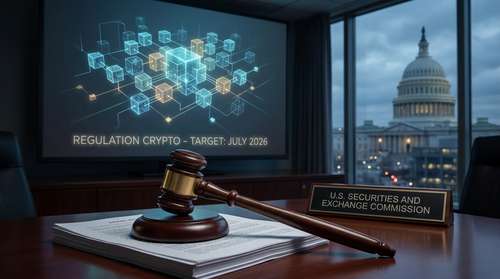
The decade-long era of "regulation by enforcement" has officially come to an abrupt halt. In a historic move on March 17, 2026, the landmark SEC CFTC crypto guidance 2026 was jointly issued, delivering the definitive rulebook the digital asset industry has desperately sought. Signed simultaneously by SEC Chairman Paul Atkins and CFTC Chairman Michael Selig at the DC Blockchain Summit, the 68-page interpretive release completely upends the regulatory landscape, providing much-needed clarity that will echo through global financial markets.
The sweeping joint directive explicitly establishes a formal US crypto token taxonomy, officially categorizing digital assets into five distinct regulatory buckets. Most notably, the release definitively confirms the Solana XRP commodity status, legally distinguishing 16 major altcoins from traditional investment contracts. As Atkins bluntly stated during the announcement, the agency is "no longer the securities and everything commission". For investors, developers, and institutional allocators, the legal fog has finally lifted.
The New US Crypto Token Taxonomy Explained
For years, digital asset developers and centralized exchanges operated under the persistent threat of retroactive lawsuits and overlapping agency jurisdictions. The new SEC CFTC crypto guidance 2026 resolves this systemic friction by instituting a definitive five-category framework: digital commodities, digital collectibles, digital tools, stablecoins, and digital securities. Under this modern structure, only tokenized versions of traditional financial instruments fall squarely under the SEC’s purview as digital securities.
This long-awaited US crypto token taxonomy introduces critical legal protections for foundational network participants. The guidance explicitly clarifies that protocol staking, proof-of-work mining, token wrapping, and standard network airdrops are considered administrative or ministerial functions—not securities transactions. This ensures that infrastructure providers, node operators, and everyday retail participants can interact with decentralized networks without inadvertently violating federal securities laws.
SEC Reclassifies Altcoins: Solana XRP Commodity Status
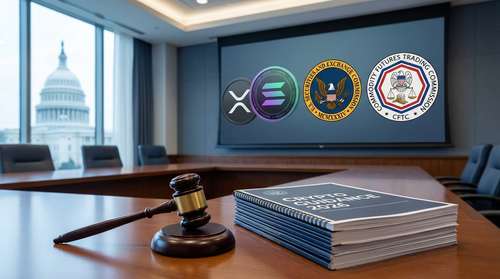
Perhaps the most market-moving element of the release is exactly how the SEC reclassifies altcoins. The joint interpretive rule formally names 16 top digital assets as digital commodities, effectively handing primary spot market oversight to the CFTC. The comprehensive list includes legacy heavyweights like Bitcoin and Ethereum, but more importantly, it cements the Solana XRP commodity status alongside Cardano, Chainlink, Polkadot, Avalanche, Hedera, Litecoin, and even high-volume meme assets like Dogecoin and Shiba Inu.
By explicitly categorizing these 16 assets as digital commodities, regulators have finally provided clear, functional digital asset secondary market rules. Centralized exchanges no longer have to second-guess whether listing a prominent layer-1 token will trigger a devastating Wells Notice. Furthermore, the guidance notes that an asset's "investment contract" classification is not permanent. If a digital asset project fulfills its initial developmental promises and achieves sufficient network decentralization, its native token can safely "graduate" out of the securities classification entirely.
Digital Asset Secondary Market Rules and Exchange Impact
The immediate impact on secondary markets cannot be overstated. By establishing bright-line digital asset secondary market rules, the joint guidance drastically reduces the compliance costs burdening U.S.-based trading platforms. Exchanges can now confidently expand their domestic product offerings without the looming threat of multi-million dollar settlements.
Additionally, this regulatory pivot paves the way for a new wave of spot exchange-traded funds (ETFs). With the SEC reclassifies altcoins narrative confirmed in binding agency text, asset managers have a clear runway to file for Solana, XRP, and Chainlink institutional products. The removal of security-classification risk fundamentally alters the calculus for institutional capital, which has historically been restricted by strict internal compliance mandates regarding unregistered securities.
Looming Crypto Clarity Act Senate Hearing
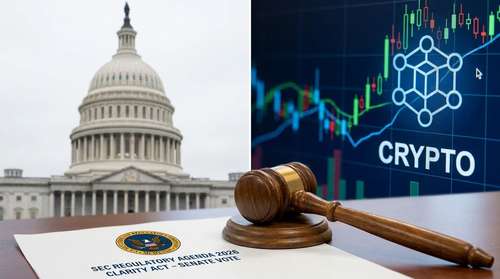
While the joint agency interpretation represents a monumental leap forward, it remains an administrative rule rather than permanent statutory law. For the framework to become fully entrenched, Congress must pass corresponding market structure legislation. All eyes are now tightly focused on the highly anticipated Crypto Clarity Act Senate hearing, which has become the primary focal point of Washington's financial policy debate.
Formally known as the Digital Asset Market Clarity Act (H.R. 3633), the bill previously passed the House with a strong bipartisan 294-134 vote in July 2025. However, it has faced consecutive delays in the Senate Banking Committee since mid-January 2026. The primary bottleneck stems from intense lobbying by traditional banking associations regarding stablecoin yield regulations. Commercial banks fear that interest-bearing stablecoins could trigger severe deposit flight from standard, lower-yield savings accounts.
Market Reaction and Cryptovot Regulation News
The broader financial markets are reacting dynamically to the shifting legislative landscape. As of March 20, 2026, the total cryptocurrency market capitalization sits at approximately $2.48 trillion amid ongoing legislative uncertainty. While prediction markets like Polymarket currently assign a 74% probability that the bill will be signed into law before the end of 2026, institutional capital is waiting to see if the Crypto Clarity Act Senate hearing will produce a workable compromise on stablecoin yields.
Despite short-term volatility driven by Senate delays, the joint guidance serves as a massive, structural derisking event for the entire sector. Keep following our latest cryptovot regulation news as lawmakers attempt to bridge the final gaps in the Senate. One thing is certain: between the finalized agency interpretation and advancing legislation, the United States has finally laid the required groundwork to reclaim its competitive edge in the global digital economy.