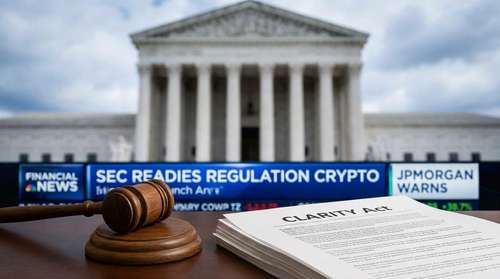

The U.S. Securities and Exchange Commission is aggressively moving to assert its administrative authority over the digital asset industry, setting up a high-stakes legislative showdown. On July 7, the agency unveiled the highly anticipated SEC crypto regulatory agenda 2026, signaling a massive push to establish clear rules for tokenized assets under Chair Paul Atkins. Yet, this regulatory sprint coincides with a critical legislative window on Capitol Hill. Lawmakers and industry advocates are scrambling to schedule the landmark CLARITY Act Senate vote before lawmakers leave Washington for their August 7 summer recess.
With both federal regulators and Congress racing the clock, the financial sector is watching closely. At stake is nothing less than the operational foundation of the American digital asset economy, as policymakers battle to clarify who oversees the trillion-dollar market and how digital assets will integrate with traditional financial infrastructure over the next decade.
Inside the SEC Crypto Regulatory Agenda 2026
More than a year into his tenure, SEC Chair Paul Atkins has drastically pivoted the agency's approach to digital markets. Moving away from the previous administration's regulation-by-enforcement model, the newly published agenda outlines 38 proposed rules. Atkins emphasized that the commission is dedicated to fulfilling the goal of making the United States the undisputed crypto capital of the world. Among the comprehensive list of priorities, three major crypto rulemaking proposals are slated to begin their comment periods this July.
Paul Atkins SEC Crypto Rules and Capital Formation
The core of the new Paul Atkins SEC crypto rules focuses on establishing a functional market architecture rather than merely debating asset classification. The agency aims to streamline capital formation for blockchain startups, providing a safe-harbor framework that gives developers a defined period to build and test tokenized products with lighter compliance burdens. This approach is designed to reverse the decline in public offerings and encourage domestic innovation.
Additionally, the commission is looking to overhaul the crypto custody rules SEC enforces on broker-dealers and registered investment advisors. By expanding the definition of a "qualified custodian," the SEC hopes to offer financial firms a practical set of standards for holding on-chain assets safely. This replaces traditional securities guidelines that often proved unworkable for decentralized technology. The proposal is reportedly already undergoing review by the White House, highlighting the administration's urgency.
The Stakes for the Digital Asset Market Clarity Act
While the SEC accelerates its administrative engines, the U.S. Senate is feeling the pressure to pass comprehensive statutory reforms. The Digital Asset Market Clarity Act (CLARITY) cleared the Senate Banking Committee in mid-May, marking the furthest any comprehensive market structure bill has ever advanced in Congress. Now, industry advocates and key lawmakers are pushing for a full floor vote.
Senator Cynthia Lummis recently warned that momentum for the bill is fading, stressing that Congress must act before election pressures and the end of the current session stall legislative progress. "This is likely our last chance to get real legislation for digital assets on the books before 2030," Lummis cautioned on July 8. She argued that failure to pass the bill ensures foreign jurisdictions will write the global standards, leaving the U.S. spending the next decade playing catch-up.
Solving the SEC vs CFTC Crypto Turf War
If passed, the legislation would fundamentally redraw the jurisdictional lines of the ongoing SEC vs CFTC crypto oversight battle. Under the bill, the Commodity Futures Trading Commission (CFTC) would regulate "digital commodities"—assets intrinsically linked to decentralized blockchain systems like Bitcoin and Ethereum. The SEC would retain authority over digital representations of securities and investment contracts.
This statutory division would effectively curtail some of the SEC's unilateral rulemaking power, forcing a more collaborative regulatory environment. CFTC Chairman Michael Selig publicly backed the bill this week, noting that the industry requires bipartisan congressional certainty rather than regulators writing all the rules independently.
A Collision Course Before August Recess
The timeline for these dual regulatory tracks is incredibly tight. The Senate's impending August recess creates a hard deadline of August 7 for the CLARITY Act Senate vote. Advocacy groups like Stand With Crypto are mobilizing voters to contact their representatives immediately, while institutional heavyweights are also chiming in. Recent commentary from JPMorgan executives highlighting the benefits of tokenization and the need for regulatory clarity has bolstered industry hopes, pushing betting market odds for the bill's 2026 passage to 44%.
However, securing the 60 votes needed on the Senate floor remains a significant hurdle. Lawmakers are still negotiating specific Bank Secrecy Act extensions, anti-money laundering requirements, and mandates for crypto kiosk operators. If the Senate fails to act before leaving Washington, the ambitious agenda championed by Paul Atkins will likely become the de facto framework for the foreseeable future.
Whether through sweeping congressional legislation or targeted administrative rulemaking, the coming weeks will dominate US crypto regulation news. Financial institutions, compliance teams, and blockchain developers alike must prepare for an imminent paradigm shift in how digital assets are issued, traded, and safeguarded in the United States.