
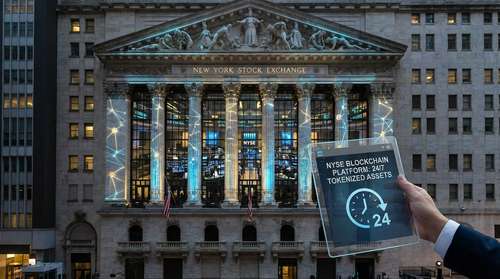
In a historic move that signals the convergence of traditional finance and digital asset technology, the New York Stock Exchange (NYSE) has announced the development of a revolutionary platform for the 24/7 trading and on-chain settlement of tokenized securities. Unveiled on Monday by NYSE's parent company, Intercontinental Exchange (ICE), this initiative aims to bring the reliability of Wall Street to the always-on nature of the blockchain economy.
A Historic Shift to On-Chain Markets
For over two centuries, the NYSE has operated within fixed trading hours, a relic of analog financial systems. The announcement of a NYSE blockchain platform marks a paradigm shift. The new venue is designed to support the trading of tokenized stocks and exchange-traded funds (ETFs) that are fungible with their traditionally issued counterparts. This move acknowledges the growing demand for continuous liquidity and the efficiency benefits of distributed ledger technology.
"We are leading the industry toward fully on-chain solutions, grounded in the unmatched protections and high regulatory standards that position us to marry trust with state-of-the-art technology," said Lynn Martin, President of NYSE Group. This development positions the exchange at the forefront of Wall Street digital assets adoption, bridging the gap between institutional finance and the crypto ecosystem.
How the NYSE Blockchain Platform Works
The proposed system is a hybrid marvel, integrating the NYSE's proprietary Pillar matching engine—known for its high performance and low latency—with blockchain-based post-trade infrastructure. This combination ensures that while trade execution remains as fast and reliable as traditional equity markets, the settlement process is modernized for the digital age.
Key features of the platform include:
- 24/7 Stock Market Access: Investors will be able to trade U.S.-listed equities and ETFs round-the-clock, eliminating the constraints of the traditional 9:30 AM to 4:00 PM trading window.
- Tokenized Capital & Stablecoin Funding: The platform supports orders sized in dollar amounts rather than share counts, facilitating fractional ownership. Crucially, it enables funding and settlement using stablecoins and tokenized capital.
- Multi-Chain Interoperability: The post-trade systems are designed to be blockchain-agnostic, capable of supporting settlement and custody across multiple blockchain networks.
The End of T+1: On-Chain Settlement
One of the most significant advantages of the NYSE tokenization initiative is the potential for on-chain settlement. Currently, U.S. equities settle on a T+1 basis (one business day after the trade). The new platform targets instant or near-instant settlement, reducing counterparty risk and freeing up capital that would otherwise be trapped in the clearing process.
By leveraging blockchain capital markets infrastructure, the NYSE can offer a trading experience where the transfer of ownership happens almost simultaneously with trade execution. This efficiency is expected to appeal to both retail traders accustomed to crypto markets and institutional investors seeking better capital efficiency.
Strategic Banking Partnerships and Infrastructure
The initiative is part of a broader digital strategy by Intercontinental Exchange (ICE). To support this ecosystem, ICE is collaborating with major financial institutions, including BNY and Citi, to develop solutions for tokenized deposits. These partnerships are critical for enabling clearing members to manage liquidity and meet margin requirements outside of traditional banking hours.
"Supporting tokenized securities is a pivotal step in ICE's strategy to operate on-chain market infrastructure for trading, settlement, custody, and capital formation," stated Michael Blaugrund, Vice President of Strategic Initiatives at ICE. These collaborations ensure that the platform has the necessary banking rails to support a truly 24/7 stock market.
What This Means for Investors
While the platform is still subject to regulatory approvals, its announcement suggests that the future of investing is digital and continuous. For investors, this means greater flexibility and access. Tokenized shareholders will retain the same dividend and governance rights as traditional shareholders, ensuring that the benefits of equity ownership are preserved even as the delivery mechanism evolves. As Wall Street embraces tokenized stocks trading, the lines between traditional finance and decentralized finance (DeFi) continue to blur, paving the way for a more accessible global financial system.