
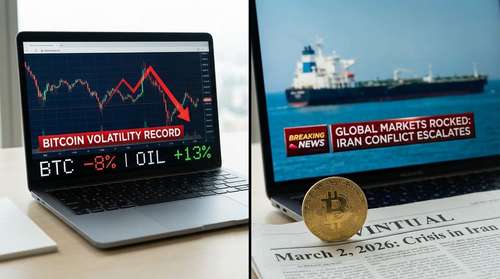
Global financial markets are in turmoil this Monday morning, March 2, 2026, following the confirmation of Supreme Leader Ayatollah Ali Khamenei's death and joint US-Israel military strikes on key Iranian infrastructure. The geopolitical shockwave has sent Bitcoin price volatility March 2026 to record highs, with the cryptocurrency experiencing a chaotic trading session that saw prices whiplash between $63,000 and $68,000. As traders scramble to assess the fallout, Brent crude oil has spiked over 13%, driven by reports of a blockade at the Strait of Hormuz, threatening to choke off nearly 20% of the world's oil supply.
Bitcoin's Wild Ride: A Failed Safe Haven?
In the immediate aftermath of the overnight airstrikes, Bitcoin initially plunged to a two-week low of roughly $63,000, triggering over $128 million in liquidations within a single hour. However, the asset staged a rapid recovery, briefly touching $68,196 as rumors of the Supreme Leader's death were confirmed by state media, before sliding back to trade around the $65,300 level. This intense Bitcoin price volatility March 2026 has reignited the debate over whether cryptocurrency truly functions as a "digital gold" or merely a high-beta risk asset during times of extreme geopolitical stress.
While gold prices surged nearly 2% to fresh highs, Bitcoin's correlation with tech stocks seems to be holding firm. "The market is currently pricing in maximum uncertainty," notes Hayden Hughes, a market analyst. "We saw Bitcoin ETF news today indicating massive inflows of $1 billion last week, but the real test is how these institutional heavyweights react to the global financial market crash today. If we see panic selling from ETF holders when Wall Street opens, the $60,000 support level could be tested very quickly."
Strait of Hormuz Blockade Triggers Oil Crisis
The most immediate economic threat comes from the Persian Gulf. Following the military escalation, Iranian forces have reportedly moved to close the Strait of Hormuz oil price spike catalyst that economists have feared for decades. This narrow waterway handles approximately 20 million barrels of oil per day—roughly 30% of all seaborne-traded crude. The mere threat of a prolonged closure sent Brent crude skyrocketing over 13% in early Asian trading, creating a supply shock that could send inflation soaring globally.
Energy analysts warn that if the Strait of Hormuz remains impassable for even 48 hours, we could see oil prices breach $100 per barrel, exerting immense pressure on global logistics and manufacturing. This energy crisis is a double-edged sword for crypto: while it drives inflation narratives that favor hard assets, it also sucks liquidity out of risk markets as investors retreat to cash and treasury bonds.
The Power Vacuum in Tehran
The confirmed death of Ayatollah Ali Khamenei has created a dangerous power vacuum in Tehran. With an interim "Leadership Council" hurriedly formed to manage the transition, intelligence reports suggest severe internal friction between the Revolutionary Guards and the clerical establishment. This political instability adds a layer of unpredictability to the Iran Israel conflict market impact, as splinter factions may launch independent retaliatory strikes, keeping geopolitical risk in cryptocurrency markets elevated for the foreseeable future.
Crypto Safe Haven Assets 2026: The Verdict
Investors are currently fleeing to traditional safety. Gold and US Treasuries have seen significant bids, while the "risk-on" trade has collapsed. For crypto safe haven assets 2026, the narrative is complicated. Stablecoins like USDT have seen a surge in volume as traders exit altcoins, but Bitcoin has yet to decouple from the broader equity market sell-off. The coming days will be critical; if Bitcoin can stabilize above $65,000 while traditional equities bleed, it may regain its status as a non-sovereign hedge.
However, cautious positioning is evident in the derivatives market. Options data shows a massive stack of put options at the $60,000 strike price, suggesting that whales are hedging against further downside. As the situation in the Middle East remains fluid, volatility is the only guarantee.
What to Watch This Week
As we move through this historic week, three key factors will dictate market direction:
- ETF Flows: Will institutional investors buy the dip or liquidate? Monday's US trading session data will be the bellwether.
- Military Escalation: Any further direct conflict between US naval forces and Iranian assets in the Gulf could trigger a secondary crash.
- Oil Prices: Sustained oil prices above $90 will likely force central banks to remain hawkish, dampening the appetite for risk assets like crypto.