
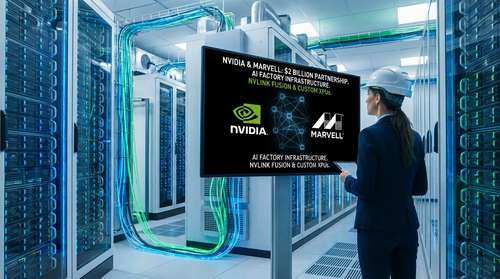
The race to build the ultimate computing ecosystem just received a massive financial and technological injection. In major AI infrastructure news, NVIDIA has officially announced a $2 billion strategic investment in Marvell Technology. Unveiled on March 31, 2026, the sweeping NVIDIA Marvell partnership fundamentally alters the hardware landscape, bridging Marvell's expertise in custom silicon with NVIDIA's dominant data center architecture. As global token generation demand skyrockets, this alliance sets the stage for highly specialized, radically efficient computing facilities.
Redefining the Ecosystem with NVLink Fusion Technology
At the heart of this multi-billion dollar agreement is a decisive push toward heterogeneous computing. Traditional data centers are rapidly being replaced by specialized acceleration facilities, making hardware flexibility a premium asset. The technical integration centers on NVLink Fusion technology, a rack-scale platform designed to let hyperscalers build semi-custom infrastructure without abandoning the NVIDIA ecosystem.
Under the terms of the deal, Marvell is taking the lead on custom XPU development and NVLink-compatible scale-up networking. In return, NVIDIA will supply the critical backbone components: Vera CPUs, ConnectX Network Interface Cards (NICs), Bluefield Data Processing Units (DPUs), and Spectrum-X switches.
Seamless Heterogeneous Integration
For enterprises investing heavily in cutting-edge AI factory hardware, this means they no longer have to choose between proprietary custom silicon and NVIDIA's robust networking stack. The NVLink Fusion platform allows developers to integrate custom XPUs seamlessly with NVIDIA GPUs, LPUs, and advanced storage platforms. They get the unparalleled performance of tailored silicon backed by the reliability of an established global supply chain.
Advancing Connectivity: Optical Interconnects and 6G Networks
Processing power is only half the battle; moving massive datasets at light speed is equally crucial. The two tech giants are aggressively collaborating on silicon photonics—a technology that utilizes light instead of electrical signals to transfer data across chips. This innovation dramatically reduces energy consumption while boosting transmission speeds, solving a critical bottleneck in massive server clusters.
Beyond traditional server farms, the alliance has its sights set on the global telecommunications sector. The companies plan to transform telecom networks into intelligent compute hubs using NVIDIA's Aerial AI-RAN platform. By merging Marvell's high-performance analog and optical DSP leadership with NVIDIA's architecture, the partnership is laying the groundwork for 6G AI-RAN networking. This evolution will allow telecom providers to run inference directly at the network edge, powering next-generation smart cities and instantaneous edge computing.
The Market Impact of a Massive 2026 Investment
Wall Street immediately recognized the gravity of this collaboration. Following the announcement, Marvell shares surged as much as 11% in early trading, while NVIDIA saw a steady 2% climb. This momentum is not happening in a vacuum. Industry analysts project that major tech firms—including Alphabet and Meta—will spend upwards of $630 billion on infrastructure buildouts this year alone.
This semiconductor investment 2026 highlights a strategic pivot. NVIDIA recognizes that as adoption matures, large cloud providers increasingly want custom chips tailored to their specific workloads rather than standard processors. By pouring $2 billion into Marvell, NVIDIA ensures its networking gear and interconnects remain the undisputed standard, even when a customer opts for a third-party or custom-designed processing unit.
Powering the Inference Inflection Point
We are firmly entering a new phase of the generative technology boom. The initial industry rush focused almost entirely on training massive foundational models. Today, the focus has shifted heavily to inference—the actual generation of tokens, agentic reasoning, and real-time application delivery. NVIDIA founder and CEO Jensen Huang highlighted that the inference inflection has arrived, noting that the world is actively racing to construct specialized facilities just to meet this surging token demand.
By joining forces, NVIDIA and Marvell are ensuring that the physical hardware foundation can handle this exponential software growth. The alliance secures a highly lucrative pipeline for Marvell in the Application-Specific Integrated Circuit (ASIC) and XPU markets. Simultaneously, NVIDIA actively fortifies its competitive moat against rivals who are pushing traditional Ethernet or alternative interconnect consortiums like UALink.
Ultimately, this agreement represents far more than a simple financial transaction. It is a comprehensive blueprint for the future of enterprise computing. As intelligent applications continue to infiltrate every digital sector—from telecommunications to autonomous manufacturing—the hardware required to sustain them must be scalable, energy-efficient, and adaptable. Through combined engineering prowess and shared open-platform ecosystems, NVIDIA and Marvell are building exactly what the next decade of technology demands.