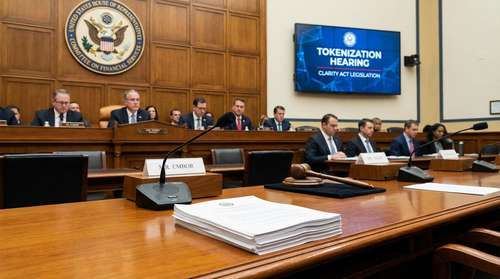
The U.S. capital markets are experiencing a watershed moment today. Lawmakers have convened the highly anticipated House Financial Services tokenization hearing to scrutinize how blockchain technology is fundamentally rewiring Wall Street. Held on March 25, 2026, the session arrives just days after landmark regulatory approvals and aims to lay the groundwork for a comprehensive US crypto regulatory framework. At the center of this legislative sprint is the push to finalize the CLARITY Act, a bill that promises to legitimize the booming multibillion-dollar real-world asset (RWA) sector.
Modernizing Capital Markets: The $26 Billion RWA Surge
Behind closed doors and across public order books, financial institutions have been aggressively migrating traditional assets onto blockchains. The tokenized real-world asset market has swelled to an astonishing $26.4 billion in on-chain value, representing a nearly fourfold increase from just a year ago.
Currently, tokenized U.S. Treasury debt dominates this landscape, accounting for $11.8 billion of the total locked value, while private credit also commands a massive share. Tokenized stocks are gaining rapid traction as well, having recently crossed the $1 billion threshold with monthly transfer volumes jumping 45%.
With such explosive growth, lawmakers recognize that tokenization is no longer a speculative experiment—it is a live, maturing ecosystem. Witnesses at today's hearing, including Blockchain Association CEO Summer Mersinger and representatives from Plume Network and the DTCC, are testifying that blockchain capital markets reform is essential to maintain American financial supremacy. Mersinger emphasized that adopting programmable, token-based rails allows for faster settlement and deeper liquidity, effectively moving traditional batch-based clearing into the modern era.
SEC and Nasdaq Propel Tokenized Securities Mainstream
Congress is not operating in a vacuum. On March 18, 2026, the market received a massive regulatory green light when the SEC approved a proposal from Nasdaq to allow tokenized securities trading. This pivotal ruling permits select Russell 1000 stocks and major exchange-traded funds (ETFs) to trade and settle as blockchain-based digital tokens.
The approval triggered an immediate competitive response. Intercontinental Exchange (ICE), the parent company of the New York Stock Exchange, recently made a strategic investment in crypto platform OKX to power its own 24/7 tokenized stock ecosystem.
If you are an investor watching the digital asset space, the integration of the tokenized securities Nasdaq infrastructure means traditional finance and digital asset rails are now operating simultaneously on the same order book. A tokenized security on Nasdaq carries the exact same voting rights, dividends, and CUSIP numbers as its traditional counterpart. Traders simply use a "tokenization flag" when executing an order, routing the settlement through a specialized Depository Trust Company (DTC) pilot program.
The SEC CFTC Joint Taxonomy Eases Jurisdictional Wars
Regulatory clarity has historically been bottlenecked by turf wars between federal agencies. However, the regulatory landscape shifted dramatically earlier this month when a new SEC CFTC joint taxonomy was published. This cooperative memorandum of understanding clearly distinguishes "investment contract assets" overseen by the SEC from "digital commodities" regulated by the CFTC. By preemptively aligning their oversight responsibilities, the agencies have effectively cleared a major regulatory hurdle.
The Final Push for the CLARITY Act 2026 Legislation
All roads now lead to the Senate. The House passed the Digital Asset Market Clarity (CLARITY) Act last summer, but the legislation stalled over a bitter dispute regarding yield-bearing stablecoins. Traditional banks expressed intense concern that allowing crypto exchanges to offer interest-like rewards on stablecoins would trigger a massive flight of consumer deposits.
After months of gridlock, crypto industry leaders and banking lobbyists converged on Capitol Hill this week to review a breakthrough compromise. Under the tentative agreement, passive stablecoin rewards will remain prohibited, but activity-based incentives tied to network transfers and platform usage will be permitted. With this roadblock seemingly cleared, the Senate Banking Committee is targeting the second half of April 2026 for a final markup.
If the CLARITY Act 2026 legislation advances to the President's desk, it will mandate formal registration regimes for digital commodity exchanges and permanently codify the SEC's jurisdiction over tokenized equities. Senator Cynthia Lummis confirmed the April timeline, while Senator Bernie Moreno warned that missing the May window could pause digital asset legislation entirely until after the midterm elections.
Shaping the Future of Real-World Asset Regulation
The implications of today's House hearing extend far beyond technical market plumbing. Effective real-world asset regulation promises to democratize access to previously illiquid or high-barrier investments through fractional ownership.
The coordinated actions of the SEC, the CFTC, and Congress signal a turning point. Instead of fighting the technology, the United States is finally building the structural guardrails needed to govern it safely. With major exchanges already proving that on-chain stock trading is viable, the passage of the CLARITY Act would provide the comprehensive legal certainty institutional investors have been waiting for. The next few weeks of Senate markups will dictate whether the U.S. can successfully integrate a $26 billion digital economy into the heart of global finance.