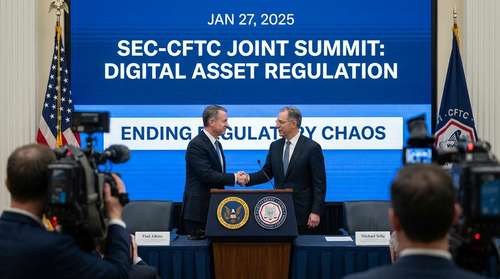
In a watershed moment for the U.S. digital asset industry, Securities and Exchange Commission (SEC) Chair Paul Atkins and Commodity Futures Trading Commission (CFTC) Chair Michael Selig have announced a historic joint summit scheduled for January 27, 2026. The unprecedented gathering in Washington, D.C., aims to formally dismantle the "regulatory chaos" that has plagued the sector for over a decade and align the agencies behind the administration's aggressive US crypto capital strategy. This summit marks the first time the heads of both primary market regulators will appear together with a shared mandate: transitioning the United States from an enforcement-heavy regime to a unified, pro-innovation jurisdiction.
Ending the Turf War: A Unified Front for 2026
For years, the crypto industry has navigated a precarious "regulation by enforcement" minefield, trapped between the SEC's securities laws and the CFTC's commodities oversight. The January 27 summit represents a decisive break from this adversarial past. Chairmen Atkins and Selig confirmed that the event will focus on harmonizing their respective flagship initiatives—Atkins' "Project Crypto" and Selig's newly unveiled "Future-Proof" program—into a cohesive federal framework.
"The era of agency infighting ends next Tuesday," insiders familiar with the planning told reporters. The summit is expected to produce a "Joint Statement of Jurisdictional Clarity," a document designed to offer immediate guidance to market participants while Congress finalizes the statutory details. This move is critical for ending crypto regulatory chaos, a promise that swept both chairs into office with strong mandates to modernize America's financial infrastructure.
Rescuing the Digital Asset Market Clarity Act
The timing of the SEC CFTC joint crypto summit is no accident. It comes just days after the Senate Banking Committee delayed the markup of the Digital Asset Market Clarity Act (H.R. 3633) due to industry pushback over stablecoin yield restrictions. Sources suggest that Atkins and Selig will use the summit to present a compromise on the controversial "rewards" language that stalled the bill, potentially clearing the path for its passage before the summer recess.
Bridging the Stablecoin Divide
The legislative stall earlier this month highlighted the friction between banking interests and crypto innovators. Selig, a former crypto attorney who was confirmed as CFTC Chair in December 2025, has been a vocal advocate for allowing yield-bearing stablecoins, viewing them as essential for consumer utility. By presenting a united front with Atkins, the regulators aim to reassure skeptical lawmakers that these products can be overseen safely without stifling the US crypto regulation 2026 agenda.
By the Numbers: The Enforcement Shift is Real
While the summit promises future clarity, the shift in regulatory posture is already visible in the data. A Cornerstone Research report released on January 22, 2026, revealed a stunning 60% drop in cryptocurrency-related enforcement actions in 2025 compared to the previous year. This SEC enforcement decline 2026 statistic validates Atkins' pledge to pivot the agency away from litigation and toward rulemaking.
Under the previous administration, the SEC averaged over 30 crypto enforcement actions annually. In Atkins' first year, that number plummeted to just 13, with nearly half of those initiated before he even took office. "The data proves that 'Project Crypto' isn't just rhetoric," said legal analyst Robert Letson. "The SEC has effectively ceased fire on legitimate projects to focus solely on clear-cut fraud."
The 'Crypto Capital' Vision Takes Shape
The joint summit is the keystone of the White House's broader ambition to cement the United States as the "crypto capital of the planet." With other jurisdictions like the EU (MiCA) and the UK already implementing comprehensive rules, the U.S. has been playing catch-up. Paul Atkins' crypto regulation approach, combined with Selig's derivatives expertise, offers the first viable path for the U.S. to leapfrog global competitors.
Market reaction to the announcement has been overwhelmingly positive. Bitcoin and major DeFi tokens rallied on the news, with industry leaders praising the coordination. As the January 27 date approaches, all eyes are on Washington to see if this "regulatory peace treaty" can finally unlock the trillion-dollar potential of the American digital asset market.