Early March 2026 will be remembered as one of the most dramatic points in the geopolitical arena in recent years. The unprecedented military escalation between the US, Israel, and Iran, which began with a series of strikes in late February, sent immediate shockwaves through global economies. However, while the general public's initial instinct is panic, the financial markets are currently providing a fascinating lesson in risk pricing against a rapidly shifting reality.
Bitcoin: From a State of Shock to a Surge of Over 6%
With the initial reports of the joint strikes in Iran, the crypto market exhibited a classic knee-jerk reaction: Bitcoin plummeted rapidly toward the $63,000 mark. Investors initially treated it as a distinct risk asset, rushing to liquidate.
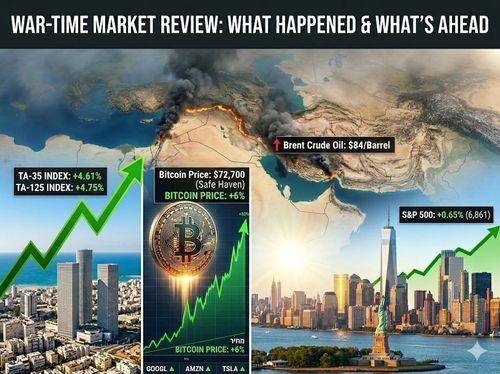
However, the trend reversed just as quickly as it began. As of March 4, Bitcoin has not only recovered but has broken past the $72,700 threshold, recording an intraday surge of over 6%. The "Safe Haven" narrative has returned to the table. Unlike in the past, institutional presence is changing the rules of the game. The inflow of capital into spot ETFs, such as IBIT and FBTC, has created a rigid floor of support. Large entities capitalized on the sudden dips to accumulate the asset, and the market began pricing in expectations of central bank liquidity injections as a response to the crisis.
Wall Street: Pricing in the Day After
The US market has demonstrated impressive resilience in the face of Iranian threats to close the Strait of Hormuz, a threat that caused Brent crude oil to jump to the $84 per barrel range. Despite the obvious fear of returning inflation due to rising energy costs, investors are choosing to look ahead.
Following slight declines in the early days of the fighting, the S&P 500 returned to a positive trend, trading around the 6,861 level (an increase of about 0.65% during the current trading day). Investors exposed to the broader index (for example, through ETFs like VOO) or to tech giants, EVs, and retail (such as Google, Tesla, and Amazon) recognize this event as a localized crisis rather than a systemic collapse. The market assumes that the US economy is robust enough to absorb the shock, or that the Federal Reserve will provide a monetary safety net if the situation worsens.
The Local Paradox: The Historic Surge of the Tel Aviv Stock Exchange
While the fighting continues, the Tel Aviv Stock Exchange reacted with sharp jumps that surprised many commentators. On March 2, the TA-35 index surged by 4.61% to a record level of 4,318.50 points, and the TA-125 jumped by 4.75%.
This phenomenon is entirely rational in capital market terms. "Smart money" doesn't trade today's news; it looks six months ahead. The direct US involvement against Iran signals the potential for a tectonic strategic shift in the Middle East. If Iran's nuclear program or military capabilities suffer a fatal blow, the geopolitical weight that has burdened the Israeli economy, and tech companies with local ties (like Mobileye), will be lifted. The market identifies the potential for a regional resolution and is repricing Israel's risk profile.
Looking Ahead: What to Expect?
As long as the intensive phase of the fighting continues, we must prepare for a bipolar and volatile market.
On the one hand, headlines regarding damage to oil infrastructure in the Gulf or further escalation could lead to rapid sell-offs in major indices, pulling money back into cash.
On the other hand, Bitcoin's behavior crossing the $72,000 mark and the stability of the S&P 500 prove that investors' "risk-on" appetite is alive and well. Financial markets, by nature, precede the reality on the streets. They are already looking past the fog of war, searching for the opportunities of the day after.