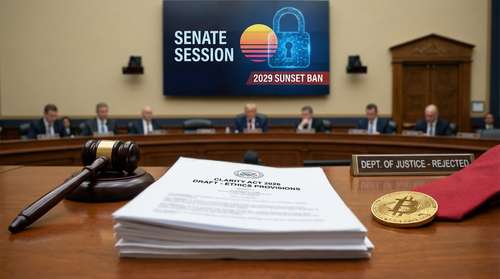

The long-awaited digital asset market structure bill has just cleared its most formidable obstacle. In a major CLARITY Act 2026 breakthrough, Senate negotiators Thom Tillis (R-N.C.) and Angela Alsobrooks (D-Md.) finalized a critical compromise regarding stablecoin yield provisions. Reached late last week, this bipartisan agreement successfully bridges the gap between banking industry concerns and crypto innovation, reviving hopes for comprehensive digital asset regulation before the looming August legislative recess.
The Tillis-Alsobrooks Stablecoin Compromise Explained
The core dispute holding up the legislation revolved around how to treat stablecoin rewards. Traditional banking advocates strongly objected to crypto firms offering interest on idle stablecoin balances, arguing it essentially recreated bank deposits without the necessary regulatory safeguards. The Tillis-Alsobrooks stablecoin compromise addresses this tension directly by drawing a distinct legal line between passive interest and active network rewards.
Banning Passive Yield, Protecting Active Rewards
Under the newly finalized legislative text, crypto platforms face a broad prohibition against paying yield that functions as the economic equivalent of bank-deposit interest simply for holding stablecoins. However, the deal preserves the ability for issuers and exchanges to distribute rewards tied to "bona fide activities". This means users can still earn returns based on genuine transaction volume, network staking, or active platform participation. Coinbase Chief Policy Officer Faryar Shirzad noted that while banks secured more restrictions on passive yields, the agreement successfully protects the fundamental mechanisms of how digital asset networks actually operate.
Not everyone in the sector celebrated the compromise without reservations. Helius Labs CEO Mert Mumtaz offered a sharper critique, noting the result essentially meant Americans could not earn risk-free yield on their digital dollars without going through a traditional banking institution. However, the new language explicitly addresses the regulatory gaps left by the GENIUS Act, which established foundational reserve requirements for payment stablecoin issuers in 2025 but remained ambiguous on secondary market yields. By directing regulators to develop a clear catalog of permissible reward activities, the updated text provides the exact compliance roadmap the industry has been demanding for US stablecoin yield regulation.
SEC vs CFTC Crypto Jurisdiction and Market Impact
With the yield hurdle cleared, lawmakers can finally focus on the primary goal of the legislation: ending the regulatory turf war in Washington. A central pillar of the proposed federal crypto framework is establishing definitive SEC vs CFTC crypto jurisdiction. For years, the industry has suffered from a regulation-by-enforcement approach that left companies guessing whether a specific token was an unregistered security or a standard commodity.
The CLARITY Act proposes a functional test to determine an asset's status. Tokens that achieve specific decentralization milestones or serve primarily functional purposes on a blockchain will transition to digital commodity status. By introducing this concept of "digital commodities," the legislation aims to shift oversight of adequately decentralized assets to the Commodity Futures Trading Commission (CFTC), reserving the Securities and Exchange Commission's (SEC) authority primarily for tokens that function as traditional investment contracts. Removing the stablecoin deadlock brings this much-needed structural overhaul closer to reality, a sentiment reflected by prediction markets which saw the bill's passage odds surge past 55% to near 69% following the announcement.
Maintaining Global Competitiveness
The push for regulatory clarity is fundamentally a matter of international competitiveness. With jurisdictions like the European Union already implementing comprehensive frameworks, industry executives have consistently warned that ongoing uncertainty could push American innovation offshore. Passing a robust digital asset market structure bill is widely viewed as the necessary legislative counterweight to keep capital, development, and talent within the United States.
The Road Ahead for the Digital Asset Market Structure Bill
Industry leaders and policymakers are now looking at an accelerated legislative timeline. The momentum is palpable; a coalition of over 100 crypto firms, organized by the Blockchain Association and the Crypto Council for Innovation, recently urged the Senate to capitalize on this breakthrough. Senate Banking Committee Chairman Tim Scott is reportedly targeting a markup for the bill, potentially as early as the week of May 11.
Racing Against the August Recess
For any crypto regulation news 2026 updates to become signed law this year, the Senate must move aggressively. Washington insiders warn that lawmakers have an effective window of roughly 10 to 13 weeks to push the legislation through the Senate floor, reconcile it with the House, and send it to the President's desk before the August congressional recess. Midterm election pressures and competing legislative priorities—such as homeland security funding and budget negotiations—could still derail the momentum if delays occur.
Ultimately, the latest agreement proves that stakeholders are willing to make difficult concessions for the greater good of the financial ecosystem. While some crypto advocates argue the ban on passive stablecoin yield restricts consumer freedom, the broader consensus is that a finalized regulatory structure is non-negotiable for mainstream institutional adoption. As Coinbase CEO Brian Armstrong stated following the text's release, it is time for the Senate Banking Committee to "mark it up" and solidify America's leadership in the global financial technology race.