The legislative clock is winding down for the 119th Congress, and the digital asset industry is bracing for a defining moment. Following months of closed-door negotiations and bitter lobbying disputes, the highly anticipated CLARITY Act Senate markup is officially scheduled for mid-May. As the most comprehensive piece of US stablecoin legislation 2026 has seen to date, the bill promises unprecedented regulatory certainty for the market. However, this newfound clarity comes at a steep cost: a controversial provision that threatens to fundamentally alter how retail investors interact with digital dollars.
The Fierce Battle Over Crypto Yield Regulations
At the heart of the upcoming Senate Banking Committee crypto bill is a high-stakes tug-of-war between traditional commercial banks and digital asset innovators. The groundwork for this showdown was laid last year with the passage of the GENIUS Act, which officially defined payment stablecoins and established basic licensing requirements. However, that legislation left the thorny issue of interest generation unresolved, kicking the can down the road to this broader market structure bill.
For months, the banking lobby has forcefully argued that allowing crypto firms to offer interest on stablecoins effectively creates unlicensed savings accounts. Their primary fear is massive deposit flight; analysts previously estimated that without restrictions, yield-bearing stablecoins could siphon up to $500 billion from traditional bank deposits by 2028.
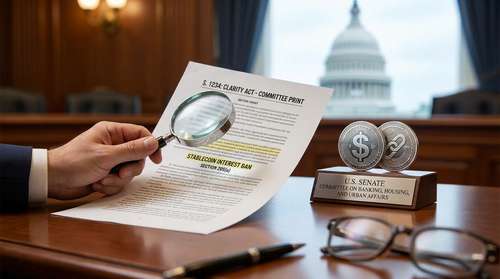
According to draft texts circulated by lead negotiator Senator Thom Tillis, the banking sector has seemingly won this specific battle. The revised legislation implements a strict stablecoin interest ban, effectively prohibiting any passive yield applied directly or indirectly to idle stablecoin balances that mimics traditional bank interest. When initial drafts containing this restriction leaked, the market reacted violently, with major issuers seeing their stock plummet 20% in a single session, wiping out billions in market value.
The Activity-Based DeFi Exemption
Despite the ban on passive interest, the crypto industry managed to secure a critical lifeline. Following intense negotiations—highlighted earlier this month when Coinbase Chief Legal Officer Paul Grewal signaled a deal was "very close"—lawmakers carved out an exemption for active network participation. While funds sitting idle in a custodial wallet cannot accrue interest under the new crypto yield regulations, retail users and institutions are still permitted to earn returns through activity-based rewards. This allows investors to deploy their capital into decentralized finance instruments, such as liquidity pools, lending protocols, and structured yield vaults.
Ending the Turf War: SEC CFTC Joint Statement
While stablecoin yield dominates the immediate headlines, the broader implications of the CLARITY Act address the structural foundation of the U.S. crypto market. For years, the industry suffered under regulation by enforcement, caught in a jurisdictional crossfire between competing federal agencies. The new framework finally resolves this by establishing clear pathways for tokens to achieve digital asset commodity status.
Under the proposed rules, oversight is divided based on network decentralization. Assets sold initially as investment contracts remain under SEC purview, but once a blockchain network demonstrates that no single entity controls it, the native token can graduate to commodity status under the exclusive jurisdiction of the CFTC.
Anticipating the passage of this landmark legislation, federal regulators are already aligning their postures. A recent landmark SEC CFTC joint statement underscored an unprecedented unified front. Under the leadership of SEC Chair Paul Atkins and his CFTC counterparts, the agencies signaled a readiness to coordinate oversight and facilitate the lawful trading of spot crypto assets on regulated exchanges. This preemptive regulatory harmony suggests that Washington is finally ready to integrate blockchain innovation into the traditional financial system rather than pushing it offshore.
What This Means for the Future of U.S. Crypto Markets
As the mid-May committee vote approaches, lawmakers are rushing to finalize the remaining technical provisions. Senator Cynthia Lummis has been a vocal proponent of ensuring the final text includes robust safe harbors for non-custodial software developers, protecting them from being classified as money transmitters under outdated 1960s-era statutes. These protections are viewed by the crypto lobby as an absolute red line for keeping blockchain talent onshore.
If the Senate Banking Committee crypto bill successfully clears the markup phase, it will face a tight legislative calendar before the August recess. While market analysts previously pegged the bill's chances of passing in 2026 at a coin toss, the recent breakthrough on yield rules has dramatically improved the odds of enactment.
For the broader cryptocurrency ecosystem, the passage of the CLARITY Act would represent a historic maturation point. While the loss of passive stablecoin interest is undeniably a bitter pill for retail platforms to swallow, the trade-off is a robust, federal framework that codifies digital property rights. By providing institutional capital the legal certainty it has long demanded, this legislation could ultimately unlock the next major growth cycle for the global digital asset economy.