
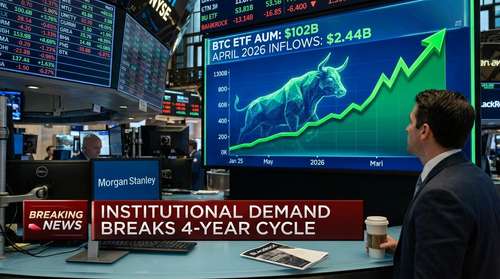
April 2026 has definitively reshaped the digital asset landscape. U.S. spot Bitcoin exchange-traded funds just registered their strongest monthly performance of the year, drawing a staggering $2.44 billion in net capital. This aggressive accumulation pushed cumulative lifetime flows to $58.5 billion and lifted total assets under management across all products to a landmark $102 billion. What began as a speculative experiment has transformed into a high-stakes accumulation race among global wealth managers.
But beyond the headline numbers, these monumental Bitcoin ETF inflows April 2026 signal a fundamental shift in market mechanics. The infamous four-year halving cycle—long the predictable heartbeat of crypto volatility—is effectively being neutralized by Wall Street's insatiable appetite.
The Math That 'Killed' the Four-Year Cycle
Historically, Bitcoin's price trajectory was dictated by the supply shock of its quadrennial halving events. Retail speculation would front-run the halving, causing predictable boom-and-bust cycles. This time, the sheer scale of institutional crypto adoption has overridden that organic rhythm.
During an eight-day streak stretching to April 23, U.S. spot funds absorbed roughly 19,000 BTC. In that exact same window, miners produced a mere 2,100 BTC. This means institutional demand moving through regulated vehicles consumed nearly nine times the new supply entering the market. Wall Street is no longer just participating in the crypto market; it is actively swallowing the available float. The historic retail-driven four-year cycle simply cannot compete with capital flows of this magnitude.
BlackRock's Dominance and the Morgan Stanley Threat
The battle for spot Bitcoin ETF market share is now a clash of traditional finance titans. BlackRock's iShares Bitcoin Trust continues to capture the lion's share of capital, taking in approximately 75% of April's net inflows. As a result, BlackRock IBIT AUM 2026 has ballooned to roughly $62 billion, giving the fund control over a massive stash of approximately 810,000 BTC.
However, the competitive landscape shifted dramatically on April 8 with the launch of the Morgan Stanley Bitcoin Trust MSBT. As the first spot ETF from a major U.S. bank issued under its own name, the fund shattered internal records by processing 1.6 million shares and pulling in $34 million on its opening day. By undercutting the market with a sponsor fee of just 0.14%—significantly lower than BlackRock's 0.25%—Morgan Stanley is aggressively targeting large institutional allocators.
Morgan Stanley is not just relying on a low fee. The banking giant is constructing a comprehensive digital asset pipeline. Their vast wealth management network, managing nearly $1.9 trillion in assets, now has a proprietary vehicle to recommend to clients. This built-in distribution network means capital that previously bled out to third-party funds can now remain in-house. While MSBT currently holds around $163 million compared to BlackRock's tens of billions, this internal funnel positions it as a legitimate, long-term challenger.
Analyzing the Bitcoin Price Recovery April 2026
This structural supply squeeze has provided a formidable floor for asset prices. The Bitcoin price recovery April 2026 was essentially a 1:1 reflection of ETF capital flows. After a sluggish first quarter that saw minor outflows and macro-driven selloffs, the $2.44 billion capital injection propelled Bitcoin up 12% to 16% over the month.
Prices rallied from the $68,000 range to stabilize near the $77,000 mark, even brushing against $80,000 before pre-FOMC caution tempered the momentum late in the month. Unlike the momentum-driven, blow-off tops witnessed in late 2025, this current price floor is being cemented by steady, methodical accumulation. Asset managers are treating price dips as buying opportunities, viewing sub-$70,000 levels as accumulation zones rather than signals to panic sell.
Defining Crypto Market Trends 2026
If the robust Bitcoin ETF inflows April 2026 prove anything, it is that the infrastructure surrounding digital assets has reached total maturity. One of the defining crypto market trends 2026 is the transition from speculative retail trading to sustained corporate and institutional hoarding.
Derivatives and options data further confirm this structural pivot. Long-dated contracts currently reveal a heavy bullish skew, with the put/call ratio for early 2026 options sitting at 0.48. Institutional players are overwhelmingly favoring call options, signaling deep conviction in higher price thresholds. Additionally, prediction markets priced a sub-$60,000 dip at a mere 1.3% probability in late April, reflecting near-certainty that ETF-driven support levels will hold.
When you analyze the daily trading volumes, the story is clear: market momentum is now dictated by New York trading hours rather than late-night retail speculation. With products like MSBT funneling traditional wealth management capital directly into the asset class, and BlackRock continuing to act as a black hole for circulating supply, the traditional crypto rulebook has been thrown out. The market is no longer waiting for a halving to restrict supply; Wall Street is restricting the supply itself, fundamentally altering how digital assets will be valued moving forward.