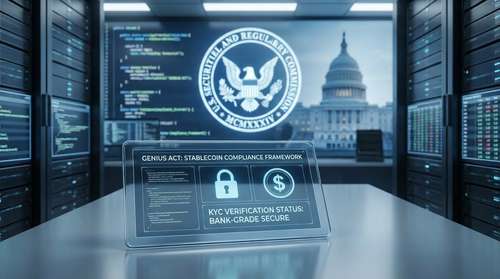
The regulatory landscape for digital assets experienced a seismic shift this week. On June 18, 2026, a coalition of five major U.S. financial watchdogs—including the Federal Reserve, the Office of the Comptroller of the Currency (OCC), and the Financial Crimes Enforcement Network (FinCEN)—issued a joint proposed rule that effectively transitions the digital asset sector into the traditional banking perimeter. At the heart of this sweeping GENIUS Act stablecoin regulation is a mandate requiring token issuers to implement bank-grade identity verification procedures.
By targeting the point of issuance, federal authorities are aiming to curb illicit finance while allowing compliant digital assets to integrate more seamlessly into mainstream commercial banking. The stakes are massive; in just the five months following the passage of the landmark legislation in 2025, stablecoin firms purchased an estimated $109 billion in U.S. Treasury bills, underscoring their growing systemic footprint.
Decoding the FinCEN Stablecoin KYC Rules
Under the newly published guidelines, the government is redefining who bears the burden of anti-money laundering compliance in the Web3 ecosystem. The proposal dictates that Permitted Payment Stablecoin Issuers compliance must now mirror the operational rigor expected of traditional national banks and credit unions.
According to the interagency notice, these digital asset companies will be legally classified as financial institutions. This regulatory classification forces them to adopt stringent crypto Bank Secrecy Act requirements. Specifically, stablecoin operators must collect and verify detailed personal data—such as legal names, dates of birth, physical addresses, and government-issued identification numbers—from anyone opening an account or minting tokens directly through their platforms.
The FinCEN stablecoin KYC rules represent the long-awaited enforcement mechanism of the Guiding and Establishing National Innovation for U.S. Stablecoins (GENIUS) Act. Until now, the industry has operated in a fractured environment, with many issuers classified broadly as state-level money services businesses. This formal elevation to bank-level scrutiny aims to flush out bad actors exploiting the speed and borderless liquidity of dollar-pegged digital tokens.
Inside the US Stablecoin Customer Identification Program
The core of the joint regulatory proposal revolves around establishing a formal US stablecoin Customer Identification Program (CIP). This is not merely a superficial compliance checklist. Issuers must draft, maintain, and execute written, risk-based procedures tailored to their specific corporate size and operational scope.
For companies operating in the digital asset space, achieving this level of identity verification will require significant operational overhauls. Firms must check prospective clients against government terrorist watchlists and maintain exhaustive records of their verification methods. If a permitted issuer operates as a subsidiary of an insured depository institution, the Federal Deposit Insurance Corporation (FDIC) proposal notes that the firm may leverage its parent bank's existing CIP infrastructure, provided it meets all comprehensive risk-mitigation standards.
The Secondary Market Exemption: A Win for Peer-to-Peer?
A major point of contention prior to the release of these federal stablecoin rules 2026 was whether regulators would attempt to force issuers to identify every single individual who ever holds or transfers a token. The new proposal explicitly avoids this technically prohibitive approach.
Ordinary users can continue to send and receive stablecoins on secondary markets in a decentralized, peer-to-peer manner. Issuers will not be required to track or collect personal information from downstream participants who hold tokens in self-custody wallets. This pragmatic carve-out suggests that federal agencies are attempting to fit digital currencies into a standardized regulatory framework without breaking the fundamental utility that makes blockchain-based payments so efficient.
Evaluating the Operational Burden for Market Participants
Complying with these heightened standards will fundamentally alter the cost of doing business in the digital asset sector. Companies seeking to maintain their status as permitted issuers will need to invest heavily in specialized compliance personnel and advanced blockchain analytics software to monitor transactions effectively.
Regulators are aware of this friction. To ease the transition, the proposal outlines procedures allowing issuers to rely on the identity checks performed by other federally regulated financial institutions under specific circumstances. This concession could pave the way for expansive partnerships between traditional commercial banks and crypto-native firms, creating a unified network of verified financial data.
Preparing for the Next Era of Digital Finance
The rollout of these proposed requirements marks a definitive turning point for dollar-backed digital assets. The agencies, which also include the National Credit Union Administration (NCUA), have opened a 60-day public comment period following the document's publication in the Federal Register on June 22.
Market participants, from legacy financial institutions to native cryptocurrency exchanges, now have a limited window to weigh in on the operational burdens these rules might impose. Some stakeholders, including Federal Reserve Vice Chair for Supervision Michael Barr, have already voiced concerns that the rules might not go far enough to mitigate illicit finance risks associated with secondary market trading. Conversely, crypto advocates are preparing to push back against any language that could inadvertently stifle domestic financial innovation.
As the comment period unfolds throughout the summer, the broader financial industry is watching closely. The ultimate finalized version of this interagency proposal will dictate the operational realities for digital asset firms well into the future, permanently altering how the American economy interacts with blockchain technology.