In a watershed moment for American financial technology, lawmakers in Dover have introduced a sweeping legislative package poised to redefine the digital economy. The highly anticipated stablecoin licensing act, formally presented on March 23, 2026, positions the state at the vanguard of modern finance. As the most significant update to state financial law since 1981, this bold move in Delaware crypto regulation establishes a formal framework for cryptocurrency companies to operate within the traditional banking system. For anyone following US crypto news 2026, this legislative push signals a definitive shift from regulatory uncertainty to structured, institutional integration.
The Scope of Delaware's Blockchain Banking Reforms
The proposed legislative overhaul centers on two primary bills designed to modernize the state's financial code. Senate Bill 19, known as the Delaware Payment Stablecoin Act, creates a specialized licensing regime for issuers and service providers. Parallel to this, Senate Bill 16—the Delaware Banking Modernization Act of 2026—represents the first massive overhaul of Title 5 of the Delaware Code in over four decades. Spearheaded by Senator Spiros Mantzavinos and Representative Bill Bush, these blockchain banking reforms collectively build an infrastructure capable of handling modern financial demands.
Crucially, SB 16 legally defines virtual currencies as personal property. This seemingly simple classification carries massive implications. It explicitly authorizes state-chartered banks and trust companies to manage digital asset deposits in a fiduciary capacity. By providing clear definitions, Delaware removes the legal ambiguity that has long kept traditional financial institutions from engaging with digital currencies. Governor Matt Meyer has heavily backed the initiative, emphasizing that the reforms will democratize financial services and lower barriers to entry for everyday consumers.
Strict Guardrails for Market Stability
Under the new stablecoin licensing act, companies seeking to operate in Delaware face rigorous oversight. Issuers must maintain a strict 1:1 reserve ratio, ensuring that every token in circulation is fully backed by equivalent, highly liquid dollar-denominated assets such as U.S. Treasury bills. The legislation also mandates mandatory monthly audits, strict anti-money laundering (AML) and Know Your Customer (KYC) protocols, and a baseline capital requirement of $5 million that scales based on operational risk. Issuers are also required to hold enough capital to cover at least one year of projected operating expenses, safeguarding users against sudden market downturns.
Furthermore, the legislation establishes three distinct regulatory categories: a payment stablecoin issuer license, a digital asset service provider license, and a combined license for entities executing both functions. This tiered approach ensures that companies of varying sizes and operational models can find a home in Delaware without being subjected to a one-size-fits-all regulatory hammer.
Federal Alignment and the GENIUS Act
Delaware isn't operating in a vacuum. The state's rapid legislative action is a direct response to the federal Guiding and Establishing National Innovation for U.S. Stablecoins Act, which President Donald Trump signed into law in July 2025. The federal statute gave states until July 18, 2026, to implement local rules to become certified regulatory jurisdictions. By moving swiftly, Delaware aims to capture a massive share of the market for issuers operating below the $10 billion federal threshold.
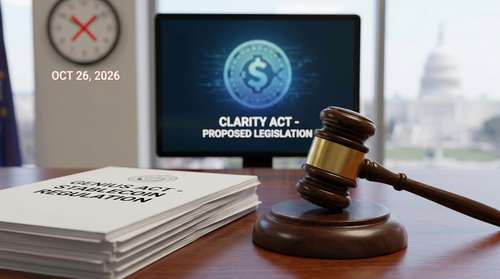
One highly debated aspect of the new legislation revolves around the stablecoin yields GENIUS act restrictions. Currently, SB 19 strictly follows the federal mandate by prohibiting issuers from paying interest or yield to users simply for holding payment stablecoins. This restriction aims to prevent these tokens from being classified as unregistered securities. However, the regulatory landscape remains fluid. Lawmakers have explicitly written forward-looking provisions allowing Delaware to adapt immediately if the federal government approves yield-bearing stablecoins. This flexibility is critical, given the intense ongoing debates in Washington surrounding the proposed CLARITY Act, which seeks to reverse the current federal ban on stablecoin yields.
Pioneering the Future of Digital Asset Deposits
By establishing clear rules of the road, Delaware is recreating the magic of the 1981 Financial Center Development Act, which successfully transformed the state into the credit card capital of the world. The current stablecoin licensing act offers a similar magnetic pull for digital asset companies. Businesses that secure a state license can bypass a more cumbersome federal chartering process while remaining fully compliant with national standards.
The local ecosystem is already preparing for the influx of technology and capital. University of Delaware President Laura Carlson recently announced that the institution is exploring a pilot program to utilize stablecoins directly on campus. This practical application underscores how these legislative changes extend far beyond corporate boardrooms, potentially shifting how residents interact with money daily.
What This Means for Cryptovot Tech News Readers
For followers of cryptovot tech news, Delaware's proactive stance is a massive indicator of where the broader industry is heading. A predictable, safe, and state-backed regulatory environment attracts institutional capital. When a jurisdiction famous for housing the majority of Fortune 500 companies integrates digital asset deposits into its core banking code, the rest of the country takes notice.
As lawmakers prepare to file a third interlocking bill—the Delaware Money Transmission and Virtual Currency Modernization Act—the state's comprehensive strategy is becoming undeniably clear. This forthcoming legislation will replace fragmented money transmission statutes with a unified regime, eliminating duplicative licensing burdens and enhancing multi-state coordination. Together, these initiatives form a formidable triad of Delaware crypto regulation.
The bills currently await committee approval and full legislative debate. Should they pass as expected, the Office of the State Bank Commissioner will rapidly issue the implementing regulations. Delaware has thrown down the gauntlet, challenging other states to either match its modernized framework or risk missing out on the next great financial migration.