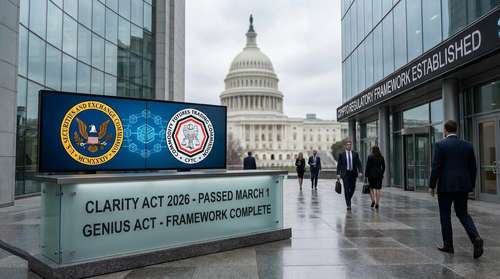
In a historic weekend session that stretched into the early hours of Sunday, the U.S. Congress has successfully met its self-imposed March 1 deadline to finalize the Digital Asset Market Clarity Act 2026 (CLARITY Act). This landmark legislation, hailed as the “missing piece” of the American financial regulatory puzzle, officially ends years of jurisdictional ambiguity by establishing a clear boundary between the Securities and Exchange Commission (SEC) and the Commodity Futures Trading Commission (CFTC). For the crypto industry, which has long clamored for a concrete crypto regulatory framework 2026 marks the dawn of a new era of legitimacy and institutional growth.
CLARITY Act Crypto Deadline: A New Dawn for Digital Commodities
The passage of the CLARITY Act comes just months after President Trump signed the US stablecoin regulation GENIUS Act into law, signaling a rapid acceleration in Washington’s approach to digital assets. House Financial Services Committee Chairman French Hill, a primary architect of the bill, announced the breakthrough this morning, confirming that the legislation provides the CFTC with “exclusive jurisdiction” over digital commodity spot markets—covering assets like Bitcoin and Ethereum—while narrowing the SEC’s focus to investment contracts and corporate fundraising tokens.
The CLARITY Act crypto deadline was seen as a critical test of political will. Negotiations had stalled earlier in the year over the contentious issue of stablecoin yield-bearing products, with traditional banks lobbying hard against them. However, a last-minute compromise allows for “active participation rewards” while maintaining strict prohibitions on passive interest for payment stablecoins, unlocking the deadlock just hours before the March 1 cutoff.
SEC vs CFTC Crypto Jurisdiction: Drawing the Line
The core achievement of the CLARITY Act is the resolution of the SEC vs CFTC crypto jurisdiction war. Under the new law, the “regulation-by-enforcement” era is officially over. The Act creates a distinct asset class for “digital commodities,” defined by their decentralization and utility, placing them firmly under the oversight of the CFTC. This move is expected to drastically reduce legal costs for crypto firms that have spent the last half-decade fighting subpoenas.
“We are finally treating digital assets based on what they are, not what they used to be,” said Senator Bill Hagerty, who played a key role in bridging the gap between the Senate Banking and Agriculture Committees. The law creates a provisional registration pathway for exchanges, allowing them to operate legally while transitioning to the new dual-agency compliance regime.
Paul Atkins SEC Crypto Policy: The “Project Crypto” Shift
Crucial to this legislative success was the support of SEC Chairman Paul Atkins. Since taking the helm from Gary Gensler, Paul Atkins SEC crypto policy has pivoted toward modernization. His initiative, dubbed “Project Crypto,” aligns perfectly with the CLARITY Act’s provisions. Atkins recently admitted that the U.S. had “missed major opportunities” by being hostile to innovation and has pledged to fast-track the approval of tokenized money market funds and other regulated digital financial products.
Under Atkins, the SEC is expected to issue new guidance within 90 days clarifying exactly when a token “decentralizes” enough to transition from a security to a commodity—a process the CLARITY Act codifies into federal law. This synchronization between the legislative branch and the regulator is unprecedented in the sector’s history.
GENIUS Act and Institutional Adoption
While the CLARITY Act handles market structure, the ecosystem is already stabilizing thanks to the US stablecoin regulation GENIUS Act (Guiding and Establishing National Innovation for U.S. Stablecoins Act), passed in July 2025. The GENIUS Act mandated 100% reserve backing for payment stablecoins, effectively removing credit risk from the system. With the OCC issuing implementation rules just days ago, major banks are now preparing to enter the market.
This regulatory certainty is fueling massive institutional crypto adoption USA. With Bitcoin stabilizing near $67,000 and clear rules of the road now established, Wall Street firms that were previously hesitant are finalizing plans for spot trading desks and proprietary digital asset custody solutions. The “wild west” days are over; the era of the regulated digital economy has begun.