As lawmakers return to Capitol Hill this week, the digital asset industry is watching Washington closer than ever. At the center of the legislative storm is the Digital Asset Market CLARITY Act 2026, a landmark bill aiming to definitively end the grueling era of regulation by enforcement. Following months of partisan gridlock, a late-weekend compromise between the White House and key lawmakers has injected sudden momentum into the proceedings, setting the stage for a dramatic policy showdown.
Thawing the Ice on Stablecoin Yield Regulation US
For weeks, the primary hurdle stalling the legislation has been the contentious debate over yield-bearing stablecoins. Regulators have fiercely debated whether these assets act as traditional banking products, commodities, or unregistered securities. However, late Sunday evening, negotiators reportedly reached a tentative framework that provides a clear runway for stablecoin yield regulation US.
Under the new compromise, stablecoin issuers will be permitted to pass through treasury yields to token holders, provided they adhere to stringent reserve verification standards and maintain a strict firewall between customer assets and operational funds. This breakthrough resolves a critical deadlock, alleviating concerns from consumer protection advocates while keeping the United States competitive in the rapidly expanding global Web3 economy.
Treasury Secretary Scott Bessent Crypto Strategy
A major catalyst for this weekend's breakthrough was the active involvement of the Treasury Department. Recent Treasury Secretary Scott Bessent crypto policies have increasingly focused on preserving the dominance of the U.S. dollar in digital spaces. Bessent and his team have privately urged lawmakers to finalize a workable framework, warning that offshore, unregulated stablecoins pose a far greater systemic risk to the economy than domestic, yield-bearing alternatives.
By bringing these assets securely into the regulatory fold, the Treasury aims to solidify dollar-pegged stablecoins as a major institutional buyer of short-term U.S. government debt. This strategic move elegantly aligns decentralized crypto innovation with vital national economic interests.
Resolving the SEC vs CFTC Jurisdiction 2026 Battle
Beyond stablecoins, the most anticipated element of this crypto regulatory clarity act is its approach to broader market supervision. For years, digital asset exchanges and token developers have been caught in a relentless tug-of-war between competing federal agencies.
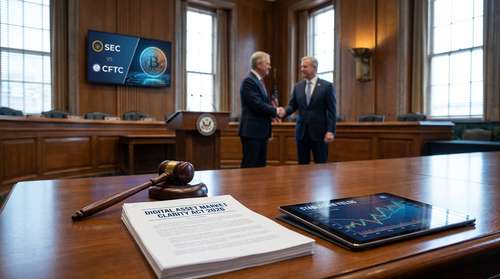
The CLARITY Act finally addresses the SEC vs CFTC jurisdiction 2026 dilemma head-on. The current markup draft proposes a joint-rulemaking mandate, but distinctly categorizes purely decentralized tokens as digital commodities under the exclusive purview of the Commodity Futures Trading Commission. The Securities and Exchange Commission would retain statutory authority over digital assets that represent traditional debt, equity, or rely heavily on centralized managerial efforts for their core value.
Industry insiders suggest this dual-framework approach is the most pragmatic solution to emerge from Washington in years. It offers the first genuine roadmap for exchanges to register and operate compliantly without facing overlapping and contradictory enforcement actions.
Impact on Decentralized Finance (DeFi)
The ripple effects of this legislative push are already being felt across the broader Decentralized Finance ecosystem. Historically, DeFi protocols that integrated yield-bearing stablecoins operated under a cloud of existential legal threat. The proposed safe harbor provisions within the CLARITY Act would theoretically shield decentralized lending markets and liquidity pools from sudden regulatory crackdowns, provided the underlying stablecoins are minted by registered U.S. entities.
The Road to the Senate Banking Committee Crypto Vote
With the yield impasse ostensibly cleared, the pressure is squarely on the upper chamber. Sources on Capitol Hill indicate that a Senate Banking Committee crypto vote is tentatively scheduled for the final week of April. Committee leadership is rushing to finalize the markup text, knowing that any further delay could push the legislation into the chaotic summer recess period, severely jeopardizing its chances of passing this year.
Lobbying groups are currently mobilizing massive resources to ensure the tentative White House compromise holds together. Analysts are keeping a close eye on the moderate swing votes within the committee, as their unwavering support will be crucial in advancing the bill to the full Senate floor. If the markup succeeds, this week will go down as a monumental turning point for US crypto legislation news.
The days of operating in the regulatory gray area are rapidly closing. For investors, blockchain developers, and traditional institutional players alike, the CLARITY Act represents the inevitable maturity of a financial technology sector that can no longer be ignored, marginalized, or regulated strictly through court battles.