The digital asset landscape is undergoing a monumental, $70 billion structural transformation in late March 2026. Faced with an unforgiving combination of historically low hash prices and soaring operational costs, the Bitcoin mining pivot to AI has officially shifted from a speculative alternative to an absolute necessity. Mining giants are rapidly liquidating portions of their Bitcoin treasuries to finance this transition, effectively turning their energy-intensive operations into high-margin artificial intelligence hubs. What began as a defensive maneuver has morphed into an aggressive land grab, as former crypto purists realize they hold the exact resources the booming AI industry desperately needs.
The Breaking Point for Crypto Margins
To understand this exodus, you only need to look at the brutal economics defining the crypto hash price 2026 landscape. Following Bitcoin's massive rally to nearly $126,000 in October 2025, the market experienced a sharp correction, dropping prices to the mid-$60,000 range by early 2026. According to recent data from CoinShares, the weighted average cash cost to produce a single Bitcoin skyrocketed to approximately $79,995 for publicly listed miners in the last quarter.
Meanwhile, the hash price—a key metric of daily miner revenue per unit of computing power—plunged to a devastating post-halving low of $28 to $30 per petahash per second (PH/s). Although the hash price has stabilized near $33 as of late March, an estimated 15% to 20% of the global mining fleet remains entirely unprofitable. For legacy operations, clinging to older ASIC machines while paying premium winter electricity rates is no longer a viable strategy. Instead, exploring profitable crypto mining alternatives outside of the blockchain ecosystem has become a matter of corporate survival.
The HPC Data Center Conversion Rush
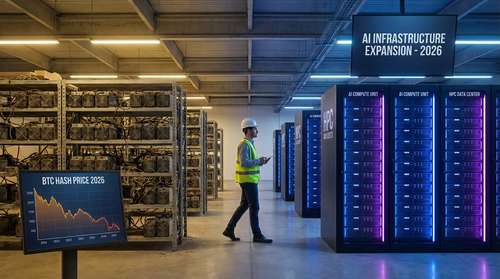
Generative AI and machine learning require exactly what Bitcoin miners already possess: massive interconnection rights, extreme power density, and advanced cooling infrastructure. The HPC data center conversion is accelerating because tech giants simply cannot afford to wait three to five years for new energy grids and substations to be built.
By retrofitting existing facilities, miners are instantly unlocking a goldmine. The sheer demand for high-performance computing energy has driven the industry to secure over $70 billion in cumulative AI and HPC contracts. The valuation disparity is glaring: companies securing HPC contracts are currently trading at an enterprise value to next-twelve-months (EV/NTM) revenue multiple of 12.3, compared to just 5.9 for pure-play mining firms. Projections now indicate that top publicly traded miners could derive up to 70% of their total revenue from AI operations by the end of 2026, a staggering leap from roughly 30% today.
Industry Giants Forging New Alliances
This historic shift is being spearheaded by major players who are fundamentally redefining their corporate identities. The IREN digital infrastructure evolution is a prime example of this trend. Originally built purely as a crypto miner, IREN recently secured a massive $9.7 billion, five-year agreement with Microsoft. This deal leases roughly 200 megawatts (MW) of GPU-powered data center capacity specifically for AI workloads, pushing their projected HPC revenue to an estimated 71% of their total income.
Similarly, the TeraWulf AI strategy is actively reshaping the global hash map. The company has aggressively prioritized its HPC expansion at its Lake Mariner and Abernathy facilities, utilizing zero-carbon nuclear and hydro power. Highlighting the scale of this ambition, TeraWulf recently entered into a $9.5 billion joint venture with Google-backed Fluidstack. They are systematically scaling down pure Bitcoin mining to redirect crucial megawatts toward AI. Other major players are following suit; Core Scientific is energizing hundreds of megawatts for CoreWeave, and Cipher Mining recently inked a 15-year, $5.5 billion deal with Amazon AWS.
A Net Positive for the Bitcoin Network?
To fund these capital-intensive infrastructure transitions, mining heavyweights are offloading significant corporate treasuries. In late March 2026, MARA liquidated over 15,000 BTC—worth more than $1 billion—to pay down debt and fund its AI data center developments. While this mass sell-off creates short-term downward pressure on Bitcoin's market price, the corporate hash rate exodus carries a distinct silver lining for the broader ecosystem.
As large industrial players take their mining rigs offline to make room for GPU clusters, network difficulty experiences steep drops. Following a rare streak of negative difficulty adjustments in late 2025, the network saw another 7.7% difficulty reduction on March 20. For the medium and solo miners who stay behind, this decrease translates directly into improved profit margins and easier block discovery. The global network hash rate, which peaked around 1,160 EH/s, has stabilized near 1,020 EH/s. Ultimately, the great Bitcoin mining pivot to AI isn't a death knell for the network—it’s a dramatic rebalancing of global computing power that rewards the most efficient operators who remain.