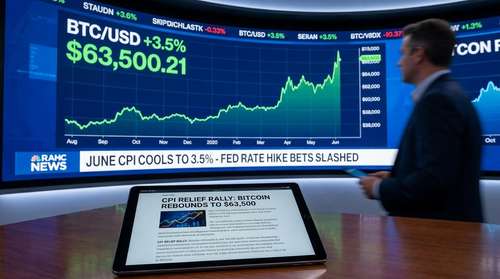
Bitcoin has surged to an 11-day high, reclaiming the $69,500 mark as escalating geopolitical tensions inject fresh momentum into digital assets. Testing a critical Bitcoin price $70000 forecast, the flagship cryptocurrency's sudden rally comes amid the extreme crypto market volatility April 2026 has experienced. The primary catalyst for this rapid price action stems from the Middle East, where U.S. President Donald Trump has issued a strict deadline for Iran to reopen a vital global shipping lane. Against this backdrop of international uncertainty and surging global energy costs, institutional giants are continuing their aggressive accumulation strategies, proving that digital scarcity remains a heavily favored hedge during periods of global instability.
Trump's Ultimatum and the Strait of Hormuz Market Impact
The global geopolitical landscape took a dramatic turn over the Easter weekend, deeply influencing both traditional and digital markets. Following over a month of regional conflict that has disrupted global supply chains, President Trump delivered a severe ultimatum to Iran, demanding the immediate reopening of the Strait of Hormuz by Tuesday evening. Through social media posts on Truth Social and subsequent television interviews, the administration threatened significant military consequences against Iranian power plants and civilian infrastructure if the crucial waterway remains blocked.
However, the Strait of Hormuz market impact took an unexpected twist when mixed diplomatic signals emerged. While the public rhetoric remained fiery, Trump also acknowledged in a Fox News interview that negotiators were active, noting a good chance of an agreement within 24 hours. Shortly after, an Axios report revealed that the U.S., Iran, and regional mediators were actively discussing a 45-day ceasefire. This whiplash of news—from threats of escalated warfare to whispers of an imminent, permanent end to the six-week conflict—became the perfect storm for a sudden crypto market breakout.
The broader macroeconomic implications are also driving crypto adoption. The ongoing closure of the strait has pushed West Texas Intermediate crude oil prices back up to roughly $112 per barrel. With Americans spending an estimated additional $240 million per day on fuel, analysts warn that sustained energy costs could push U.S. Consumer Price Index-related inflation up to 3.7%. In response to this looming inflationary pressure, investors are increasingly pivoting back to digital assets.
Short Squeeze Fuels Market Volatility
The sudden influx of positive ceasefire rumors and inflation-hedging caught bearish traders completely off guard. Following a weekend where social sentiment data showed an overwhelmingly negative skew, the market violently reversed. Trading data revealed that the broader crypto market witnessed nearly $274 million in total liquidations across over 81,000 traders within a single 24-hour window. Short sellers bore the brunt of this pain, accounting for $196.7 million—or roughly 73%—of the wiped-out positions.
This massive short squeeze propelled Bitcoin directly through its short-term bearish trend lines and lifted the total cryptocurrency market capitalization back above $2.44 trillion. Altcoins heavily benefited from Bitcoin's resurgence, with Ethereum climbing 3.7% to $2,130, while assets like Solana and XRP also posted notable gains. The crypto market volatility April 2026 has proven that liquidity can shift rapidly when geopolitical and macroeconomic indicators align.
Institutional Conviction: MicroStrategy's Bold Buy
Despite the broader macroeconomic turbulence and Extreme Fear sentiment lingering in traditional retail markets, corporate accumulation of digital assets shows no signs of slowing. In a stunning display of long-term conviction, institutional giant MicroStrategy has once again doubled down on its corporate treasury strategy. Capitalizing on the recent market consolidation, the firm executed a massive MicroStrategy Bitcoin purchase 2026, acquiring an additional 4,871 BTC.
What makes this latest acquisition particularly noteworthy is the surrounding financial context. MicroStrategy executed this multi-million dollar buy while officially absorbing a staggering $14.5 billion unrealized loss on its existing digital asset holdings. Rather than capitulating during the recent five-week market drought, the firm capitalized on the localized dip. This aggressive move highlights a broader trend of resilient institutional Bitcoin adoption, where corporate treasuries view geopolitical stress and the threat of fiat inflation as primary signals to increase their unconfiscatable digital asset exposure.
Navigating Bitcoin Resistance Levels
Currently, traders are closely monitoring key Bitcoin resistance levels as the asset attempts to break free from a prolonged consolidation phase. After breaking past $67,650 and maintaining momentum above the 100-hour simple moving average, Bitcoin touched $69,500 on major exchanges like Coinbase. Analysts suggest that a decisive daily close above this local high is essential to validate any sustained Bitcoin price $70000 forecast.
If bulls can successfully shatter the $70,000 psychological barrier, market data indicates that the next significant resistance looms at $71,500. Conversely, support remains heavily fortified around $68,500 and $67,500. As the Tuesday deadline regarding the Trump Iran ultimatum crypto reaction approaches, market participants are bracing for continued price swings. Whether Bitcoin can definitively claim the $70,000 territory will likely depend on the final resolution of the Strait of Hormuz standoff in the critical hours ahead.