
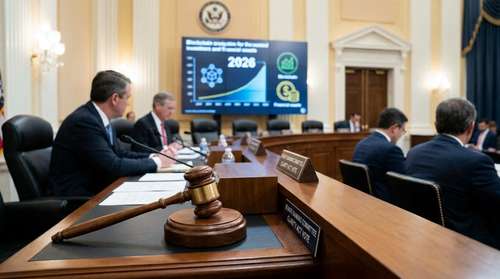
The recent CLARITY Act Senate vote has officially catalyzed the most significant legislative shift in the history of U.S. financial technology. On May 14, 2026, the Senate Banking Committee passed the Digital Asset Market Clarity Act with a decisive 15-9 bipartisan vote, propelling a comprehensive digital asset market framework toward a full floor vote. By formally ending the years-long jurisdictional turf war between regulatory agencies, this landmark legislation sets the stage for unprecedented institutional digital asset adoption. With the White House eyeing a potential July 4 signing, the traditional financial sector is rapidly pivoting to integrate decentralized finance (DeFi) into global banking infrastructure.
Breaking Down the Senate Banking Committee Crypto Vote
The legislative breakthrough follows months of intense negotiations and delays. Chairman Tim Scott guided the 309-page bill through a contentious markup session that saw Democrats Michelle Alsobrooks and Ruben Gallego break ranks to join 13 Republicans in favor of the measure. This Senate Banking Committee crypto vote signals a definitive departure from the government's previous regulation-by-enforcement approach.
At its core, the legislation redraws the legal boundaries that have historically hampered technology innovation. It formally grants the Commodity Futures Trading Commission (CFTC) authority over decentralized digital commodities, while strictly confining the Securities and Exchange Commission (SEC) to assets marketed as investment contracts. For Wall Street, this resolution of digital asset market laws is the ultimate green light. Financial holding companies and traditional banks are now explicitly authorized to offer crypto custody, execute trades, and run node operations under existing banking regulations.
The New Stablecoin Legal Framework
A pivotal component of this sweeping 2026 crypto regulation is Section 404, internally dubbed the Tillis-Alsobrooks compromise. This segment establishes the nation's first concrete stablecoin legal framework, fundamentally altering how capital flows through the ecosystem.
Under the revised rules, stablecoin issuers are prohibited from paying passive yield directly to retail users. However, activity-based rewards and institutional yield-generation through DeFi protocols remain legally protected. This nuanced distinction acts as a massive regulatory moat for established banks. While ordinary users face tight restrictions on passive stablecoin interest, institutional players are cleared to route trillions in capital through compliant DeFi platforms. Industry analysts predict this dynamic will trigger a mass migration of capital from sidelined wealth management accounts directly into heavily vetted protocols.
Furthermore, legacy banks have spent decades building robust Bank Secrecy Act (BSA) and Anti-Money Laundering (AML) programs. The new legislation mandates that crypto-native startups replicate these massive compliance structures, handing traditional financial institutions an immediate competitive advantage as they absorb decentralized capabilities.
RWA Tokenization News: Wall Street Accelerates
The immediate market impact of the legislation is already highly visible in the real-world asset sector. In the latest RWA tokenization news, the on-chain market capitalization for tokenized assets surged to $31.42 billion the week of the vote, representing one of the largest single-month increases on record.
Financial giants are not waiting for a presidential signature to mobilize their resources. BlackRock recently announced plans to deploy two new tokenized money market funds tailored specifically for stablecoin holders, expanding its existing partnership with Securitize. Simultaneously, JPMorgan is rolling out its second Ethereum-based tokenized fund, JLTXX. The legislation provides the precise legal certainty these asset managers required to scale their blockchain operations beyond experimental pilot programs.
What's Next for 2026 Crypto Regulation?
The journey for the CLARITY Act still faces remaining hurdles, despite its profound momentum. The bill requires 60 votes to clear the full Senate floor, meaning at least seven Democrats must vote in favor assuming total Republican alignment. It is worth noting that the House already passed a preliminary version of the bill in July 2025 with an overwhelming 294 to 134 bipartisan majority. The Senate's action was the final major legislative bottleneck.
Lawmakers are also actively debating stricter ethics provisions targeting government officials' digital asset holdings, a point raised frequently during the committee markup. Meanwhile, global competitors like the Bank of England are concurrently opening applications for stablecoin recognition, highlighting the urgent need for competitive American legislation.
Despite the procedural requirements ahead, prediction markets reflect overwhelming optimism, pricing the bill's final enactment at over 70%. By establishing clear, enforceable guardrails, the United States is finally positioning itself to lead global blockchain innovation. For banks, asset managers, and protocol developers, the regulatory winter has formally ended, and the race to dominate the newly legalized financial infrastructure has officially begun.