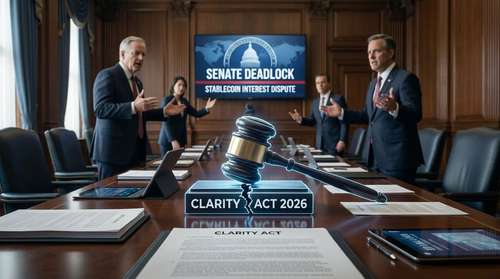
The landmark US Clarity Act 2026, poised to be the most significant federal crypto regulation in American history, has slammed into a legislative wall this week. What was intended to be a celebratory markup session by the Senate Banking Committee was abruptly cancelled on January 15, leaving the industry in a state of high-stakes limbo. At the heart of this collapse is not a debate over blockchain technology or decentralization, but a fierce, old-fashioned turf war over interest rates and banking privileges. As the dust settles from the delay, the dispute over whether stablecoin issuers can pay yields to users has become the single fragile thread holding back a comprehensive digital asset market structure.
The Core Dispute: Banks vs. Stablecoin Yields
The primary catalyst for this legislative breakdown is a provision in the Clarity Act that effectively prohibits stablecoin issuers from paying interest to token holders. This clause has drawn a sharp line in the sand between traditional financial institutions and the crypto sector. The American banking lobby has aggressively pushed for this ban, arguing that interest-bearing stablecoins would essentially function as unregulated high-yield savings accounts. Their fear is palpable: if a digital dollar can offer a 4-5% return without the overhead of a brick-and-mortar bank, trillions in deposits could flee the traditional banking system.
On the other side of the table, industry giants like Coinbase have revolted. With the Senate draft threatening to cut off revenue streams derived from stablecoin rewards, major crypto players have withdrawn their support, effectively freezing the bill's progress. They argue that banning yield is a protectionist move designed to shield banks from legitimate competition rather than protect consumers. This stablecoin interest dispute has transformed a bill about regulatory clarity into a battle over the future of money itself.
White House Fury and Trump's Davos Ultimatum
The political fallout reached a fever pitch this week, extending all the way to the executive branch. Sources close to the administration report that the White House views the sudden withdrawal of industry support as a "rug pull" during critical negotiations. President Donald Trump, speaking at the World Economic Forum in Davos on January 21, made it clear that patience is wearing thin. While he reaffirmed his desire to see the U.S. remain the "crypto capital of the world," his administration has signaled it may abandon the legislation entirely if a compromise isn't reached soon.
This friction between the crypto industry and its political allies represents a dangerous gamble. The administration had hoped to sign the federal crypto regulation news into law before the midterm election cycle heats up later this year. By stalling now, the industry risks losing its best window for legislative legitimization, potentially facing another two years of enforcement-focused regulation rather than the clear rules of the road promised by the Clarity Act.
Jurisdictional Clarity and DeFi Left Hanging
While the yield fight dominates the headlines, other critical components of the digital asset market structure bill are now gathering dust. The legislation was designed to finally settle the SEC vs CFTC crypto jurisdiction war, assigning spot market oversight to the CFTC while leaving securities regulation with the SEC. This division of labor was seen as a major win for the industry, offering a reprieve from years of aggressive litigation.
Furthermore, the delay leaves the burgeoning Decentralized Finance (DeFi) sector in a precarious position. The bill included controversial provisions regarding the tokenization of real-world assets (RWAs) and strict compliance requirements for DeFi protocols. Without a legislative framework, these innovative sectors remain exposed to interpretation by regulators who have historically taken a hostile stance. The current impasse doesn't just block stablecoin yields; it halts the modernization of America's entire financial infrastructure.
What Comes Next for the Clarity Act?
The path forward is murky. With the Senate Banking Committee pivoting its schedule to address housing initiatives, the momentum for the Clarity Act is rapidly dissipating. Legislative experts warn that if the standoff isn't resolved by late February, the bill could be effectively dead for the 2026 session. The crypto industry must now decide whether to compromise on the yield issue to secure broader regulatory recognition or hold the line and risk ending up with no federal framework at all.