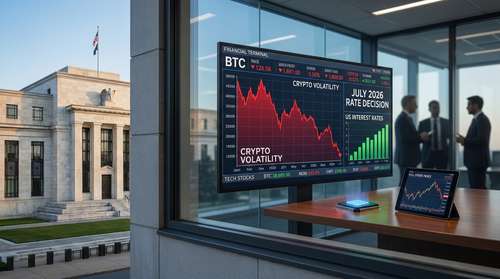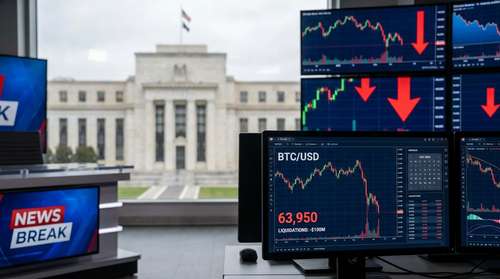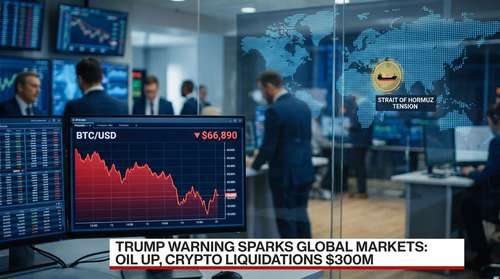
The global financial landscape took a sharp defensive turn this week as escalating geopolitical rhetoric sparked panic across equities and digital assets. At the center of the storm is the Bitcoin price April 2026 action, which saw the premier cryptocurrency briefly plunge below the critical $67,000 psychological support level today . The sudden pullback comes on the heels of President Donald Trump's severe "Stone Ages" warning regarding the ongoing blockade of the Strait of Hormuz . As crude oil prices surged over 5%—pushing well past $100 per barrel—a massive shockwave of liquidations rippled through the crypto derivatives market . This volatility serves as a stark reminder that despite its maturing ecosystem, Bitcoin remains highly sensitive to macroeconomic and global security shocks.
Trump's 'Stone Ages' Threat Ignites the Energy Market
The immediate catalyst for the broader market selloff was a dramatic escalation in the five-week-old Middle Eastern conflict. In a fiery address and subsequent social media posts on Truth Social, President Trump delivered a stark ultimatum to Tehran . He demanded the immediate reopening of the Strait of Hormuz to international shipping, warning that the United States military would bomb the nation "back to the Stone Ages" if compliance was not met . He further challenged oil-dependent nations to secure the strait themselves, boldly telling allies to "go to the Strait, and just take it" .
With approximately one-fifth of the world's daily oil consumption passing through the Hormuz chokepoint, the threat of a prolonged shutdown triggered an aggressive spike in energy costs. Brent crude shot past $100 per barrel, with some indices tracking spikes as high as $113 . The Hormuz crisis crypto market impact was immediate and severe. Rather than focusing on blockchain fundamentals or software upgrades, institutional traders were forced to price in higher global shipping rates, stubborn inflation, and the growing likelihood that central banks will delay highly anticipated interest rate cuts . Consequently, capital fled volatile risk assets in favor of traditional defensive positions like the U.S. dollar and short-term Treasuries.
Navigating the $300 Million Crypto Liquidation Event
The sudden shift to a risk-off macro environment resulted in a bloodbath for over-leveraged crypto traders. A comprehensive Bitcoin price volatility analysis reveals that nearly $300 million in bullish long positions were wiped out in a matter of hours . As Bitcoin fell as low as $65,500 during early Asia trading sessions, algorithmic trading bots and margin calls accelerated the downward momentum .
For those following Trump crypto news today, the irony is palpable. While the administration's domestic regulatory posture has heavily influenced digital asset narratives over the past year, it is the president's foreign policy maneuvering that is currently the primary driver of crypto price action. Altcoins felt an even sharper sting during the selloff, with Ethereum sliding 5% to the $2,050 range, and other major tokens like Solana and XRP posting substantial losses . The swift wipeout underscores how clean positioning is absolutely essential during periods of heightened global instability.
The 'Bitcoin Safe Haven War' Debate Continues
Whenever global military conflict erupts, the same fundamental question surfaces among investors: is digital gold actually a reliable geopolitical hedge? The recent price action adds complex new data to the ongoing Bitcoin safe haven war narrative. Historically, hardcore proponents have argued that Bitcoin operates entirely outside traditional sovereign structures, making it the ultimate refuge during times of war and fiat debasement.
However, the reality of the market in 2026 is far more nuanced. Bitcoin is currently heavily integrated into traditional finance, trading as a high-beta risk asset in many large institutional portfolios . When crude oil spikes and U.S. Treasury yields climb, institutional portfolio managers reduce their exposure to volatile assets first. Rather than acting purely as an untouchable sanctuary, Bitcoin is frequently utilized as a highly liquid instrument to quickly manage overall portfolio risk. This dynamic has driven the crypto fear and greed index 2026 firmly out of the "Extreme Greed" territory it enjoyed earlier this year, reflecting a cautious, defensive posture from retail and institutional participants alike.
Can Institutional Inflows Cushion the Geopolitical Blow?
Despite the harrowing wartime headlines and immediate price corrections, the medium-term outlook for the crypto market shows underlying structural resilience. After dipping to $65,500, bargain hunters quickly stepped in, helping Bitcoin stabilize back near the $68,000 range by press time . A major factor preventing a deeper, systemic capitulation is the persistent underlying strength of institutional Bitcoin ETF inflows .
Wall Street's ongoing appetite for spot Bitcoin ETFs continues to provide a robust liquidity buffer. Even as macroeconomic pressures mount from the energy sector, the structural, automated demand from registered investment advisors and pension funds acts as a silent shield against a total market breakdown. Analysts note that if oil prices begin to stabilize and the Strait of Hormuz tensions ease, historical patterns suggest that cyclical peaks in energy prices often precede significant crypto market recoveries .
The coming weeks will be absolutely critical for risk assets. Traders must navigate a treacherous minefield of geopolitical developments, inflammatory rhetoric, and shifting inflationary data. Until the global energy supply chain finds a new equilibrium, market participants should brace for continued turbulence across both traditional equities and digital asset classes.