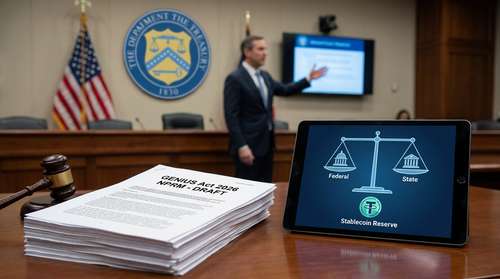
Late Sunday, April 19, 2026, the financial landscape shifted dramatically as the U.S. Department of the Treasury officially escalated the GENIUS Act 2026 into its formal rulemaking phase. The resulting notice, widely referred to as the US Treasury NPRM, has instantly ignited a high-stakes regulatory battle over stablecoin regulation US. The sweeping framework establishes rigorous "substantially similar" standards that local watchdogs must meet to maintain authority over any payment stablecoin issuer operating within their borders.
Redefining State Crypto Oversight
Passed with bipartisan support in July 2025, the original legislative framework set a much-needed national baseline for digital currencies backed by fiat. However, the detailed guidance published over the past 48 hours marks a pivotal and controversial moment for state crypto oversight. Under the new proposal, a state-regulated issuer with up to $10 billion in outstanding circulation can elect to sidestep direct supervision by the Office of the Comptroller of the Currency (OCC) or other federal banking agencies.
The catch is severe: a state's regulatory regime must match federal standards "in all substantive respects," effectively limiting local regulatory autonomy. This bifurcated, dual-banking approach forces states into a difficult corner. Rather than writing bespoke, flexible laws to attract fast-moving fintech startups, states must now strictly mirror federal mandates. Industry advocates argue this strips away the competitive edge of localized innovation, demanding full alignment with Washington's rigid oversight expectations and threatening the very nature of state-chartered crypto businesses.
Strict Digital Asset Reserve Requirements
Central to the US Treasury NPRM is an uncompromising stance on digital asset reserve requirements. To qualify for state-level supervision, a local framework must guarantee that all stablecoins are backed on a strict 1:1 basis by highly liquid, low-risk assets. Regulators have designated short-term U.S. Treasuries and dollar deposits as the only acceptable backing, aggressively targeting systemic financial risk.
The rule explicitly bars riskier assets like corporate debt, equities, and complex algorithmic mechanisms from the reserve pool. Federal regulators want to permanently eradicate the risk of destabilizing bank runs that historically plagued the digital asset sector during previous crypto winters. Furthermore, any state-qualified issuer must commit to transparent, monthly public disclosures regarding their reserve composition. This introduces a hefty compliance burden that smaller issuers may struggle to manage, potentially forcing consolidation in the market.
The Controversial Stablecoin Yield Prohibition
Perhaps the most fiercely debated component surfacing from this weekend's policy drop is the absolute stablecoin yield prohibition. To ensure payment stablecoins function strictly as a medium of exchange rather than an unregistered investment contract, issuers are explicitly banned from offering interest or yield to token holders.
State regulators and crypto proponents have voiced immediate frustration over the past two days, arguing this prohibition stifles product evolution and severely limits consumer choice. Yet, federal authorities maintain that barring yield prevents stablecoins from directly competing with traditional, FDIC-insured bank deposits. This structural firewall keeps the payments ecosystem fundamentally separate from commercial banking, preventing non-banks from assuming bank-like systemic importance.
AML Rules and the Future of Issuers
The Treasury's latest push extends far beyond balance sheets and asset reserves. Paired with concurrent directives from the Financial Crimes Enforcement Network (FinCEN) and the Office of Foreign Assets Control (OFAC), the NPRM mandates that any payment stablecoin issuer operating under state purview must adopt robust anti-money laundering (AML) and sanctions compliance programs.
Recent statements from Secretary of the Treasury Scott Bessent emphasized that protecting the U.S. financial system from illicit finance and national security threats remains paramount, even as the administration supports American leadership in digital financial technology. Issuers must now prove they possess the technological capability to freeze and seize illicit assets and comply swiftly with lawful orders. Failure to meet these uniform obligations will result in the immediate revocation of their state-supervised status.
The Path Forward for State-Regulated Platforms
As the June 2, 2026, deadline for public comments approaches, the industry is mobilizing. Local lawmakers face a distinct choice: invest heavily in regulatory infrastructure to match the GENIUS Act 2026 standards, or abandon state crypto oversight altogether and defer to federal agencies. For many states, the cost of certifying their regime as "substantially similar" may prove too steep, effectively pushing a majority of issuers toward the federal option. Ultimately, the outcome of the US Treasury NPRM will undoubtedly redefine stablecoin regulation US and set the standard for the rest of the globe.