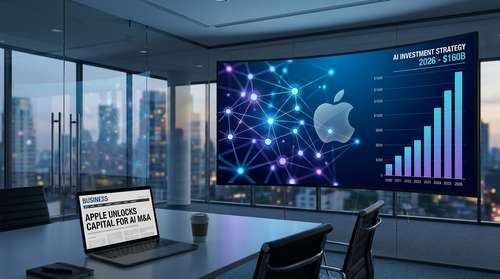
A seismic shift has just occurred in Cupertino. Under the strategic direction of John Ternus, Apple CEO-elect, the company has officially abandoned its long-standing mandate to aggressively reduce its massive cash reserves. Instead of channeling excess funds strictly into shareholder returns, the tech giant is repurposing its $160 billion treasury to fuel an unprecedented Apple AI acquisition spree. As the battle for artificial intelligence supremacy accelerates, Apple is finally unleashing its financial war chest to secure proprietary technology and close the gap with industry rivals.
For nearly a decade, former Chief Financial Officer Luca Maestri championed the Apple net-cash-neutral target, a philosophy first introduced in 2018 to balance total cash with total debt through aggressive stock buybacks and dividends. That era is definitively over. In the face of a rapidly evolving digital landscape, holding cash is no longer viewed as an inefficiency by leadership—it is the ultimate ammunition for dominating the next computing revolution.
The End of the Apple Net-Cash-Neutral Target
To understand the magnitude of this strategic pivot, you have to look at Apple's capital allocation history. The Apple net-cash-neutral target dictated that the iPhone maker return nearly all of its free cash flow to investors rather than hoarding it on the balance sheet. While this strategy artificially inflated earnings per share and delighted Wall Street for years, it arguably left the company playing a conservative game in the early days of the generative artificial intelligence race.
Ternus, who built his stellar reputation heading Apple's hardware engineering division, recognizes that renting capabilities is not a long-term survival strategy. Relying entirely on external partnerships limits the deep, hardware-level integration that has historically defined Apple products. By retaining cash, the company gains the agility to execute a high-stakes Apple M&A strategy. This allows Cupertino to aggressively buy out smaller startups, snap up top-tier machine learning talent, and consolidate critical intellectual property before competitors like Meta or OpenAI can react.
Accelerating the Apple M&A Strategy
The financial pivot is already materializing into concrete action. Just months ago, Apple executed a $2 billion buyout of the Israeli audio-intelligence startup Q.AI. This monumental deal secured groundbreaking technologies in whispered speech interpretation and audio enhancement in noisy environments. It marked the company's second-largest purchase since acquiring Beats Electronics in 2014 and served as the opening salvo for its revised 2026 product roadmap.
Building on previous quiet purchases like the 2024 buyout of Canadian vision-optimization firm DarwinAI, the tech behemoth is actively scouting new targets. This aggressive Apple AI acquisition strategy targets both consumer-facing applications and the underlying processing architecture. The company is reportedly seeking out startups specializing in low-latency inferencing, edge computing, and neural processing optimization. Rather than building every large language model from scratch, Apple is effectively buying the foundational building blocks to integrate localized intelligence directly into its custom silicon.
Moving Beyond the Siri Gemini Integration
The timing of this financial paradigm shift coincides directly with the rollout of iOS 26.4, an operating system update that heavily features the highly publicized Siri Gemini integration. By reportedly paying Google an estimated $1 billion annually, Apple successfully replaced Siri's legacy rule-based backend with Google's sophisticated generative language models. This partnership provided an immediate, much-needed conversational intelligence boost to billions of iPhones and iPads worldwide.
However, industry analysts view the Siri Gemini integration as a temporary bridge, not a final destination. Relying on a chief competitor's cloud infrastructure fundamentally contradicts Apple's core philosophy of owning the primary technologies behind its devices. The abandonment of the cash-neutral goal indicates a clear path toward independence. The company plans to use its capital to build out dedicated processing centers, eventually weaning its tight-knit ecosystem off third-party dependencies.
Impact on Big Tech AI Infrastructure and Markets
Apple's explosive entry into the aggressive buyout market is sending shockwaves through Silicon Valley. Developing robust Big Tech AI infrastructure requires staggering capital expenditure—not just for software algorithms, but for the specialized servers, liquid cooling systems, and custom networking equipment necessary to train proprietary multi-modal models. Apple's newfound willingness to spend directly challenges Microsoft and Google, forcing a fierce bidding war for the industry's most promising startups and infrastructure providers.
Furthermore, this shift drastically alters the forecast for generative AI stocks 2026. Small-cap artificial intelligence companies and specialized hardware vendors are experiencing a massive surge in valuation. Investors realize that Apple's $160 billion war chest can validate an entire sector overnight. If Cupertino is actively shopping, any startup holding critical patents in audio processing, visual interpretation, or neural networking is viewed as a highly lucrative potential target.
The Ternus era signals a fundamental transformation for the world's most valuable company. The shift away from strict financial engineering toward bold, structural technology investments proves that Apple intends to lead, rather than follow, the artificial intelligence revolution. With the restrictive constraints of the cash-neutral target officially removed, the next major Apple AI acquisition is no longer a matter of if, but when.