SEC Chair Paul Atkins delivered a regulatory breakthrough at this week's Bitcoin 2026 conference in Las Vegas, announcing a historic 'innovation exemption' that will permit U.S. financial firms to issue and trade tokenized securities directly on public blockchains. This monumental development in US crypto regulation news arrives precisely as the Senate prepares for the highly anticipated CLARITY Act 2026 passage, following its extensive markup in the Senate Banking Committee. Together, these regulatory shifts represent a decisive departure from years of legal ambiguity, with industry leaders predicting the moves will unlock trillions in institutional assets for decentralized infrastructure.
Paul Atkins SEC Roadmap Signals a New Era for Digital Capital
Taking the main stage at The Venetian Expo during one of the most widely covered Bitcoin 2026 Las Vegas highlights, Chairman Atkins formally closed the book on the agency's previous strategy. He acknowledged that the commission's past posture of "regulation by enforcement" acted like an ostrich with its head in the sand, driving blockchain innovation offshore and severely hindering domestic capital formation.
The newly detailed SEC Innovation Exemption crypto framework fundamentally rewrites the rules of engagement. Under the umbrella of "Project Crypto," Atkins revealed that within weeks, the agency will publish specific exemptions allowing firms to build, issue, and trade securitized tokens on-chain inside the United States. This marks the first time the federal securities regulator has explicitly carved out a compliant pathway for natively digital securities on open, permissionless ledgers.
The Mechanics of the Innovation Safe Harbor
The forthcoming "Regulation Crypto Assets" introduces bespoke pathways tailored to the technical realities of digital assets. Atkins outlined a time-limited startup exemption that grants developers a crucial four-year runway to raise up to $5 million using principles-based disclosures akin to traditional whitepapers.
For larger institutional players, the framework creates a legal safe harbor allowing on-chain tokenized securities to function without triggering the punitive registration requirements designed for 20th-century paper equities. By recognizing the difference between the underlying code and the investment contract itself—applying the Howey test to the ecosystem of promises rather than the token itself—the SEC is providing builders with the breathing room necessary to innovate securely.
CLARITY Act 2026 Passage: The Legislative Anchor
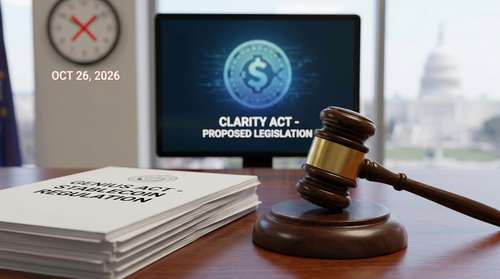
While the SEC's internal rule-making provides immediate oxygen to the market, long-term stability requires an act of Congress. The Digital Asset Market Clarity Act (H.R. 3633) serves as that critical legislative anchor. Following months of bipartisan negotiations and extensive markup sessions within the Senate Banking Committee, lawmakers are staging a decisive floor vote expected to pass before the summer recess.
The CLARITY Act formally bisects market jurisdiction, assigning the oversight of digital commodities to the Commodity Futures Trading Commission (CFTC) while preserving SEC authority over digital asset securities. This bifurcated approach relies on a newly established token taxonomy that effectively future-proofs the Paul Atkins SEC roadmap.
If passed, the legislation will statutorily protect decentralized finance (DeFi) developers from being treated as traditional financial intermediaries, provided they meet specific decentralization thresholds. It also establishes vital guidelines for stablecoin yields, addressing the concerns of traditional banking institutions regarding deposit outflows while permitting activity-based rewards.
Triggering the Tokenization of Real World Assets
The traditional financial sector has spent the last decade running closed-loop, private blockchain pilots, largely sidelined by the lack of clear federal guidance. The combined force of the SEC's innovation exemption and the impending CLARITY Act is the exact catalyst required to activate dormant institutional capital.
With the SEC and CFTC having already issued a joint interpretive release on token classification earlier this spring, the legal foundation is now set. Major legacy banks and asset managers are rapidly preparing to migrate traditional financial instruments onto decentralized networks.
The tokenization of real world assets—ranging from real estate and private credit to government treasuries and corporate debt—is now transitioning from a theoretical whitepaper concept into a primary market function. Industry analysts at the Las Vegas summit estimate that integrating just a fraction of the traditional securities market onto public blockchains could inject trillions into the digital asset ecosystem over the next five years, bridging the gap between legacy finance and decentralized rails.
Rewriting US Crypto Regulation News
The prevailing narrative surrounding American digital asset policy has flipped entirely over the past year. Just two years ago, the United States was widely considered a hostile jurisdiction for blockchain developers. Today, propelled by the momentum of the CLARITY Act and the SEC's proactive policy pivot, the nation is aggressively repositioning itself as the undisputed global hub for digital capital and financial engineering.
As all eyes turn toward the Senate floor this May, the stakes for the global economy are immense. If lawmakers successfully execute the CLARITY Act 2026 passage, the legal architecture for the next century of digital finance will be irrevocably codified in American law. The era of regulatory hostility has officially ended, giving way to a structured, institutionalized, and highly lucrative digital asset economy.