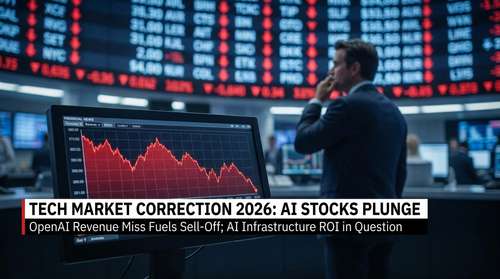
A recent Wall Street Journal report revealing a significant OpenAI revenue miss has sent shockwaves through global markets, erasing tens of billions of dollars from leading technology stocks. The artificial intelligence pioneer reportedly failed to hit aggressive internal sales targets and missed its milestone of reaching one billion weekly active users by the close of 2025. Now, the resulting fallout is forcing Wall Street to aggressively reevaluate the astronomical capital expenditures propping up the generative AI ecosystem.
The Numbers Behind the ChatGPT User Growth Decline
The market panic stems directly from leaked internal metrics that paint a sobering picture of the company's current trajectory. While OpenAI reached an undeniably impressive 900 million weekly active users by February 2026, it still fell short of its one-billion-user mandate. More concerning for investors is the shifting competitive landscape. The company's generative AI web traffic market share has recently slid to 64.5%, down from over 80% just a year prior.
Rivals are actively eating into their early lead. Competitor Anthropic recently crossed $30 billion in annualized revenue, operating on a fraction of OpenAI's training budget, while OpenAI's annualized revenue hovers around $25 billion. This tightening race has reportedly prompted intense internal anxiety. According to the WSJ, Chief Financial Officer Sarah Friar warned executives that the firm might struggle to fund its gargantuan future computing contracts if revenue growth doesn't drastically accelerate.
Adding friction to the financial strategy, reports indicate a growing disconnect internally regarding the company's initial public offering timeline. While CEO Sam Altman prefers an aggressive push to go public by the end of the year, Friar has expressed caution, warning that the organization may not yet be able to meet the stringent reporting standards required of a publicly traded entity.
AI Stock Market Crash: Softbank Oracle Slump
The immediate financial ripple effects of this revelation were severe, triggering an undeniable AI stock market crash across the hardware and infrastructure sectors. Investors rapidly dumped shares of companies whose future earnings are tightly tethered to OpenAI's aggressive growth assumptions, wiping out significant market capitalization in mere hours.
The Softbank Oracle slump became the starkest indicator of this market anxiety. Oracle, which secured a massive $300 billion, five-year partnership to supply computing power to the AI juggernaut, saw its shares tumble as much as 7.7% in pre-market trading before closing down 3.7%. The pressure was equally brutal overseas, where SoftBank—which previously committed $60 billion to the startup—plummeted nearly 11% in Tokyo trading.
Broader Contagion Across Silicon Valley
The sell-off didn't stop with direct partners. Infrastructure firm CoreWeave dropped 7.4%, while semiconductor giants felt the sudden chill. Nvidia slid roughly 2%, and AMD declined nearly 3%. This broad rotation out of high-growth tech pulled the Nasdaq Composite down 1.12% and the S&P 500 down 0.56%, cementing fears of a broader tech market correction 2026 as capital fled toward more defensive, traditional sectors.
Questioning the AI Infrastructure ROI
At the heart of this financial storm is a growing debate over AI infrastructure ROI. Over the last two years, tech giants and venture capitalists have underwritten an unprecedented hardware buildout. OpenAI alone had projected nearly $600 billion in data center and compute commitments through 2030, a figure designed to justify its staggering $852 billion post-money valuation following a recent $122 billion funding round.
However, when the category leader shows signs of stalling user retention and slowing monetization, the entire foundation of those massive contracts looks shaky. Industry analysts are sounding the alarm. Noah Kenney, founder of AI consultancy Digital 520, noted that when a market leader misses on both users and revenue while underwriting hundreds of billions in data-center commitments, those internal forecasts directly impact global supply chains and order books.
Corporate Pushback and Future Outlook
Executives at the startup are aggressively pushing back against the narrative. A spokesperson labeled the leaked metrics as "clickbait," insisting that enterprise demand remains stronger than ever and that the business is firing on all cylinders. Both Altman and Friar issued a joint statement to reassure markets that their leadership team remains completely aligned on acquiring compute power and scaling operations.
Despite these reassurances, analysts argue the balance of power in Silicon Valley is shifting. The central focus is no longer about launching new foundational models or chasing consumer virality; it is strictly about the math between infrastructure debt and sticky, recurring enterprise revenue. The days of blind blank-check investments in generative AI appear to be fading. As the dust settles from this week's trading volatility, hardware suppliers and software developers alike face a new reality. They must now prove that the billions funneled into data centers can actually generate sustainable profits.