The U.S. Senate Banking Committee has officially scheduled a highly anticipated CLARITY Act 2026 markup for May 14. This major legislative milestone arrives after Senators Thom Tillis and Angela Alsobrooks secured a breakthrough stablecoin yield compromise. Resolving a months-long standoff between the traditional banking sector and digital asset advocates, the agreement clears the final roadblock for comprehensive U.S. crypto regulation 2026. With the regulatory clouds finally parting, market watchers are bracing for a wave of new capital inflows that could realistically support a Bitcoin $80000 price target in the coming months.
The Tillis-Alsobrooks Crypto Deal Explained
For months leading up to the CLARITY Act 2026 markup, the legislation stalled in the Senate over a single, highly contentious issue: how to treat interest-bearing digital assets. Traditional financial institutions, represented by the American Bankers Association and other trade groups, warned that allowing crypto platforms to offer bank-like yields on stablecoins would trigger massive deposit flight. They argued this migration of funds could ultimately reduce lending capacity for consumers and small businesses by up to one-fifth.
Enter the Tillis-Alsobrooks crypto deal. Finalized earlier this week, the bipartisan agreement modifies Section 404 of the bill to explicitly prohibit crypto platforms from paying out passive interest or yield that functions identically to an interest-bearing bank deposit. Under the new language, issuers can no longer market an advertised annual percentage yield simply for holding tokens like USDC or USDT. The banking lobby secured a major victory through repeated acknowledgments in the text that anything functionally equivalent to a bank deposit is strictly forbidden. Even the section's title was updated from Preserving Rewards to Prohibiting Interest and Yield on Payment Stablecoins to reflect this stringent new reality.
However, the digital asset industry walked away with a vital concession. The revised text preserves activity-based rewards. Crypto firms and decentralized finance protocols remain free to incentivize bona fide platform usage. This means providing liquidity for market making, posting collateral for trades, and participating in network staking are fully protected activities. The distinction ensures that yield derived from actual on-chain utility survives, even as passive balance-sheet promises fade away.
Protecting Decentralized Finance Protocols
Beyond centralized stablecoin issuers, the revised language offers a crucial lifeline for the broader ecosystem. Early drafts of the legislation threatened to inadvertently classify standard on-chain mechanisms, like automated fee sharing from decentralized exchange swaps, as illegal unregistered securities offerings. The current framework explicitly protects these mechanics. For example, when a protocol distributes a fraction of real trading volume fees to its network participants, that activity is now legally recognized as a bona fide network reward.
Accelerating Institutional Stablecoin Adoption
This newfound clarity is a massive catalyst for institutional stablecoin adoption. The lingering threat of SEC enforcement actions has historically deterred major corporate treasuries from integrating digital dollars into their balance sheets. By clearly defining what constitutes a permitted reward versus a prohibited bank-like yield, enterprise players can now confidently utilize stablecoins for cross-border settlements and programmatic transactions without fear of inadvertently violating securities laws.
Inside the Senate Banking Committee Crypto Strategy
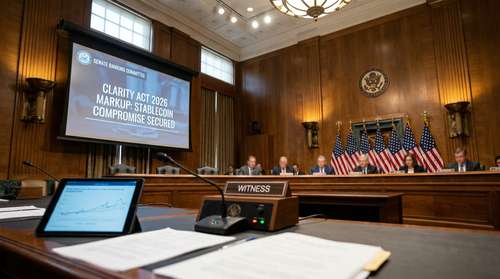
The Senate Banking Committee crypto markup executive session will commence at 10:30 a.m. in Room 538 of the Dirksen Senate Office Building on May 14. During this live-streamed session, lawmakers will debate amendments and vote on whether to advance the Digital Asset Market Clarity Act toward a full Senate floor vote.
Committee Chairman Tim Scott is operating on a highly compressed legislative timeline. Sources indicate he aims to complete the markup before the Memorial Day recess kicks off on May 21. If the committee advances the bill, it must secure 60 votes on the Senate floor, reconcile with overlapping agricultural committee frameworks, and merge with the House-passed version. The White House reportedly has its sights set on a July 4 signing ceremony, perfectly timed for America's 250th anniversary.
The path to this moment required heavy lifting from industry heavyweights. Ripple CEO Brad Garlinghouse and other executives spent months lobbying aggressively in Washington to ensure the jurisdictional lines between the Securities and Exchange Commission and the Commodity Futures Trading Commission were clearly drawn. By permanently shifting digital commodities under the CFTC's purview, the bill provides protocols with the exact regulatory clarity they need to operate domestically. Industry leaders who previously blocked the bill's momentum have officially reversed course. Coinbase CEO Brian Armstrong, who famously pulled his support on the eve of a prior markup attempt in January, took to social media platform X this weekend with a simple message: Mark it up.
Surging Sentiment and the Bitcoin $80000 Price Target
The political breakthrough has immediately altered market psychology. Prediction platforms like Polymarket saw the odds of the CLARITY Act passing in 2026 skyrocket from 46% to roughly 67% following news of the compromise, setting a bullish stage for the upcoming vote. Recent polling data underscores the political tailwinds, revealing that 52% of registered voters actively support the legislation, while 70% believe federal crypto rules are already long overdue.
Traders are responding to the shifting landscape. With the SEC's era of regulation by enforcement potentially ending, institutional risk models are rapidly being recalibrated. Analysts suggest that the formal establishment of CFTC jurisdiction over digital commodities and secure safe harbors for decentralized protocols will unlock massive amounts of sidelined capital. As a result, the elusive Bitcoin $80000 price target is looking increasingly achievable. Establishing a legitimate, federally recognized market structure isn't just about compliance, it's about opening the floodgates for the next generation of global financial infrastructure.