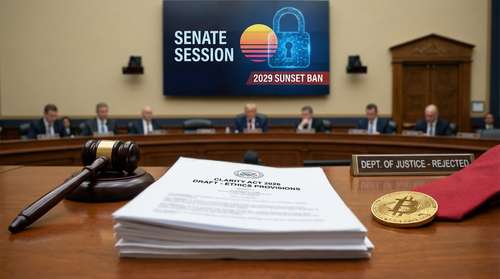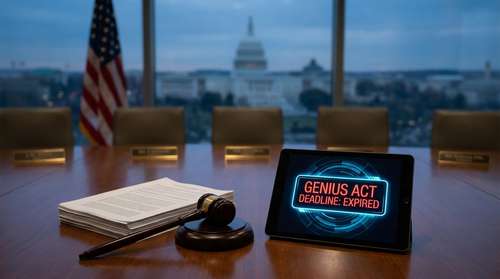
The latest push for comprehensive digital asset legislation has hit a major roadblock on Capitol Hill. A fierce US Senate crypto deadlock regarding the CLARITY Act 2026 has emerged, specifically over whether platforms can offer interest-bearing rewards on dollar-pegged tokens. This high-stakes standoff over stablecoin rewards is triggering massive crypto market uncertainty, stalling the most significant regulatory framework in recent US history, and leaving major industry players scrambling to protect their business models.
The Heart of the CLARITY Act 2026 Deadlock
For months, the stablecoin yield question has been the immovable object blocking the Digital Asset Market Clarity Act—widely known as the CLARITY Act—from receiving its crucial Senate Banking Committee markup. The core dispute centers on a deceptively simple question: should crypto platforms be allowed to pay users for holding stablecoins?
On March 20, 2026, Senators Thom Tillis (R-NC) and Angela Alsobrooks (D-MD) struck an "agreement in principle" backed by the White House. The proposed compromise establishes a strict crypto rewards ban on passive yield, meaning investors can no longer earn a return simply for holding digital dollars in a crypto wallet. However, the draft does permit "activity-based" rewards tied to transactions, loyalty programs, or payments. The catch is that these rewards cannot achieve "economic equivalence" with traditional bank deposits, a vague standard that has industry insiders highly concerned about future enforcement.
Banks vs. Crypto: The $6.6 Trillion Deposit Flight Fear
Traditional banking institutions have fiercely lobbied against stablecoin yields, heavily influencing this digital asset legislation. Industry titans like JPMorgan, alongside the American Bankers Association, argue that unregulated stablecoin rewards act as a dangerous form of shadow banking. Bank lobbyists have circulated internal analyses warning that up to $6.6 trillion in deposits could migrate out of traditional banks if passive stablecoin yields remain unchecked. Traditional savings accounts currently offer minimal interest, whereas crypto platforms frequently deliver 3.5% to 4% on stablecoins like USDC, creating a highly competitive yield gap.
By banning passive yield, the CLARITY Act effectively closes a massive loophole left open by the GENIUS Act of July 2025. While the GENIUS Act prevented stablecoin issuers from paying direct interest, it allowed third-party exchanges to offer their own reward programs. The latest legislative draft demands that the SEC, CFTC, and US Treasury jointly define the exact boundaries of permissible stablecoin rewards within 12 months of the bill's enactment.
Coinbase and Circle Feel the Squeeze
The immediate financial fallout of the latest stablecoin yield news has been severe. The crypto market structure relies heavily on yield generation to attract retail and institutional liquidity. When the draft language was reviewed behind closed doors this week, markets reacted violently.
Circle Internet Group, the co-issuer of the USDC stablecoin, saw its stock crash by nearly 20% on March 24, wiping out $5.6 billion in market value in a single trading session. Investors immediately priced in a banking industry victory that threatens core crypto revenue streams.
Meanwhile, major exchanges are pushing back. Coinbase has reportedly rejected the Senate compromise, calling the language overly restrictive. Coinbase CEO Brian Armstrong previously forced the Senate Banking Committee to cancel a markup in January by withdrawing support for earlier restrictive language, and the exchange remains firm in its opposition today. Because stablecoin-related operations accounted for roughly 20% of Coinbase's total revenue in late 2025, the stakes for survival and profitability are existential. Banning passive rewards fundamentally alters user acquisition strategies and weakens dollar liquidity on-chain.
What's Next for Stablecoin Regulation in the USA?
Despite the ongoing turmoil, the CLARITY Act is about much more than just yield. If passed, it will draw a desperately needed jurisdictional boundary between the SEC and the CFTC, creating a clear registration framework for digital commodity exchanges and brokers while defining spot market oversight.
Navigating the Tight Legislative Timeline
Frustration over the gridlock is spilling into the House of Representatives. Rep. French Hill (R-AR) recently pressured the Senate to adopt the already House-passed Clarity for Payment Stablecoins Act to bypass the deadlock entirely, warning that prolonged debates are becoming a political liability.
With the Senate Banking Committee markup targeted for late April 2026, the timeline is dangerously tight. If lawmakers fail to reach a workable consensus on stablecoin regulation USA, the bill could be swallowed by midterm election dynamics. This would leave the $316 billion stablecoin market in regulatory limbo. For now, the standoff continues to hang over the industry, leaving investors and innovators waiting to see if Washington can successfully balance financial stability with blockchain innovation.