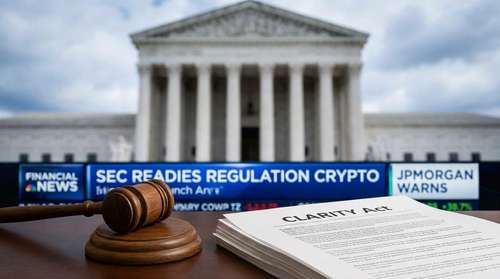
The U.S. Senate Banking Committee is poised for a historic showdown this Thursday as lawmakers prepare to mark up the Digital Asset Market Clarity Act (CLARITY Act). With Bitcoin surging past $96,000 in anticipation, the legislation represents the most significant attempt yet to end the decade-long jurisdictional tug-of-war between the SEC and the CFTC. As Chairman Tim Scott (R-S.C.) pushes to finalize the bill before the midterm election cycle, a fresh clash has erupted over the inclusion of digital assets in 401(k) retirement plans, threatening to derail the bipartisan momentum.
The CLARITY Act: Ending the SEC vs. CFTC Turf War
Scheduled for a critical markup session on January 15, the CLARITY Act (H.R. 3633) aims to codify the elusive "rules of the road" that industry leaders have demanded for years. The 278-page manager's amendment, released by Chairman Scott earlier this week, proposes a comprehensive "lane system" for token classification. Under the new framework, assets that are sufficiently decentralized would be classified as "ancillary assets"—commodities under the jurisdiction of the Commodity Futures Trading Commission (CFTC)—while those relying on active management would remain under the Securities and Exchange Commission (SEC).
Crucially, the bill introduces an "ETF gatekeeping" clause. This provision suggests that any network token serving as the principal asset of an exchange-traded product listed before January 1, 2026, effectively bypasses future securities litigation. For major assets like Bitcoin and Ethereum, this offers an immediate legal shield, a development that has fueled the current market rally. Institutional investors view this as the green light they have been waiting for, potentially unlocking trillions in capital currently sitting on the sidelines.
Warren Leads Resistance Against Crypto in 401(k) Plans
Despite the bill's momentum, it faces fierce opposition from the committee's Ranking Member, Senator Elizabeth Warren (D-Mass.). In a sharply worded letter sent Monday to SEC Chair Paul Atkins, Warren warned that the legislation, combined with President Trump's recent executive orders, could create a "tokenization loophole" that endangers American retirement savings.
The Retirement Savings Battleground
Warren's primary contention centers on the integration of volatile digital assets into 401(k) plans. She argues that the CLARITY Act would weaken the SEC's ability to police the "wild west" of crypto, allowing financial firms to push high-risk tokens into the portfolios of unsuspecting workers. "For most Americans, their 401(k) represents a lifeline to retirement security rather than a playground for financial risk," Warren wrote, urging Chair Atkins to provide detailed responses on investor protection measures by late January.
This political friction highlights a deep philosophical divide in the Senate Banking Committee. While Republicans frame the CLARITY Act as a necessary step to keep financial innovation within the United States, Democrats aligned with Warren fear it capitulates to industry lobbyists at the expense of consumer safety. The markup session is expected to be contentious, with multiple amendments likely to be introduced regarding consumer disclosures and liability standards for decentralized finance (DeFi) protocols.
Stablecoins and the Banking Sector Compromise
One of the bill's most debated sections addresses the lucrative relationship between stablecoins and the traditional banking sector. In a concession to banking lobbyists, the latest draft prohibits crypto companies from paying yield or interest solely for holding a payment stablecoin. This provision is designed to prevent non-bank stablecoin issuers from acting like unregulated banks, a major concern for traditional financial institutions fearing deposit flight.
However, the bill leaves the door open for "activity-based" rewards, allowing users to earn incentives for specific network participation or transactions. This nuance has been welcomed by DeFi proponents, who argue that banning all yield would stifle the programmable money revolution. The compromise suggests that lawmakers are attempting to thread the needle between protecting the incumbent banking system and allowing the digital asset economy to function.
Market Reaction: Bitcoin Eyes $100k Amid Regulatory Hopes
The crypto markets have responded explosively to the news of the impending markup. Bitcoin (BTC) broke through resistance levels to trade above $96,000 on Wednesday, driven by speculation that a clear regulatory framework is finally imminent. Analysts at major desks are targeting the psychological $100,000 barrier, citing the CLARITY Act as the "missing link" for the next phase of the bull market.
Market sentiment is heavily heavily influenced by the belief that the current political landscape—with a Republican-led Senate and a pro-crypto administration—favors the bill's passage. However, traders remain cautious. Any delay in the markup process or significant dilution of the bill's core provisions could trigger a swift correction. As the Senate Banking Committee convenes this Thursday, the eyes of the entire financial world will be fixed on Capitol Hill, waiting to see if the U.S. finally grants crypto the clarity it craves.