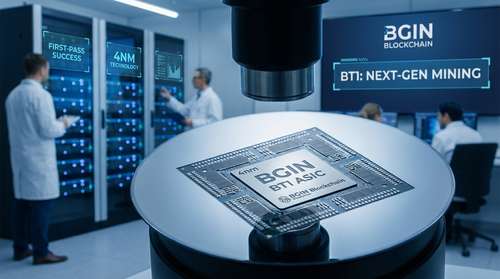
In a milestone development for the cryptocurrency infrastructure sector, BGIN Blockchain Limited has officially announced first-pass silicon success for its proprietary 4nm BT1 chip. For investors following BGIN Blockchain NASDAQ updates, entering the tape-out phase in October 2025, this breakthrough 4nm Bitcoin ASIC marks the company's ambitious leap into the top tier of Bitcoin mining hardware 2026. As the global mining industry faces escalating demands for processing power and reduced energy consumption, this semiconductor silicon success positions BGIN as a formidable competitor in the rapidly evolving digital asset landscape.
The Dawn of a New Era in Mining Infrastructure
The competitive arms race in cryptocurrency mining is historically defined by process node advancements, and the 4nm threshold is the current frontier. Tuesday's announcement validates the technical viability of the BGIN BT1 chip, signaling its transition from the design and tape-out phase into rigorous system-level testing. By confirming this initial silicon validation, the company has effectively mitigated the highest-risk and most capital-intensive stages of advanced semiconductor development.
For an industry seeking better margins, next-gen mining technology is no longer optional—it is a baseline requirement. The leap to a 4nm architecture ensures a massive increase in transistor density on a smaller silicon die. This density drastically enhances the hash rate output while conserving power, hitting the sweet spot for sustainable, energy efficient crypto mining.
Strategic Pivot: From Altcoin Roots to Mainstream Bitcoin
BGIN is not a newcomer to the hardware manufacturing space. Operating largely under its widely recognized ICERIVER brand, the company built a strong foundation designing 12nm and 8nm chips targeting alternative digital assets like KAS, ALPH, and RXD. However, the introduction of the BT1 represents a massive strategic pivot toward the core of the digital asset ecosystem.
Leadership Perspectives on the BT1 Evolution
BGIN Chairman Oisin Li recently characterized the company's previous operations as a necessary stepping stone. "Altcoin mining was our training ground; Bitcoin is where we apply those lessons at scale," Li stated regarding the transition. He emphasized that moving from alternative coins to Bitcoin reflects the natural progression of their engineering capabilities and a strategic decision to focus on the most resilient segment of the blockchain. This evolution highlights a broader trend of infrastructure providers migrating toward assets viewed as critical layers of global finance rather than speculative opportunities.
Engineering Excellence and Rapid R&D Execution
Executing a flawless tape-out at the 4nm node is notoriously complex, requiring immense precision and capital. Yet, this recent announcement marks the company's seventh consecutive successful tape-out across its ASIC mining programs since 2022, culminating in this high-performance 4nm Bitcoin ASIC. According to CEO Allen Wu, achieving first-pass validation demonstrates the firm's exceptional execution capabilities within advanced process nodes.
With the initial silicon validated, the BT1 is currently undergoing comprehensive stability and performance evaluations. This semiconductor silicon success proves that their rapid design cycle is effective. These system-level tests are critical before the hardware enters mass production. The successful execution of this multi-generation roadmap not only accelerates time-to-market but also builds confidence among institutional miners looking to deploy next-gen mining technology at scale.
Paving the Way for Energy Efficient Crypto Mining
As regulatory scrutiny around the environmental impact of proof-of-work networks intensifies globally, the demand for sustainable solutions has never been higher. By utilizing a 4nm fabrication process, the BGIN BT1 chip is engineered to significantly improve joules-per-terahash efficiency.
Management has already confirmed that early development is underway for even more advanced architectures aimed at maximizing power conservation. For data centers and industrial-scale miners hosting thousands of machines, upgrading to 4nm hardware directly translates to drastically reduced cooling requirements and operational overhead. With a current hosting capacity of over 47 megawatts across five locations, BGIN is well-positioned to leverage these efficiencies internally while supplying external clients.
Market Outlook for BGIN Blockchain NASDAQ Investors
The financial markets have closely monitored this transition. For stakeholders tracking BGIN Blockchain NASDAQ performance, the successful BT1 tape-out serves as a major de-risking event. While the company reported total revenues of $47.7 million in the first half of 2025 alongside a net loss due to aggressive R&D expansion, commercializing a top-tier Bitcoin ASIC could significantly transform its financial trajectory.
By capturing market share in the competitive landscape of Bitcoin mining hardware 2026 alongside established giants, BGIN stands to diversify its income away from the volatility of niche altcoins. As the BT1 completes its final testing phases and moves toward mass production, the broader industry will be watching closely to see how this technical achievement translates into real-world hashing dominance.