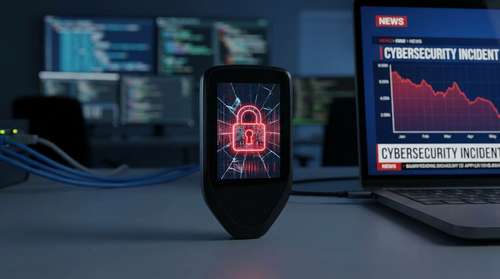
For years, cryptocurrency investors viewed offline devices as the impenetrable fortress of digital asset protection. That illusion shattered this week following a catastrophic Coldcard hardware wallet exploit that allowed unknown attackers to drain over $100 million in Bitcoin. The sophisticated attack targeted a fundamental flaw in the device's internal random number generator, triggering widespread panic across the industry. Over the last 48 hours, on-chain data shows a massive exodus of roughly 39,600 BTC shifting from small self-custody wallets onto centralized exchanges as fearful users scramble to secure their funds.
Anatomy of the Predictable Seed Phrase Bug
At the heart of this crisis is a devastating predictable seed phrase bug stemming from a firmware update originally released in March 2021. Rather than utilizing the secure, dedicated hardware random number generator (RNG) built into the silicon chips, a simple coding error forced the wallet software to fall back on a deterministic software-based generator.
Security engineers at Block recently discovered that a specific code macro intended to verify the hardware RNG was incorrectly configured. Because the system read this value as zero, the firmware defaulted to a MicroPython fallback called Yasmarang. This software generator initialized its state using easily identifiable metrics, such as the microcontroller's internal timer registers and serial number. This mistake effectively slashed the device's cryptographic entropy—the randomness that makes a private key mathematically impossible to guess—from a robust 128 bits down to a brittle 72 bits.
Hackers never needed physical access to any compromised devices. Instead, they reverse-engineered the weakened algorithm and ran automated scripts offline to generate millions of potential recovery phrases until they found matching balances. The Coldcard Mk3 firmware vulnerability was heavily exploited, though seed phrases generated on Mk4, Mk5, and Q models prior to recent emergency patches were equally exposed.
The Scope of the Coldcard Bitcoin Hack
Blockchain investigators at Galaxy Research pinpointed the exact moment the nightmare began. In a highly coordinated 41-minute window early on July 30, 2026, an attacker quietly swept 1,082 BTC from nearly 1,200 distinct addresses. As the weekend progressed, subsequent waves of the Coldcard Bitcoin hack pushed the total theft past 1,367 BTC, valued well over $100 million at current market rates.
The thief executed these transactions methodically. Every unauthorized transfer featured an unusually high mining fee to ensure immediate block confirmation and left absolutely no change outputs. This specific pattern confirms the attackers possessed the raw private keys and simply batched automated withdrawal commands across the Bitcoin network. Cybersecurity analysts suspect the vulnerability lived unnoticed in the wild for five years before independent hackers discovered the flaw and weaponized it.
A Stress Test for Bitcoin Cold Storage Security
The psychological impact on the broader market has been immediate and severe. The core ethos of digital assets is financial sovereignty, but this incident violently exposes a massive crypto self custody risk. When an investor acts as their own bank, a single point of failure in their operational security—or in this case, the manufacturer’s underlying code—can result in absolute financial ruin.
In the aftermath, fierce debate has erupted across community forums regarding software licensing. Critics argue that when Coinkite transitioned its codebase from fully open-source to a restricted 'source verifiable' model in 2021, it inadvertently limited the pool of independent security researchers analyzing the code. Had the code remained entirely open, proponents argue, this glaring entropy failure might have been flagged years before hackers exploited it.
Retail and institutional holders are suddenly recalibrating their risk models. Fearing hidden supply chain vulnerabilities or lingering software flaws in other devices, tens of thousands of Bitcoin have flooded back into major trading platforms. While centralized exchanges carry inherent counterparty risks, this sudden flight to familiar custodial services highlights a growing distrust in hardware solutions that were once considered the undisputed gold standard of Bitcoin cold storage security.
Stolen Bitcoin Wallet Recovery and Mitigation
If you suspect your funds have already been moved by an attacker, the reality of stolen bitcoin wallet recovery is incredibly grim. Once a hacker reconstructs a master seed and broadcasts a transaction, those assets are functionally gone, barred by the immutable nature of the blockchain. However, securing remaining funds is the absolute highest priority for users who haven't yet been targeted.
Immediate Actions for Coldcard Users
Coinkite has released emergency hotfixes (version 4.2.0 for Mk2/Mk3, 5.6.0 for Mk4/Mk5, and 1.5.0Q for Q models). Upgrading your firmware is mandatory, but it is crucial to understand that a software update does not repair a compromised seed. Because your original phrase was generated with flawed math, the key itself remains permanently weak.
To safely migrate your assets, follow these steps calmly to avoid making irreversible errors during a panic:
- Update your device to the latest patched firmware.
- Generate a completely new wallet seed on the updated hardware.
- Verify the new backup and carefully send a small test transaction.
- Transfer the remaining balance from the compromised addresses to the newly generated wallet.
The only exception to this mandatory migration applies to users who generated their initial seeds using at least 50 private, independent dice rolls, which provided sufficient physical entropy to bypass the software glitch entirely. As the fallout from this historic breach settles, the crypto industry is learning a harsh lesson: true security requires constant vigilance, and even the most trusted vaults can hide devastating invisible cracks.