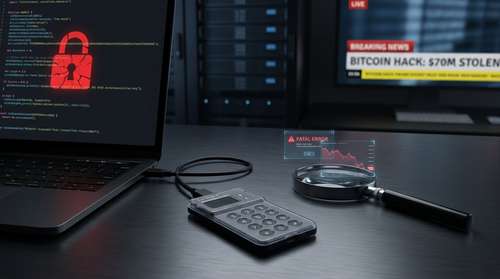
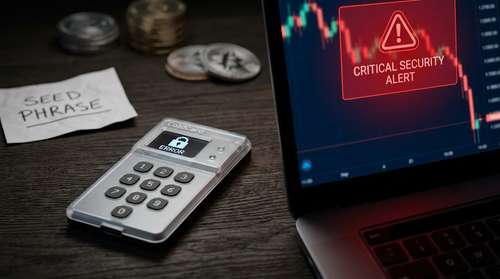
The ongoing Coldcard wallet exploit has fractured confidence in the cryptocurrency industry's gold standard for digital asset protection. In a highly sophisticated attack, hackers have successfully drained 1,367 BTC—valued at approximately $88.6 million—from 4,585 victim addresses. The sheer scale of the theft triggered an unprecedented wave of panic among retail investors, resulting in the highest volume of small-value self-custody transfers since the catastrophic collapse of FTX in November 2022.
Anatomy of the Coinkite Firmware Bug
The vulnerability stems from a severe Coinkite firmware bug that remained undetected in the open-source code for over five years. According to security analysts, the crisis originated from a catastrophic crypto wallet entropy flaw introduced in the Mk3 firmware version 4.0.1 in March 2021.
Instead of pulling randomness from the device's dedicated physical hardware random number generator (RNG) chip, a coding integration error forced the wallet software to rely on a fallback pseudorandom number generator. This critical bypass drastically reduced the entropy of affected devices from the strict cryptographic standard of 128 bits down to roughly 40 bits for the Mk3 model, and approximately 72 bits for newer models like the Mk4, Mk5, and Q.
Because the entropy was artificially constrained, the devices generated highly predictable seed phrases. Attackers with sufficient computational resources were able to systematically brute-force these compromised private keys offline, completely bypassing the physical security of the air-gapped hardware wallets.
Why a Simple Firmware Update Is Not Enough
Coinkite swiftly released emergency firmware patches across all its release tracks to address the software flaw. However, security researchers stress a grim reality: installing the new firmware does absolutely nothing to secure a seed phrase that was already generated under the compromised conditions. The underlying mathematical weakness is permanently baked into the existing private key.
Owners of affected devices must update their hardware, generate a completely new seed phrase, and transfer their digital assets to the newly secured addresses. Restoring an old, compromised seed onto a newly updated device simply carries the vulnerability forward, leaving funds entirely exposed to the ongoing sweeps.
Tracing the Galaxy Research BTC Drain
Blockchain investigators began tracking the stolen funds immediately, revealing a highly organized and patient operation. The Galaxy Research BTC drain analysis showed that the theft did not occur organically over time, but rather in three meticulously coordinated attack waves.
Attackers reportedly gathered a massive list of vulnerable addresses generated by the flawed firmware over several months. Rather than stealing funds piecemeal and alerting the community, they waited until the cumulative balance justified exposing their zero-day methodology. The initial wave swept millions in a matter of minutes, followed by a second operation, and a subsequent third wave that alone captured an additional 207.7 BTC (roughly $13.2 million).
Security firms warn that this attack remains actively ongoing. Any wallet generated using the compromised firmware versions without an external passphrase remains at extreme risk of immediate liquidation.
Retail Panic Matches FTX Collapse Levels
The psychological impact on the broader market has been immediate and severe. Fear regarding hardware wallet security has driven retail holders to execute an astonishing volume of small transactions to rotate their keys or move to centralized platforms.
Data provided by CryptoQuant reveals that users moved over 39,600 BTC in sub-1 BTC transactions over a single day. Julio Moreno, head of research at CryptoQuant, confirmed this represents the largest movement by retail holders since November 16, 2022—just days after the FTX bankruptcy. The panic reflects a stark reality: users are scrambling to move their funds to exchanges, multi-signature setups, or unaffected devices manufactured by competitors like Trezor and Ledger.
Reigniting the Bitcoin Self Custody Debate
This catastrophic event has heavily reignited the Bitcoin self custody debate. For years, the rallying cry of "not your keys, not your coins" served as the foundational ethos for cryptocurrency holders. When the very tools designed to secure those keys contain fundamental flaws, the argument becomes significantly more complex.
While self-custody eliminates counterparty risk, it places the burden of technical execution entirely on the user and the hardware manufacturer. Industry veterans are now emphasizing that true security requires a multi-layered approach. Relying on a single point of failure—even an air-gapped device—is proving insufficient against sophisticated adversaries.
To protect against similar vulnerabilities in the future, security experts recommend the following active strategies:
- Use a BIP-39 Passphrase: Adding a 13th or 25th word that you memorize creates an entirely new wallet hidden behind the primary seed, effectively nullifying firmware entropy flaws.
- Physical Dice Rolls: Manually generating entropy via physical dice rolls bypasses the hardware RNG software entirely, ensuring true mathematical randomness.
- Multi-Signature Wallets: Distributing risk across different devices from various independent manufacturers prevents a single firmware bug from compromising your entire net worth.
As the crypto ecosystem digests the reality of this $88.6 million theft, the overarching focus must shift from blind trust in hardware brands to verifiable, layered security architectures.