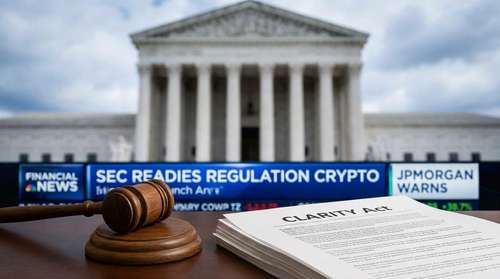

The landmark Digital Asset Market Clarity Act passed the US House of Representatives with a decisive 294-134 bipartisan vote in July 2025. Yet, months later, the most comprehensive piece of crypto legislation in American history is paralyzed. The CLARITY Act 2026 is currently trapped in a bitter lobbying war, creating a severe Senate Banking Committee crypto bottleneck. As the calendar marches toward April, industry executives and political analysts are sounding the alarm. If lawmakers cannot break the current deadlock over banking industry demands, the window to pass a comprehensive federal crypto framework 2026 will slam shut, leaving digital asset markets in legal limbo until at least 2027.
The Battle Over Stablecoin Yield Regulation
At the heart of the current legislative stalemate is a fierce dispute regarding stablecoin yield regulation. The traditional banking sector is heavily lobbying for an amendment that would prohibit digital asset platforms and exchanges from paying interest or rewards to customers who hold stablecoins on their platforms. Financial institutions argue that offering yield on these digital assets essentially functions as an uninsured savings account, bypassing the strict capital requirements and federal oversight that traditional banks face.
Crypto advocates view this restriction as a direct attack on their core business models. For companies like Coinbase, stablecoin-related revenue accounted for nearly 20% of their total revenue in the third quarter of 2025. Industry leaders characterize the proposed limits as a protectionist measure designed to safeguard traditional bank profits rather than a genuine consumer protection effort. This specific friction prompted Committee Chairman Tim Scott to postpone a scheduled markup session earlier this year. Despite President Donald Trump issuing a March 1 deadline for a resolution, the window passed without any consensus between the feuding lobbies.
The GENIUS Act Loophole
The current gridlock is an indirect consequence of the Guiding and Establishing National Innovation for U.S. Stablecoins (GENIUS) Act, which was signed into law in July 2025. While the GENIUS Act successfully established ground rules prohibiting stablecoin issuers from paying interest, it did not explicitly prevent secondary market intermediaries—such as crypto exchanges—from offering rewards on stablecoin balances. The banking lobby is now using the CLARITY Act as a legislative vehicle to forcibly close that perceived loophole.
April Deadline: A Terminal Threat
Time is rapidly running out to alter the Digital Asset Market Clarity Act status before election-year politics consume the entire legislative calendar. Alex Thorn, head of firmwide research at Galaxy Digital, recently warned that if the legislation fails to clear the committee stage by the end of April, the odds of passage this year drop to near zero. To survive, the legislation realistically needs to reach the Senate floor by early May.
Investment bank TD Cowen issued a similarly stark warning. Analysts noted that if Democratic lawmakers stall the vote beyond the midterm elections, market structure legislation might not pass until 2027—and potentially wouldn't take effect until 2029. Compounding the pressure, Senate Majority Leader John Thune has indicated that the chamber is prioritizing other measures, such as the SAVE America Act, before addressing digital asset market structures.
Resolving the SEC vs CFTC Jurisdiction Bill Divide
If the legislation dies in committee, the industry loses its best immediate chance at resolving a chaotic regulatory environment. The core of the legislation acts as a definitive SEC vs CFTC jurisdiction bill. By formally defining most blockchain-native tokens as "digital commodities" rather than securities, the legislation shifts oversight of secondary market trading directly to the Commodity Futures Trading Commission (CFTC).
Under this framework, the Securities and Exchange Commission (SEC) retains authority over primary market fundraising and assets that function strictly as investment contracts. This clear division of power would finally end the era of regulation by enforcement that has frustrated institutional investors and driven crypto startups overseas.
Implications for Institutional Capital
Regulatory ambiguity remains the primary structural barrier preventing massive institutional capital from entering the digital asset market. Financial giants and asset managers refuse to build permanent payment rails on assets existing in a legal gray area. Passage of the CLARITY Act 2026 would provide the legal certainty required for banks to confidently integrate blockchain-based payment systems and ISO 20022-compliant digital assets like XRP and Stellar for high-volume cross-border settlements.
What's Next for US Crypto Regulation Updates?
With prediction markets showing wavering confidence in the bill's passage and industry leaders preparing for potential failure, the coming weeks are critical. Senator Angela Alsobrooks recently noted that both the banking and crypto lobbies will need to accept uncomfortable compromises to move forward, suggesting that neither side will walk away entirely satisfied.
If the stalemate persists, the status quo will reign supreme. The SEC will maintain its broad discretion to classify digital assets through expensive court battles, while institutional capital remains safely sidelined. For anyone tracking US crypto regulation updates, the end of April represents a terminal deadline. Without a sudden breakthrough on stablecoin yields, the United States risks surrendering its competitive edge in digital asset innovation for another long legislative cycle.