
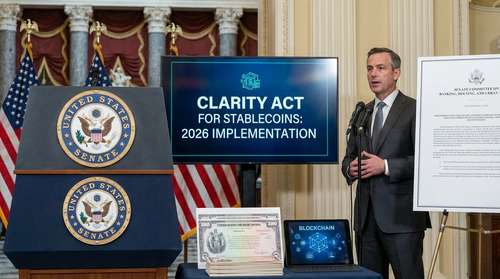
On February 4, 2026, Senate leaders convened a high-stakes, closed-door meeting to finalize the Clarity for Payment Stablecoins Act (CLARITY Act), a landmark piece of legislation poised to redefine the U.S. financial landscape. As lawmakers debate the final provisions, the bill promises to formally transition digital dollars from speculative instruments into regulated pillars of the national payment infrastructure. By mandating a rigid 1:1 Treasury backing for all payment stablecoins, the Act effectively creates a new "narrow bank" model, signaling the most significant shift in U.S. digital asset regulation since the inception of cryptocurrency.
The 'Narrow Bank' Mandate: Redefining Digital Dollars
The core of the new legislation lies in its strict reserve requirements. Unlike traditional fractional reserve banking, where deposits are lent out to fuel credit expansion, the CLARITY Act demands that stablecoin issuers hold 100% of their reserves in cash or short-term U.S. Treasury bills. This provision aims to eliminate the liquidity risks that plagued early crypto markets, ensuring that for every digital dollar in circulation, a physical equivalent exists in a secure vault.
This shift toward a stablecoin banking integration model has drawn praise from risk-averse institutional investors but criticism from those who profit from yield-bearing products. By treating stablecoin issuers as "narrow banks," the Federal Reserve aims to create a run-proof payment layer. "We are essentially building a digital upgrade to the cash system," noted a senior legislative aide familiar with the negotiations. "The goal is instant, risk-free settlement, not credit creation."
Closing the Loophole: The GENIUS Act 2026 Context
The push for the CLARITY Act cannot be understood without looking at its legislative predecessor, the GENIUS Act 2026 framework. While previous measures established basic guardrails, they left significant gaps regarding third-party yields and affiliate rewards. The CLARITY Act seeks to close these loopholes specifically through the controversial "Section 404," which would prohibit exchanges and digital asset service providers from paying interest solely for holding payment stablecoins.
This distinction is crucial for Federal Reserve stablecoin oversight. Regulators argue that if a stablecoin generates yield, it functions like a security or a bank deposit, requiring FDIC insurance. By enforcing a non-interest-bearing standard for the tokens themselves, Congress is drawing a hard line between institutional crypto settlement tools and investment products.
The Cryptocurrency Market Structure Act and Institutional Settlement
Parallel to the stablecoin specific provisions, the broader Cryptocurrency Market Structure Act is being harmonized to support this new ecosystem. The integration of stablecoins into federal banking rails means that digital assets could soon settle trades on Wall Street with the same legal finality as FedWire transfers. This development is massive for global finance, potentially reducing settlement times from days to seconds.
Major financial institutions are already preparing for this reality. With the regulatory fog lifting, banks are exploring how to utilize these government-sanctioned digital dollars for cross-border trade and wholesale interbank clearing. The vision is a seamless, 24/7 payment network that leverages blockchain speed while enjoying the safety of sovereign debt backing.
Industry Reaction: The Battle Over Yield
The transition hasn't been without friction. Crypto exchanges, which rely heavily on revenue from stablecoin rewards programs, have lobbied fiercely against the strict "narrow bank" constraints. They argue that removing yield reduces the incentive for consumer adoption. However, community bankers have sided with the Senate's approach, fearing that high-yield digital dollars could siphon trillions in deposits away from local lenders if left unchecked.
As the Senate moves toward a final vote, the message is clear: the Wild West era is over. The Clarity for Payment Stablecoins Act represents the maturation of crypto into a boring, reliable, and integral part of the American economy. By 2027, the digital dollar in your wallet may be indistinguishable—legally and structurally—from the physical greenback, save for the speed at which it moves.