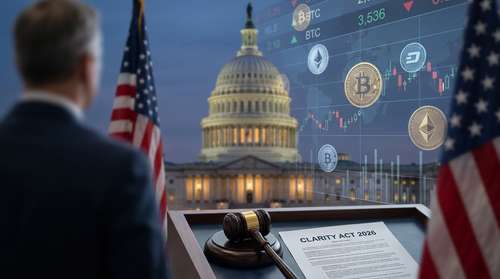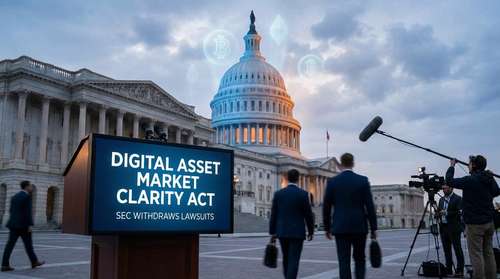
In a historic pivot for United States financial policy, the regulatory landscape has experienced an unprecedented shift this week. In a stunning reversal, the Securities and Exchange Commission (SEC) has formally withdrawn seven high-profile enforcement actions against industry titans, effectively ending the contentious SEC vs Coinbase Binance era. Amidst this regulatory rollback, Paul Atkins SEC chair and Treasury Secretary Scott Bessent have publicly demanded the immediate passage of the Clarity Act crypto bill to solidify long-term regulatory frameworks for digital assets.
The SEC Drops Major Crypto Lawsuits in Historic Policy Reversal
On April 8, 2026, the SEC confirmed the dismissal of legacy enforcement actions initiated by the previous commission against major cryptocurrency platforms. The SEC crypto lawsuits withdrawn include litigation against Coinbase, Binance, Kraken, Consensys, Cumberland DRW, Dragonchain, and Balina. The regulatory agency cited an insufficient legal basis under federal securities laws for pursuing these specific institutions.
This decision represents a monumental victory for the digital asset space, putting an end to years of regulation by enforcement. Rather than pursuing foundational platforms, the agency is now pivoting its resources to combat substantive, malicious fraud. As part of this transition, the SEC has established a Cyber and Emerging Technologies Division to tackle illicit activities directly. Recent enforcement has already targeted a $198 million fraud scheme involving PGI Global, misleading claims by Unicoin, and illegal fundraising by AI startup Nate, Inc..
While the withdrawal of these lawsuits effectively wipes the slate clean, officials warn that the industry cannot thrive on agency discretion alone. This is where comprehensive US crypto regulation 2026 becomes an urgent necessity.
Treasury Secretary Scott Bessent Sounds the Alarm
Recognizing the fragile nature of policy shifts, U.S. Treasury Secretary Scott Bessent published a forceful op-ed in the Wall Street Journal this week, calling for Congress to cement these new standards. The Scott Bessent Treasury crypto strategy heavily emphasizes passing the stalled Digital Asset Market Clarity Act (H.R. 3633) before the 2026 midterm elections shrink the legislative window.
Bessent argued that without a formalized framework, the massive digital asset sector—which has fluctuated between $2 trillion and $3 trillion in global market capitalization over the past year—remains vulnerable. He highlighted that fragmented oversight pushes essential blockchain innovation and institutional capital toward jurisdictions like Singapore and Abu Dhabi. By clearly defining which digital assets qualify as securities and which fall under the Commodity Futures Trading Commission (CFTC), the legislation aims to protect consumers while keeping the United States at the forefront of financial technology.
Paul Atkins SEC Chair Backs "Project Crypto" Readiness
Echoing the urgency emanating from the Treasury Department, SEC Chair Paul Atkins publicly aligned with Bessent's push for the Clarity Act crypto bill. Taking to social media on April 9, Atkins stated that the commission has already developed "Project Crypto," an internal initiative designed to operationalize the new law the moment Congress acts.
Atkins emphasized that lawmakers must "future-proof against rogue regulators" and advance the comprehensive market structure legislation to President Trump's desk. Having the Paul Atkins SEC chair leadership publicly champion legislation that deliberately limits and defines SEC jurisdiction is a stark departure from the agency's previous turf wars. He recently referred to the U.S. as "the Crypto Capital of the World," pledging to bridge innovators to this landmark legislation.
What the Digital Asset Market Clarity Act Will Solve
The Digital Asset Market Clarity Act passed the House of Representatives in July 2025 with a bipartisan 294-134 vote but has stalled in the Senate for 266 days. If passed, it will introduce a definitive decentralization threshold. Tokens meeting this threshold would be classified as digital commodities under CFTC oversight, while those failing to meet the criteria would remain SEC-regulated investment contracts.
Currently, prediction markets like Polymarket price the bill's passage at roughly 62% for 2026. With the recent dismissal of the SEC vs Coinbase Binance lawsuits, the passage of this legislation would finally provide these platforms with the precise compliance frameworks they have requested for years, resolving lingering disputes over stablecoin yields and traditional banking integrations.
The Path Forward for Crypto Innovation
As the Senate grapples with final negotiations, the coordinated pressure from the highest levels of financial leadership might be the catalyst needed to cross the finish line. The SEC crypto lawsuits withdrawn this week prove that the executive branch is willing to correct past overreach, but sustainable market growth requires statutory permanence.
For investors, innovators, and institutions watching from the sidelines, the message from Washington is clear: the era of hostility has ended. Now, it is entirely up to Congress to pass the Clarity Act crypto bill and secure a predictable future for the digital economy.