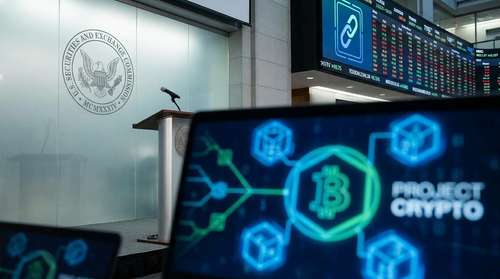
The regulatory headwinds that historically pushed digital asset innovators out of the United States are officially reversing course. Speaking at the Economic Club of New York this week, Securities and Exchange Commission Chairman Paul Atkins outlined a sweeping overhaul of federal oversight through SEC Project Crypto. The initiative is a calculated pivot designed to transition traditional financial infrastructure onto blockchain rails, effectively abandoning the agency's previous era of regulation by enforcement.
Atkins did not mince words regarding the urgency of this transition. By establishing clear regulatory guardrails, the agency aims to fulfill the administration's mandate of making the United States the undisputed US crypto capital of the world. With new frameworks rolling out, the timeline for integrating decentralized ledger technology with legacy banking is moving faster than most institutional players anticipated.
Accelerating On-Chain Financial Markets
The centerpiece of the chairman's address focused heavily on modernizing legacy securities rules to support on-chain financial markets. For years, the intersection of blockchain technology and traditional finance has been plagued by legal ambiguity. Institutions wanted the efficiency of instant settlement and programmatic compliance, but lacked the regulatory green light to launch products at scale.
That barrier is systematically being dismantled. Atkins explicitly detailed that the agency has taken historic steps to ensure that stocks, bonds, and other traditional assets can operate seamlessly on blockchain networks. Rather than forcing decentralized technology to fit into outdated compliance boxes, the SEC is actively tailoring disclosure requirements and trading frameworks to match the reality of tokenized infrastructure.
The Arrival of Tokenized Bank Deposits
Perhaps the most significant near-term catalyst revealed during the New York address was the rapid timeline for banking integration. Atkins announced that regulators expect to see tokenized bank deposits fully operational in the United States by next year. This development would act as a massive bridge between traditional fiat banking and blockchain ecosystems.
By authorizing tokenized deposits, federal regulators are opening the door for commercial banks to issue digital liabilities directly on distributed ledgers. This infrastructure allows instantaneous, round-the-clock cross-border settlement without relying on volatile stablecoins or fragmented payment networks. The move fundamentally shifts the narrative from speculative token trading toward the wholesale modernization of global financial plumbing.
The SEC CFTC MOU 2026: Ending Jurisdictional Turf Wars
Institutional adoption requires certainty, which is impossible when federal agencies dispute their own oversight boundaries. To resolve this, Atkins highlighted the critical SEC CFTC MOU 2026, a landmark memorandum of understanding advancing collaborative digital asset regulation. The formal agreement between the SEC and the Commodity Futures Trading Commission represents a total reset of how Washington handles digital assets.
Instead of battling over who controls the market, the two regulatory bodies have established joint standards and a unified approach to oversight. The agencies now share data, cross-train staff, and hold regular coordination meetings. This collaborative environment ensures that companies launching novel digital products do not fall into a regulatory no-man's land where conflicting agency mandates paralyze innovation.
Establishing a Clear Digital Asset Taxonomy
The most tangible result of this inter-agency cooperation is the newly implemented digital asset taxonomy. Introduced earlier this year, this framework officially categorizes tokens based on their underlying utility, recognizing digital commodities, collectibles, tools, and tokenized securities.
Crucially, the SEC has conceded that the vast majority of digital assets do not classify as securities. Under the new Paul Atkins crypto regulation policies, developers finally have a coherent legal map. Builders shipping base-layer network tokens or managing decentralized staking protocols now know exactly where their products stand before writing a single line of code, significantly reducing the paralyzing fear of retroactive lawsuits.
Reclaiming the Innovation Crown
The broader economic implications of Project Crypto extend far beyond domestic compliance. For the better part of a decade, regulatory hostility triggered a massive corporate exodus, forcing top-tier blockchain talent to build in friendlier jurisdictions across Europe and Asia. The SEC's sweeping policy reversal is a direct attempt to reshore this multi-trillion-dollar industry.
The message from the government is unequivocal. By offering proactive guidance for tokenized collateral, clarifying custody rules, and encouraging the tokenization of real-world assets, federal watchdogs are incentivizing financial technology to return home. As tokenized deposits launch and the new classification rules take root, the United States is positioning itself not just to participate in the next decade of digital finance, but to outright lead it.