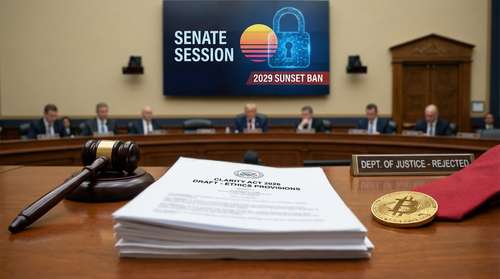
The United States digital asset industry has officially reached a historic turning point. After years of intense friction and jurisdictional overlap, the SEC and CFTC have successfully ended their decade-long turf war. Through a landmark 68-page SEC CFTC joint crypto guidance release issued on March 17, 2026, regulators have established a definitive regulatory roadmap, formally categorizing 16 major cryptocurrencies as 'digital commodities' rather than securities. This unprecedented inter-agency coordination, coupled with the latest CLARITY Act Senate update, effectively closes the chapter on the controversial 'regulation by enforcement' era and opens the floodgates for widespread institutional adoption.
The Official Digital Commodity List 2026
The joint interpretive release introduces a groundbreaking five-part token taxonomy designed to bring order to the market: digital commodities, digital collectibles, digital tools, stablecoins, and digital securities. The most highly anticipated element of this framework is the official digital commodity list 2026, which explicitly names major network tokens that now fall exclusively under the jurisdiction of the Commodity Futures Trading Commission (CFTC).
The explicitly named digital commodities include Bitcoin (BTC), Ethereum (ETH), Solana (SOL), XRP, Cardano (ADA), Avalanche (AVAX), Chainlink (LINK), Polkadot (DOT), Litecoin (LTC), and several others. To qualify under this newly clarified classification, an asset must derive its core value from the programmatic operation of a functional blockchain system driven by supply-and-demand dynamics. It must be completely detached from the "essential managerial efforts" of a centralized corporate entity—effectively bypassing the traditional Howey test constraints for these decentralized networks.
By officially shifting these assets away from the Securities and Exchange Commission's strict securities framework, regulators have cleared the path for broader exchange listings, validated staking yield products, and a massive wave of new exchange-traded funds (ETFs). Within days of the announcement, digital asset markets witnessed billions in net inflows as major institutional compliance departments finally received the clear legal green light to invest heavily in the sector.
Solana Security Status and the Historic XRP Commodity Ruling
For two of the market's most heavily debated assets, this joint guidance delivers total vindication. The Solana security status has been a lingering dark cloud since the SEC previously flagged the high-speed token in various exchange enforcement actions. Despite regulatory headwinds, developers and users continued to build a thriving decentralized finance (DeFi) ecosystem, but institutional capital remained hesitant. Now categorized firmly as a digital commodity, Solana is entirely free from regulatory purgatory, giving its ecosystem permission to scale without fear of sudden compliance crackdowns.
Equally significant is the historic XRP commodity ruling. Ripple spent over four years and hundreds of millions of dollars battling the SEC in federal court over whether its native token was an unregistered investment contract. The March 2026 joint ruling firmly settles the debate, restoring XRP to major trading platforms without the looming threat of secondary market liabilities. This legal clarity ensures that financial infrastructure providers, enterprise custodians, and global payment networks can leverage the token's inherent utility without running afoul of federal securities laws.
CLARITY Act Senate Update: The Race for Permanent Law
While the joint agency guidance provides massive immediate relief, it remains an interpretive administrative rule. To cement this framework into permanent U.S. law, Congress must pass the pending Digital Asset Market Clarity Act. The latest CLARITY Act Senate update reveals that lawmakers are racing against a tight legislative clock. After passing the House with bipartisan support in 2025, the legislation is now heading for a critical Senate Banking Committee markup scheduled between April 13 and April 20.
A central friction point in the current Senate negotiations involves the treatment of stablecoin yields. Recent closed-door meetings on Capitol Hill indicate a coordinated push by traditional banking representatives to ban crypto platforms from offering passive yield on stablecoin balances. The traditional banking sector argues forcefully that allowing digital asset exchanges to offer high-yield returns could trigger widespread deposit flight from regional banks. Lawmakers are currently attempting to strike a delicate compromise that protects blockchain innovation without destabilizing the legacy banking sector.
How the GENIUS Act Stablecoins Framework Ties In
This fierce yield debate ties directly into the overarching framework established last year for GENIUS Act stablecoins. Enacted in July 2025, the Guiding and Establishing National Innovation for U.S. Stablecoins (GENIUS) Act mandates that issuers maintain 100% reserve backing with highly liquid assets like U.S. dollars or short-term Treasuries. While the GENIUS Act explicitly prohibited stablecoin issuers themselves from paying interest, the upcoming CLARITY Act seeks to close remaining structural loopholes. The new draft language aims to prevent secondary brokers, exchanges, and decentralized finance protocols from passing economically equivalent rewards down to retail users.
A Definitive Roadmap for Crypto Regulation US News
Anyone following crypto regulation US news understands that regulatory ambiguity has historically been the primary bottleneck stifling domestic blockchain innovation. The unprecedented convergence of the SEC and CFTC under a unified interpretive framework signals that the United States is finally ready to embrace the digital economy on a structural level.
With major network tokens now trading freely as recognized commodities, staking mechanisms explicitly placed outside restrictive securities laws, and rigorous consumer guardrails forming around stablecoin issuance, the digital asset market has fundamentally matured. As the Senate prepares to vote on the CLARITY Act this spring, the U.S. crypto industry transitions away from fighting existential legal battles and moves toward competing entirely on technological merit and financial infrastructure.