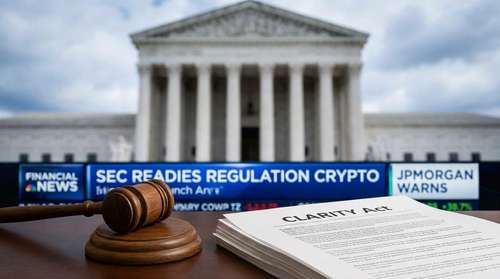

WASHINGTON, D.C. — In a historic shift for United States financial regulation, SEC Chair Paul Atkins and CFTC Chair Michael Selig have officially launched a landmark inter-agency collaboration to harmonize digital asset oversight. The initiative, widely referred to as Project Crypto 2026, promises to end the decade-long jurisdictional turf war that has stifled American innovation. By introducing a shared digital asset taxonomy and eliminating duplicative registration requirements, the agencies aim to position the U.S. as the undisputed global leader in the crypto economy.
A Unified Front: The SEC CFTC Joint Initiative
The announcement, made during a joint appearance at the CFTC headquarters earlier this week, marks a decisive pivot from the enforcement-heavy approach of previous administrations. For years, the industry has navigated a labyrinth of conflicting rules, with the Securities and Exchange Commission (SEC) and the Commodity Futures Trading Commission (CFTC) often claiming overlapping jurisdiction. The new SEC CFTC joint initiative seeks to dismantle these barriers.
"Modern markets do not divide neatly along regulatory lines," Paul Atkins, SEC Chair, stated during the rollout. "Trading, clearing, custody, and risk management now flow across asset classes and technologies. Fragmented regulation in an integrated market is not a safeguard for investors; it is a source of confusion. Project Crypto is our commitment to applying the minimum effective dose of regulation—no more, no less."
Defining the Rules: A Shared Digital Asset Taxonomy
At the heart of the initiative is the long-awaited codification of a shared digital asset taxonomy. For the first time, both agencies have agreed on a provisional framework to distinguish between securities, commodities, and a new category of "digital tools."
According to the newly released guidance, digital assets that function primarily as utilities, collectibles, or tools will not be classified as securities, even if they are initially sold as part of an investment contract. This "bright line" approach is intended to provide immediate crypto regulatory clarity while Congress finalizes broader market structure legislation.
"We are drawing clear boundaries," said Michael Selig, CFTC Chair. "Market participants have struggled for years with the basic question: 'Am I regulated by the SEC, the CFTC, or both?' Project Crypto answers that question. This is a generational opportunity to move beyond litigation and toward a durable, principles-based framework."
Streamlining US Crypto Market Oversight
Perhaps the most significant development for crypto exchanges is the move toward a unified registration regime. Under the Project Crypto 2026 roadmap, trading platforms that list both digital asset securities and digital commodities will no longer need to maintain separate, siloed legal entities for each activity.
This consolidation paves the way for the emergence of compliant "super-apps"—platforms that can offer a seamless experience for users trading everything from Bitcoin futures to tokenized equities. Chair Selig highlighted that this streamlined US crypto market oversight is essential for onshoring liquidity that has previously fled to offshore jurisdictions.
Modernizing Derivatives and Prediction Markets
Beyond the joint framework, the CFTC announced specific measures to modernize its own rulebook. Chair Selig confirmed that the agency is withdrawing the controversial 2024 proposed rule that would have banned political and sports-related event contracts. Instead, the CFTC will pursue a new rulemaking process to regulate prediction markets responsibly, acknowledging their value as hedging tools.
"We have the expertise and the responsibility to regulate these markets, not to ban them," Selig noted, signaling a more open stance toward financial innovation under the new administration.
Future-Proofing the Industry
While the joint initiative represents a massive leap forward, both Chairs emphasized that agency coordination is a bridge to statutory law, not a replacement for it. They pledged to work closely with the Senate Agriculture and Banking Committees to ensure that the principles of Project Crypto 2026 are enshrined in federal legislation.
The reaction from the industry has been overwhelmingly positive. Legal experts note that the collaboration between a deregulation-minded SEC and a modernized CFTC creates the most favorable environment for digital assets in U.S. history. By replacing turf wars with taxonomies, Atkins and Selig appear to have finally unlocked the regulatory deadlock.