
February 14, 2026 – The digital asset market is witnessing a historic resurgence today as Bitcoin (BTC) shattered the psychological $70,000 barrier, fueled by a landmark regulatory truce between U.S. financial watchdogs and cooling inflation data. SEC Chairman Paul Atkins and CFTC Chairman Michael Selig officially operationalized the joint "Project Crypto" taxonomy this morning, ending years of jurisdictional ambiguity that had stifled American innovation.
'Project Crypto' Ends the Turf War
In a joint press conference that industry veterans are calling a "turning point," Chairmen Atkins and Selig unveiled the finalized Project Crypto SEC CFTC taxonomy. This framework explicitly categorizes digital assets into three distinct buckets: digital commodities, investment contract assets, and permitted payment stablecoins. Crucially, the guidance clarifies that digital tools and collectibles are not securities—even when sold via investment contracts—provided the blockchain network is sufficiently decentralized.
"For too long, American innovators have operated in a regulatory no-man's-land," Atkins stated, referencing the aggressive "regulation by enforcement" era of his predecessor. "Project Crypto bridges the gap, allowing the SEC and CFTC to move from adversaries to partners in protecting investors while fostering the crypto capital of the world."
The Innovation Exemption
A key pillar of the new framework is the "Innovation Exemption," which grants a three-year safe harbor for decentralized projects to mature without facing immediate securities registration requirements. This move specifically targets the concerns raised during Paul Atkins' Senate testimony earlier this week, where he argued that premature compliance burdens were driving development offshore.
CLARITY Act Gains Senate Momentum
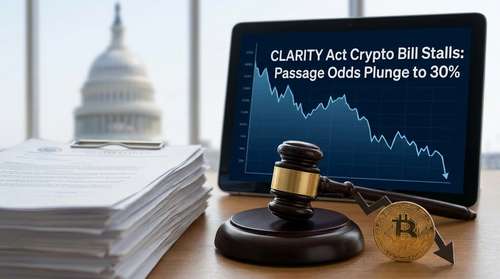
The regulatory clarity provided by the agencies has injected fresh urgency into the legislative process. The CLARITY Act news cycle heated up significantly following Atkins' testimony on February 12, where he urged the Senate Banking Committee to pass the legislation (H.R. 3633) to "future-proof" the new agency guidelines. The bill, which passed the House in July 2025, had stalled due to partisan disagreements over stablecoin yield provisions.
However, with the SEC crypto taxonomy now aligning with the bill's definitions, Senate leadership has indicated a willingness to bring the CLARITY Act to a floor vote before the spring recess. "The agencies have done the heavy lifting," remarked Senator Cynthia Lummis (R-WY). "Now it's time for Congress to codify this framework into law."
Bitcoin $70k Rally Fueled by Soft Inflation Data
The regulatory breakthrough coincided perfectly with favorable macroeconomic tailwinds. The Bureau of Labor Statistics released US inflation January 2026 data this morning, showing the Consumer Price Index (CPI) cooling to 2.4% year-over-year, beating analyst expectations of 2.6%. The "soft landing" narrative has emboldened institutional investors, driving the Bitcoin $70k rally as capital rotates back into risk assets.
"It's the perfect storm for a bull market," explained Maria Gonzalez, Chief Strategy Officer at Fidelity Digital Assets. "You have the removal of regulatory existential risk combined with a dovish macro environment. Institutions that were sitting on the sidelines fearing an SEC lawsuit are now deploying capital aggressively."
A New Era for US Crypto Regulation
As the crypto regulatory framework 2026 takes shape, the industry is already seeing tangible shifts. Major exchanges like Coinbase and Kraken have announced plans to register as "Digital Commodity Exchanges" under the new CFTC regime, a designation created by Project Crypto. This registration allows them to offer spot trading for assets deemed digital commodities—including Ethereum and Solana—with full federal compliance.
With the White House explicitly backing the initiative to make the U.S. the dominant force in the digital economy, the era of uncertainty appears to be closing. As Bitcoin holds steady above $70,000, the message from Washington is clear: America is open for business.