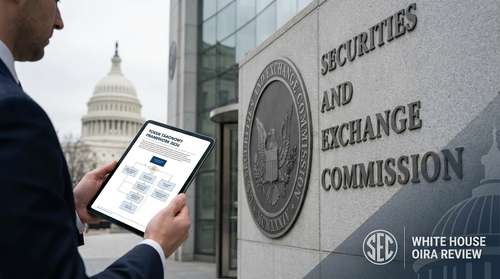
WASHINGTON, D.C. — In a decisive move to dismantle over a decade of regulatory ambiguity, the U.S. Securities and Exchange Commission (SEC), led by Chairman Paul Atkins, has officially submitted a comprehensive interpretive guidance framework to the White House for review. Filed on March 3, 2026, the document establishes a definitive 'Token Taxonomy' framework designed to clearly categorize digital assets and determine their jurisdictional status. This submission to the Office of Information and Regulatory Affairs (OIRA) represents the most significant development in SEC crypto regulation news this year, signaling a potential end to the era of "regulation by enforcement" and the beginning of a structured, transparent market environment.
The 'Token Taxonomy' Framework: Defining Digital Assets
The core of the submission, titled "Commission Interpretation on Application of the Federal Securities Laws to Certain Types of Crypto Assets," is the establishment of a four-part classification system. This framework, which Chairman Atkins first previewed during his "Project Crypto" speeches in late 2025, aims to provide precise guardrails for issuers and exchanges.
Under the new Token Taxonomy framework, digital assets are categorized based on their economic reality rather than their technological format. The guidance proposes four distinct categories:
- Digital Commodities (Network Tokens): Assets inherent to a functional, decentralized blockchain network are classified as commodities, placing them outside SEC jurisdiction.
- Digital Collectibles: Assets designed for collection or specific non-financial utility (such as NFTs) are not considered securities.
- Digital Tools: Tokens that provide access to a service or function (utility tokens) are exempt from securities registration.
- Tokenized Securities: Assets that represent a financial interest in an enterprise or a claim on profits remain under strict SEC oversight.
"Economic reality trumps labels," Atkins stated in the submission's accompanying memorandum. "Calling something a token does not exempt it from the law, but neither does using a blockchain automatically make an asset a security. This framework respects that distinction."
White House OIRA Review: A Critical Procedural Step
The submission is currently undergoing a White House OIRA review, a mandatory process for all significant regulatory actions. The Office of Information and Regulatory Affairs will evaluate the guidance for its economic impact and alignment with the administration's broader policy goals. Unlike previous staff-level bulletins (such as the controversial SAB 121), this is a Commission-level interpretation, meaning it carries significantly more legal weight and enforceability once finalized.
Legal experts anticipate a swift review process, given the administration's stated goal of making the U.S. the "crypto capital of the world." However, the OIRA review is not merely a formality; it ensures that the crypto securities law 2026 landscape is consistent across federal agencies, preventing jurisdictional friction between the SEC and the Commodity Futures Trading Commission (CFTC).
Building on the GENIUS Act: The Legislative Context
The SEC's move comes nearly eight months after the historic passage of the GENIUS Act stablecoins legislation (Guiding and Establishing National Innovation for U.S. Stablecoins Act) in July 2025. While the GENIUS Act successfully created a regulatory lane for payment stablecoins, the broader crypto market has remained in limbo due to the stalling of the Digital Asset Market Clarity Act (CLARITY Act) in Congress.
Bridging the Legislative Gap
With the CLARITY Act gridlocked by partisan disputes over decentralized finance (DeFi) provisions, the SEC's unilateral action is seen as a necessary stopgap. By codifying the "Token Taxonomy" through agency guidance rather than waiting for new legislation, Chairman Atkins is attempting to provide immediate relief to a market engaging in capital flight.
"The GENIUS Act solved the stablecoin equation," notes legal analyst Sarah Jenkins. "But the rest of the ecosystem—DeFi, governance tokens, and Layer-1 assets—was left waiting. This framework fills that vacuum, providing the certainty businesses need to stay in America."
Market Reaction and Bitcoin Price Volatility
The markets have reacted positively to the news, though cautious optimism remains the prevailing mood. Bitcoin price volatility today has been notable, with the asset trading firmly around the $66,200 mark as institutional investors digest the implications of the new framework. Analysts suggest that while the guidance creates a bullish long-term environment, short-term price action reflects traders waiting for the official OIRA clearance.
Major U.S. exchanges, which have faced years of litigation, issued statements welcoming the move. "For the first time, we have a clear rulebook," read a joint statement from the Crypto Council for Innovation. "This allows us to list assets with confidence and protects consumers without stifling innovation."
Paul Atkins SEC: A New Direction
Since his confirmation, Paul Atkins SEC leadership has been defined by a pivot away from the aggressive litigation strategy of his predecessor. This submission fulfills a key campaign promise to "demystify" securities laws for the digital age. By clearly defining what isn't a security, the SEC is effectively narrowing its own jurisdiction to focus resources on actual fraud and traditional investment schemes masquerading as crypto projects.
As the OIRA review proceeds over the coming weeks, the industry watches with bated breath. If approved, this framework will effectively rewrite the playbook for crypto securities law 2026, potentially unleashing a wave of institutional adoption and innovation that has been sidelined for years.