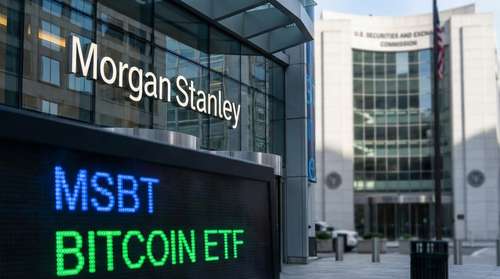
In a move that redefines the relationship between traditional finance and digital assets, global banking giant Morgan Stanley has submitted its second S-1 registration amendment to the U.S. Securities and Exchange Commission (SEC) for its spot Bitcoin ETF, set to trade under the MSBT ticker. The filing, submitted on March 18, 2026, signals a massive strategic pivot: the firm is transitioning from merely distributing third-party crypto products to establishing itself as a direct Wall Street issuer. If approved, the Morgan Stanley Bitcoin Trust will become the first spot Bitcoin ETF issued directly by a major U.S. bank.
A Watershed Moment for Institutional Bitcoin Adoption
For months, Morgan Stanley allowed its massive wealth management division to offer clients access to leading spot Bitcoin funds. By early 2026, the firm had already authorized its workforce of more than 15,000 financial advisors to proactively pitch digital asset portfolios rather than waiting for incoming client requests. However, stepping into the arena as a direct issuer fundamentally alters the economics of bank-issued crypto ETFs.
Instead of routing client capital into competitor funds and earning standard distribution commissions, issuing the Morgan Stanley Bitcoin ETF allows the bank to capture the underlying management fees directly. While the exact expense ratio remains redacted in the latest SEC S-1 filing, industry analysts estimate the fee will land competitively between 0.20% and 0.30%. With approximately $1.8 trillion in wealth management assets under its umbrella, even a fractional shift of client portfolios into the bank's proprietary digital asset fund represents a seismic shift for institutional Bitcoin adoption. This operational transition highlights how Wall Street's approach to decentralized assets has evolved from cautious skepticism to full-scale vertical integration.
Inside the MSBT Ticker: Custody, Seeding, and Mechanics
The updated SEC document provides the most comprehensive look yet at the operational infrastructure supporting the fund. Once trading commences on NYSE Arca, shares of the trust will be calculated daily using the CoinDesk Bitcoin Benchmark, specifically tracking the 4:00 PM New York settlement rate. This pricing mechanism aggregates trade data across major spot exchanges to ensure transparent, institutional-grade valuation.
To launch the product, Morgan Stanley outlined an initial seed structure involving the creation of 50,000 shares. This process is anticipated to generate around $1 million in starting proceeds, which will be used to acquire physical Bitcoin before the fund officially goes live. Furthermore, the bank has split its critical operational duties between two heavyweights in the institutional sector to mitigate counterparty risk:
- Physical Storage: Coinbase Custody Trust Company has been tapped to handle the actual Bitcoin, safeguarding the digital assets offline in highly secured cold wallets.
- Cash Management: Bank of New York Mellon (BNY Mellon) will act as the cash custodian, transfer agent, and primary fund administrator.
This dual-custodian model, supporting both cash and in-kind creations and redemptions, is designed specifically for the needs of institutional authorized participants who require maximum liquidity flexibility. By relying on established infrastructure providers, Morgan Stanley is streamlining the technical hurdles associated with a bank issued crypto ETF, reassuring regulators that physical coin management adheres to strict oversight standards.
The Evolving Wall Street Crypto News Landscape
The drive to launch a spot Bitcoin ETF 2026 product does not exist in a vacuum. Morgan Stanley is accelerating its digital strategy amid fierce competition across the legacy financial sector. According to market data from March 2026, the SEC is currently reviewing a massive backlog of over 126 pending crypto ETF applications. Traditional financial institutions now make up a growing share of this regulatory queue.
Competitors are not standing still. Goldman Sachs, for example, rapidly expanded its market footprint by acquiring Bitcoin ETF issuer Innovator for $2 billion in late 2025. That firm now manages over $2.4 billion in crypto exchange-traded products, adding significant pressure on Morgan Stanley to lock down market share. Offering an in-house ETF ensures that clients seeking exposure to the digital asset market remain fully within the bank's broader ecosystem.
Expanding Beyond Bitcoin: Ethereum, Solana, and Retail Trade
Looking ahead, the MSBT ticker appears to be just the first phase of a much broader digital asset rollout. Beyond the Bitcoin market, the bank has already submitted regulatory applications for a spot Ethereum ETF and a specialized Solana Trust. Notably, the proposed Solana product breaks new ground by including a staking component designed to distribute quarterly rewards directly to shareholders.
The financial institution has also authenticated plans to introduce retail crypto trading for core digital assets via its popular E-Trade application. In tandem with exchange-traded funds, digital asset strategy leadership has indicated that the bank is actively exploring supplementary offerings, such as institutional yield and lending services.
As regulatory frameworks mature and institutional guardrails strengthen, the impending approval of the Morgan Stanley Bitcoin Trust promises to solidify the bridge between legacy banking and decentralized assets. By bringing a comprehensive suite of digital products to market, Morgan Stanley is proving that the future of wealth management inevitably includes crypto at its core.