
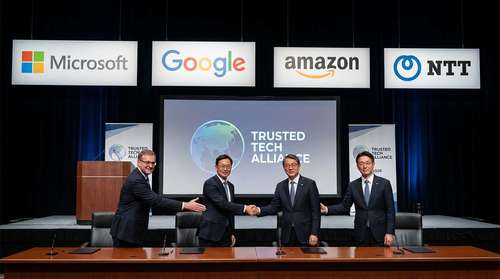
In a landmark move to bridge the growing divide between global technology innovation and national regulatory demands, a coalition of 16 global tech giants—including Microsoft, Google, Amazon (AWS), and NTT—has officially launched the Trusted Tech Alliance (TTA). Announced this week at the Munich Security Conference, this new consortium aims to define a unified Big Tech data framework that addresses the escalating geopolitical friction surrounding digital sovereignty 2026. By establishing standardized protocols for cross-border data credibility, the alliance seeks to mitigate the fragmentation of the global digital economy while ensuring nations maintain control over their critical digital infrastructure.
Defining a New Standard for Global Data Credibility
The formation of the Trusted Tech Alliance represents a direct response to the increasing patchwork of local data laws that have complicated operations for multinational technology providers. As governments worldwide—from the European Union to India and Japan—tighten regulations under the banner of digital sovereignty, the tech industry has faced a critical challenge: how to deliver seamless, global cloud and AI services while respecting strictly enforced national borders for data.
The TTA has introduced a set of global data credibility standards designed to serve as a universal baseline for trust. These standards focus on transparency, security, and legal compliance, ensuring that data flows can remain secure and verifiable regardless of where they are processed. "In the current geopolitical environment, it is critical that like-minded companies work together to protect security and advance high global standards to preserve trust in technology across borders," stated Microsoft President Brad Smith during the launch event.
The Five Pillars of the Trusted Tech Alliance
To operationalize their mission, the alliance members have committed to five core principles that will govern their operations and product development:
- Transparent Corporate Governance: Ensuring ethical conduct and clear accountability structures.
- Operational Transparency & Independent Assessment: Allowing third-party audits of security practices and development pipelines.
- Robust Supply Chain Oversight: Securing the entire technology stack, from semiconductors to software, against tampering or espionage.
- Open & Resilient Ecosystems: Promoting interoperability to prevent vendor lock-in and enhance digital trust infrastructure.
- Respect for Rule of Law: Strictly adhering to local data protection and privacy mandates.
A Historic Microsoft NTT Google Alliance
The composition of the alliance is as significant as its mission. Bringing together fierce competitors like Microsoft, Google Cloud, and AWS alongside telecommunications powerhouses like NTT, Ericsson, and Nokia signals a rare moment of industry unity. The coalition also includes AI leaders Anthropic and Cohere, as well as regional heavyweights like Jio Platforms (India), SAP (Germany), and Hanwha (South Korea). This diverse membership underscores the global nature of the challenge and the necessity for tech regulatory harmonisation.
For NTT and other telecom members, the alliance provides a crucial framework for building the next generation of secure connectivity. "There are no countries on this planet that alone can be fully sovereign," warned Börje Ekholm, CEO of Ericsson, highlighting the interdependence of the modern digital supply chain. By collaborating on the Microsoft NTT Google alliance, these companies aim to offer governments a "trusted technology stack" that balances the benefits of global scale with the security requirements of national interests.
Navigating the Era of Digital Sovereignty 2026
The push for digital sovereignty 2026 has evolved beyond simple data localization. It now encompasses control over the entire technology lifecycle, including AI algorithms, semiconductor supply chains, and critical cloud infrastructure. European nations, in particular, have been vocal about reducing dependency on non-EU tech providers. The TTA aims to address these concerns not by walling off markets, but by proving that global tech giants can operate as reliable local partners.
Critics and regulators have long argued that Big Tech's