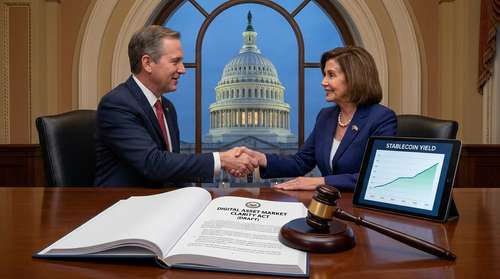
After years of operating in a regulatory gray area, the digital asset industry is finally standing on the precipice of statutory certainty. According to a Wednesday report from JPMorgan analysts, a critical CLARITY Act breakthrough has propelled the landmark legislation into its final stages of negotiation. With lawmakers successfully navigating the most contentious hurdles, the U.S. crypto rulebook is now 'close to completion,' signaling a monumental shift for institutional and retail markets alike.
The Digital Asset Market Clarity Act—which passed the House in 2025 with a 294-134 vote and has faced a grueling Senate battle—aims to replace the controversial 'regulation by enforcement' era with a concrete legal framework. Following intense closed-door discussions this week, White House adviser Patrick Witt confirmed that negotiators are rapidly clearing the final obstacles, noting that the remaining disagreements have been narrowed from roughly a dozen down to just two or three technical issues. If these final details are ironed out, we could see a comprehensive crypto market structure bill enacted before the unpredictable 2026 midterm elections reshape the political landscape.
The Sticking Point Resolved: The Stablecoin Yield Compromise
For months, the legislation was deadlocked over a single, highly polarizing issue: whether non-bank entities could pay interest on digital dollars. Traditional banks lobbied heavily against the practice, arguing that unchecked stablecoin returns would trigger massive deposit flight and destabilize fractional reserve lending. The stalemate has finally been broken by a bipartisan stablecoin yield compromise that threads a very tight needle.
Under the draft text reviewed by industry leaders this week, 'passive yield'—earning a return simply for holding a stablecoin in a wallet—will be outright banned. However, the compromise explicitly protects activity-based rewards. Platforms can still incentivize users through loyalty programs, transaction rebates, and active platform engagement, provided these rewards do not cross an 'economic equivalence' threshold with a traditional bank savings account. This delicate balance satisfies the banking lobby while giving crypto-native developers just enough breathing room to design innovative reward structures, with agencies given 12 months to define these exact boundaries.
Stablecoin Tax Treatment and DeFi Implications
Beyond the yield debate, the legislation introduces long-awaited clarity regarding stablecoin tax treatment and oversight for decentralized finance (DeFi). The bill outlines explicit developer safe harbors, specifically under Section 15H, shielding non-custodial software developers from being incorrectly classified as financial institutions. This ensures that creating a decentralized protocol, maintaining network nodes, or publishing self-custody wallet software won't automatically trigger insurmountable compliance burdens and securities registrations.
SEC vs CFTC Crypto Jurisdiction: Redrawing the Boundaries
Perhaps the most structural change embedded in the Digital Asset Market Clarity Act is the definitive resolution of the turf war between federal regulators. For the better part of a decade, the industry has suffered from jurisdictional whiplash. This legislation directly tackles SEC vs CFTC crypto jurisdiction by clearly defining what constitutes a 'digital commodity' versus an investment contract.
Here is how the regulatory responsibilities will be divided:
- The CFTC takes the spot market: The Commodity Futures Trading Commission will gain exclusive regulatory jurisdiction over the secondary market trading of digital commodities. Crypto exchanges, brokers, and dealers will register under a new, expedited CFTC framework.
- The SEC retains primary capital formation: The Securities and Exchange Commission will maintain authority over primary market fundraising (like initial token sales) and any digital asset that fundamentally functions as a traditional security.
- Joint oversight for stablecoins: Payment stablecoins will exist in a unique category with shared SEC and CFTC oversight, ensuring both market integrity and consumer protection.
The Road Ahead for U.S. Crypto Regulation 2026
While JPMorgan's optimism is a massive tailwind, the clock is ticking. The CLARITY Act breakthrough must now translate into finalized legislative text and secure a formal Senate vote. Policy experts warn that any stalling could push the bill into the late-2026 election cycle, where bipartisan cooperation typically evaporates. The looming midterms present a distinct risk; should the political environment shift, the entire legislative process could face renewed uncertainty.
Despite these political pressures, the broader market implications are staggering. Asset managers and pension funds have largely kept their institutional capital walled off from decentralized markets due to compliance fears. The Digital Asset Market Clarity Act essentially dismantles that wall. By guaranteeing that a token's classification won't arbitrarily change overnight, the legislation paves the way for deeper liquidity and the widespread integration of digital assets into the mainstream financial infrastructure.
For investors, developers, and traditional financial giants, the message from Washington this week is unmistakable. The multi-year battle for U.S. crypto regulation 2026 is no longer a theoretical debate—it is an actionable timeline. The era of regulatory ambiguity is ending, and the foundational infrastructure for the next generation of capital markets is finally ready to be switched on.