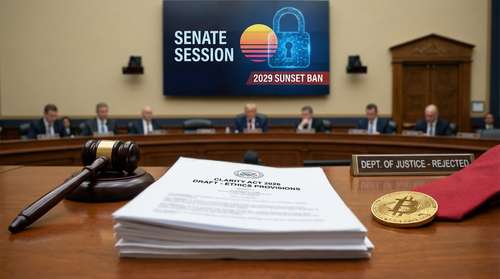
March 2026 will likely be remembered as the month the Clarity Act crypto negotiations hit a critical wall in Washington. What began as a bipartisan push for sweeping crypto market structure legislation has morphed into an intense lobbying war between traditional banking heavyweights and top digital asset firms. At the center of the dispute is the controversial topic of stablecoin yield regulation. With the landmark legislation now entirely stalled in the Senate Banking Committee, industry leaders are issuing dire warnings. If lawmakers fail to reach an agreement soon, the digital asset space may find itself thrust back into a period of severe regulatory hostility, a scenario some are already dubbing "crypto hell".
Breaking Down the Stablecoin Yield Regulation Gridlock
The Digital Asset Market Clarity Act of 2025, which comfortably passed the House last July, was designed to be the ultimate regulatory framework. However, the path forward for this US Senate crypto bill ground to a halt when the banking lobby began vehemently opposing provisions that would allow stablecoin issuers to distribute interest to users.
The core of the current stalemate revolves around how dollar-pegged tokens compete with traditional bank deposits. Under a recent compromise proposed by Senators Thom Tillis and Angela Alsobrooks, crypto platforms would be heavily restricted in how they distribute yield. While activity-based rewards tied to lending or trading might survive, passive yields—simply earning interest by holding a token like USDC in a wallet—would be banned to prevent stablecoins from acting as unregulated savings accounts.
For traditional banks, this is an existential fight to prevent billions in deposit flight. For the crypto sector, it is a massive blow to the core utility of stablecoin products. When the draft text of this compromise circulated behind closed doors earlier this week, the market reaction was swift, with shares of major stablecoin issuers and exchanges tumbling. Without the ability to offer competitive passive returns, stablecoins risk being relegated strictly to payment settlement vehicles rather than dynamic financial instruments.
Brad Garlinghouse, the Clarity Act, and the Looming Threat of 'Crypto Hell'
The prolonged deadlock has left industry executives frustrated and alarmed. Ripple CEO Brad Garlinghouse noted on Friday that negotiations surrounding the bill have "not been pretty", though he maintained a level of optimism that a consensus could eventually be reached. The Brad Garlinghouse Clarity Act commentary highlights a growing anxiety among crypto leaders who recognize that time is rapidly running out.
The stakes were forcefully articulated this weekend by Peter Van Valkenburgh, executive director at Coin Center. In a widely shared post, he cautioned that rejecting imperfect legislation in favor of short-term business interests could lead the industry directly into "crypto hell". Relying solely on the goodwill of the current administration is a dangerous gamble. If the bill completely dies, a future, less-friendly administration could easily authorize regulators to aggressively target software developers and infrastructure providers as unlicensed broker-dealers.
SEC vs CFTC 2026: The Fight for a Clear Token Taxonomy
Beyond the yield dispute, the primary goal of the bill is to establish jurisdictional boundaries. The SEC vs CFTC 2026 debate has been one of the most persistent hurdles for digital asset developers. The legislation intends to clearly define which digital assets are commodities overseen by the Commodity Futures Trading Commission, and which are securities under SEC purview.
While Congress argues over the legislative text, regulators are attempting to bridge the gap. SEC Chair Paul Atkins recently urged the Senate to pass the bill to prevent the whiplash of regulation by enforcement. In the interim, the two agencies have launched a joint initiative dubbed Project Crypto. This collaborative effort aims to establish a provisional token taxonomy SEC and CFTC officials can use to grant temporary exemptions and allow blockchain transactions to continue without constant legal threats.
The May Deadline Approaching Fast
Despite these temporary regulatory bridges, researchers at Galaxy Digital and policy analysts warn that if the legislation fails to reach the Senate floor by May, its chances of passing this calendar year will evaporate completely. Lawmakers are facing immense pressure from both the White House, which desires a legislative victory, and an aggressive banking lobby refusing to cede ground on deposit competition.
The Ticking Clock for Crypto Market Structure Legislation
The cryptocurrency industry is standing at a historic crossroads. The current legislation offers the best opportunity in a decade to legitimize the sector under a durable federal framework. However, the uncompromising stance from both traditional financial institutions and factions within the digital asset space threatens to tear the entire effort apart.
Should the stalemate persist, crypto firms will likely pivot aggressively toward securing Office of the Comptroller of the Currency trust bank charters as a fallback strategy. But a patchwork of individual bank charters will not protect decentralized finance developers or establish the broad statutory clarity the broader market desperately needs. For now, all eyes remain firmly fixed on Capitol Hill, waiting to see if a viable compromise can rescue the legislation from the brink of collapse.