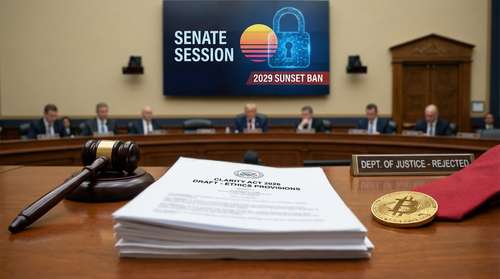
The United States is definitively stepping out of the dark ages of digital asset oversight. Following years of fragmented enforcement, the White House has issued an urgent call for Congress to finalize the CLARITY Act 2026. This legislative push coincides with a landmark decision from the Securities and Exchange Commission, signaling a coordinated effort to end the nation's long-standing regulatory limbo. With the administration and financial regulators finally aligning, the landscape for American blockchain innovation is undergoing a historic transformation.
White House Throws Full Support Behind the CLARITY Act 2026
The pressure to establish a comprehensive federal crypto framework reached a boiling point this week. Treasury Secretary Scott Bessent recently published a compelling op-ed in the Wall Street Journal, explicitly calling on the Senate Banking Committee to schedule a markup session and send the Digital Asset Market Clarity Act to the President's desk. Framing the delay as a national security risk, Bessent warned that continued ambiguity threatens to drive top-tier blockchain talent to offshore hubs like Singapore and Abu Dhabi.
White House crypto adviser Patrick Witt confirmed that major legislative hurdles are rapidly clearing. For months, the bill had stalled over a fierce dispute regarding stablecoin yields. Traditional banks feared that allowing unregulated yield would trigger mass deposit flight. However, a durable compromise has been struck: the legislation will prohibit passive yield on stablecoins while legally protecting activity-based rewards tied to genuine payments and platform usage. This breakthrough paves the way for the CLARITY Act 2026 to establish a functional, bipartisan foundation for US crypto regulation.
The Paul Atkins SEC Delivers a Historic SEC DeFi Exemption
While Capitol Hill works through the final statutory details, regulatory agencies are refusing to wait. In a decisive pivot away from the prior administration's reliance on regulation-by-enforcement, the Paul Atkins SEC has taken extraordinary administrative action. On April 14, 2026, the SEC issued a staff statement effectively granting a conditional SEC DeFi exemption.
This guidance relieves covered decentralized finance user interfaces from the heavy burden of registering as traditional broker-dealers under the Securities Exchange Act. Chairman Atkins has explicitly stated that self-custody is a foundational American value that should not be sacrificed when operating online. To further this vision, he has directed staff to develop a broader innovation exemption—a regulatory sandbox allowing entrepreneurs to launch on-chain products while permanent rules are finalized.
Shifting the Paradigm for Blockchain Builders
To qualify for this relief, DeFi interfaces must adhere to strict operational guidelines. They cannot handle or custody user funds, must avoid soliciting specific transactions, and are required to route orders based purely on objective criteria such as price execution.
By officially acknowledging that self-executing code and human-operated intermediaries are fundamentally different, the agency is delivering a massive victory to the industry. Consensys General Counsel Matt Corva described the policy shift as a transformative moment where centralized intermediaries were dealt a critical blow. It fundamentally proves that the SEC is now willing to calibrate securities laws to the realities of decentralized systems.
Cementing Comprehensive Digital Asset Legislation
The combination of the White House's legislative urgency and the SEC's administrative flexibility marks the dawn of a new era. At its core, the advancing digital asset legislation formally divides oversight responsibilities. The Commodity Futures Trading Commission (CFTC) will gain exclusive jurisdiction over digital commodity spot markets, while the SEC retains authority over investment contract assets.
This structural clarity is the exact catalyst institutional capital has been waiting for. The CLARITY Act 2026 arrives at a pivotal moment for the tokenization of real-world assets. With clear guidelines around custody obligations and market infrastructure, traditional financial institutions can finally engage with blockchain technology without the looming threat of sudden enforcement actions. The White House Council of Economic Advisers further bolstered the pro-industry stance by publishing an analysis showing that restricting stablecoin rewards offered only marginal protections to bank lending while significantly hurting consumer efficiency.
What Is Next for Blockchain Regulatory Reform?
The focus now squarely shifts to the Senate Banking Committee, which must officially schedule a formal markup session for the bill. Senate Banking Committee Chairman Tim Scott recently noted that while issues like stablecoin yield language and DeFi provisions are nearing final resolution, the ultimate goal is to secure all necessary Republican votes to advance the legislation swiftly. Ripple CEO Brad Garlinghouse echoed this timeline at the Semafor World Economy Summit, predicting that the bill could pass by the end of May 2026.
For the first time in the history of the sector, the political will exists to pass meaningful blockchain regulatory reform. Between the impending passage of the CLARITY Act 2026 and the progressive strides of the Paul Atkins SEC, the United States is aggressively positioning itself to reclaim its mantle as the global leader in financial technology. Developers, institutional investors, and digital asset advocates can finally plan for a future defined by clear rules rather than courtroom battles.