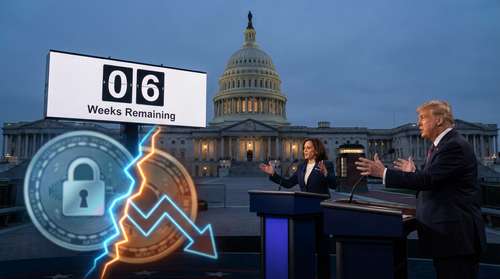
The legislative battle over the Clarity Act 2026 has officially reached a fever pitch. With U.S. senators staring down a strict six-week countdown to pass the landmark bill, a controversial provision has brought negotiations to a grinding halt. A proposed stablecoin yield ban has deeply fractured the digital asset industry, pitting heavyweights like Coinbase against decentralized finance (DeFi) proponents and traditional banking lobbyists.
If lawmakers fail to push this critical piece of U.S. crypto regulation through the finish line by early May, the entire legislative package risks being delayed until 2027. What was initially hailed as a bipartisan breakthrough for market structure has instead morphed into a high-stakes standoff over who controls the future of passive income in finance.
The 6-Week Countdown for Senate Crypto Legislation
The latest updated draft of the Digital Asset Market Clarity Act, circulated behind closed doors this week, delivered exactly what traditional banks have been aggressively lobbying for: a comprehensive prohibition on stablecoin rewards. Under the revised text, any issuer, exchange, or broker is barred from offering returns on stablecoin balances that are "economically or functionally equivalent" to traditional bank deposit interest.
The core of this conflict dates back to previous legislative efforts. While the earlier GENIUS Act of 2025 restricted stablecoin issuers from directly distributing yield, banking advocates successfully argued that a massive loophole remained, allowing crypto exchanges to act as proxies. The new provisions in the Clarity Act aim to permanently close that backdoor. Moving forward, the SEC, the Commodity Futures Trading Commission, and the U.S. Treasury would be tasked with jointly defining permissible rewards and rolling out strict anti-evasion rules within a 12-month timeframe.
For traditional financial institutions, the stakes could not be higher. Analysts at Standard Chartered previously estimated that without these strict regulations, up to $500 billion in deposits could flee from conventional bank accounts into yield-bearing stablecoin products by 2028. By securing a ban on passive yield, the banking sector has effectively protected its most lucrative deposit base from digital disruption.
Market Fallout and Circle's Historic Plunge
The immediate market reaction to the updated digital asset yield laws was brutal and swift. On March 24, shares of Circle—the prominent issuer of the USDC stablecoin—plummeted over 20%. The crash erased $5.6 billion in market value during its worst single trading session since the company's highly anticipated IPO.
Major exchanges were not spared from the carnage. Coinbase, which has relied heavily on a revenue-sharing arrangement tied to USDC reserves, watched its stock drop more than 9% as institutional investors digested the broader implications. The sudden sell-off underscores just how vital yield generation has become to the modern crypto business model.
Coinbase Regulatory News: An Industry Divided
The sweeping restrictions have exposed a fundamental, perhaps irreconcilable divide within the crypto community. On March 28, Coinbase officially informed Senate offices that it cannot support the current draft of the bill. This marks the second time CEO Brian Armstrong has rejected the proposed legislation, choosing to walk away rather than accept terms that would severely undercut his company's bottom line. In the third quarter of 2025 alone, stablecoin-related operations accounted for nearly 19% of Coinbase's total revenue.
Prominent industry voices like Crypto Banter founder Ran Neuner have publicly backed Coinbase's hardline stance. Neuner argues that the restrictive language only serves to shield a legacy banking system that had years to innovate but opted to litigate instead. However, not everyone shares this uncompromising perspective on stablecoin market structure.
The Pragmatist View on the Yield Ban
For some developers and founders, securing baseline rules of the road is worth the temporary sacrifice of yield. Speaking on a recent industry podcast, Frax Finance founder Sam Kazemian urged the community to view the legislation through a pragmatic lens.
"The crypto industry is not used to the fact that this stuff is part of politics, an ongoing process, not a one-and-done thing," Kazemian noted. His argument rests on political reality: passing a foundational law now creates permanent market structure, whereas the yield debate can be revisited in future legislative cycles. A passed law is exceptionally difficult for future administrations to undo, unlike agency-level guidance.
Furthermore, the ban's impact is surprisingly uneven. Offshore issuers like Tether (USDT), which have never paid passive yield to users, remain completely unscathed by the new text. In an ironic twist, the very regulations designed to bring clarity to U.S.-backed stablecoins may simply drive yield-seeking capital toward decentralized finance protocols and non-U.S. entities.
Will the Bill Survive Until 2027?
With only six weeks remaining before the congressional calendar effectively closes the window for complex financial legislation this year, the pressure is immense. The White House and key figures on the Senate Banking Committee are scrambling to broker a final compromise. Interestingly, while passive yield is banned, recent analyses suggest that rewards tied to specific network activities—such as payments or transfers—might still be permissible, offering a narrow glimmer of hope for negotiators.
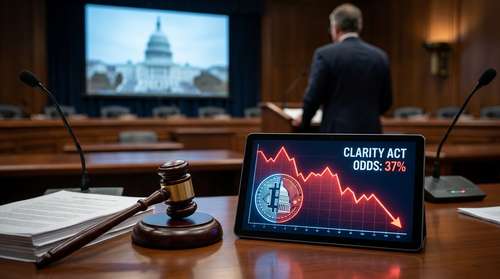
Prediction markets currently estimate a roughly 68% probability that the legislation will pass this year, buoyed by desperate behind-the-scenes mediation. However, if lawmakers cannot reconcile the demands of the banking lobby with the non-negotiable terms set by major U.S. crypto exchanges, the bill will stall indefinitely.
A delay to 2027 would leave the industry right back where it started: navigating a murky patchwork of agency enforcement actions rather than operating under clear, codified rules. As the clock ticks down, market participants must brace for a volatile six weeks that will ultimately dictate the economic landscape of digital finance in the United States.