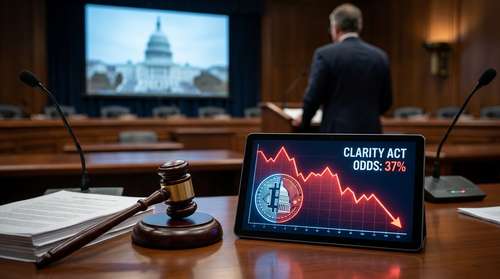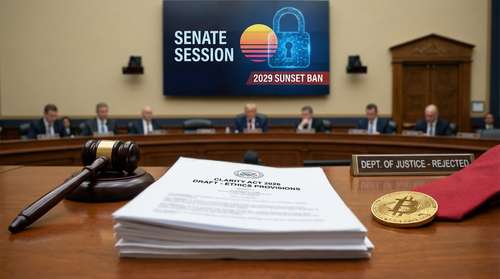

The battle over the future of American decentralized finance has reached a boiling point. As the Digital Asset Market Clarity (CLARITY) Act inches closer to a decisive Senate vote this week, a bitter dividing line has fractured the industry's top executives. At the center of the latest US crypto regulation news is a controversial provision that would effectively enact a stablecoin yield ban—a concession to traditional banking lobbyists that Cardano founder Charles Hoskinson is aggressively labeling a 'DeFi death trap'. The rift has unexpectedly reignited the Charles Hoskinson Ripple feud, pitting him against Ripple CEO Brad Garlinghouse, who appears willing to accept the stringent limitations in exchange for desperately needed legal certainty. This ideological clash is no longer just a social media dispute; it represents a fundamental divergence in how digital asset leaders believe the sector should interface with the federal government.
The Anatomy of a Stablecoin Yield Ban
Recent closed-door Capitol Hill sessions held in late March 2026 have revealed a legislative compromise heavily skewed toward traditional financial institutions. The current Senate draft of the CLARITY Act 2026 explicitly prohibits platforms from offering passive yield—directly or indirectly—on stablecoin balances like USDC and USDT. While activity-based incentives tied to trading or lending remain permissible, the easy-money narrative tied to simply holding stablecoins appears to be permanently boxed out. Traditional banking advocates pushed relentlessly for this language to prevent a mass exodus of retail deposits into digital assets offering higher returns.
While the previous GENIUS Act of 2025 restricted stablecoin issuers from paying interest directly to holders, structural workarounds allowed exchanges and decentralized protocols to pass rewards back to users. The newly updated crypto market structure legislation closes those loopholes. By banning anything economically or functionally equivalent to bank interest, lawmakers are effectively stripping the primary incentive from stablecoin liquidity pools.
The market reaction has been swift and brutal. Following the leak of the draft text last Tuesday, Circle Internet Group (CRCL), the primary operator behind the USDC stablecoin, suffered a devastating 20% drop. This marked its steepest single-session decline since going public in June 2025, wiping roughly $5.6 billion in market value. Coinbase, Circle's primary distribution partner, fell roughly 8% in sympathy. Investors are quickly pricing in a reality where dollar-pegged tokens lose their competitive edge against traditional high-yield savings accounts.
Hoskinson vs. Garlinghouse: A Fractured Alliance
The legislative drama has shattered a brief period of harmony between two of the sector's most prominent figures. Just months ago, Hoskinson and Garlinghouse were publicly mending fences following years of animosity. The Cardano founder had even apologized to the XRP community for past disputes involving the SEC lawsuit and announced preliminary plans to integrate Ripple's RLUSD stablecoin into the Cardano ecosystem through the privacy-focused Midnight sidechain.
That diplomatic progress has now completely disintegrated. Hoskinson argues that agreeing to the yield restrictions will gut the American DeFi regulatory framework, handing unchecked power to hostile traditional finance incumbents. He views Garlinghouse's support for the broader bill as a dangerous capitulation to banking monopolies. In Hoskinson's view, accepting a flawed framework establishes a precedent that will be nearly impossible to reverse, effectively killing the fundamental mechanism that allows decentralized finance to function independently of Wall Street.
Ripple's Pragmatic Gamble
Garlinghouse and his supporters maintain a starkly different perspective. For Ripple, a company that spent years battling the government in a grueling court case, securing a definitive legislative baseline is paramount. Proponents of the bill argue that the industry must accept some unfavorable terms to survive within the United States. Without statutory protections, crypto firms remain vulnerable to the arbitrary enforcement actions that have defined the last five years of federal oversight. For them, a flawed law is superior to a complete absence of rules.
SEC CFTC Joint Jurisdiction: The Price of Peace?
The primary selling point of the impending bill is its ambitious attempt to resolve the endless turf war between federal regulators. If passed, the legislation establishes clear SEC CFTC joint jurisdiction by drawing functional boundaries. The Securities and Exchange Commission would retain authority over investment contract assets, while the Commodity Futures Trading Commission would gain exclusive jurisdiction over decentralized digital commodities.
This division of power is exactly what digital asset exchanges have demanded for years. A unified framework would drastically reduce the compliance costs and legal risks associated with listing new tokens. Furthermore, it creates a tailored set of standards for new digital asset issuances, providing a clear roadmap for startups entering the space. However, the emerging consensus among decentralized protocol developers is that the cost of this regulatory peace is simply too high.
If stablecoins are legally barred from generating yield, the automated market makers and lending protocols that form the backbone of Web3 economies will struggle to attract liquidity from U.S. participants. Decentralized applications require deep pools of capital to facilitate trades without centralized intermediaries. The very tools designed by lawmakers to protect consumers might end up driving the most innovative financial products offshore to more permissive jurisdictions.
The Looming Senate Showdown
With the Senate Banking Committee markup rapidly approaching, the window for negotiation is closing. The bill previously cleared the House with a robust 294-134 bipartisan majority in July 2025, but the current Senate iteration faces an increasingly hostile reception from the very industry it aims to legitimize. Prominent voices are demanding that lawmakers strip the restrictive stablecoin language before bringing the bill to a floor vote.
As lobbying efforts intensify on both sides, lawmakers find themselves caught between banking industry pressure and a fractured digital asset coalition. Whether the legislation passes as a landmark achievement for market structure or stalls due to internal industry warfare will ultimately depend on which faction can best convince the Senate of their vision for the future of American finance.