
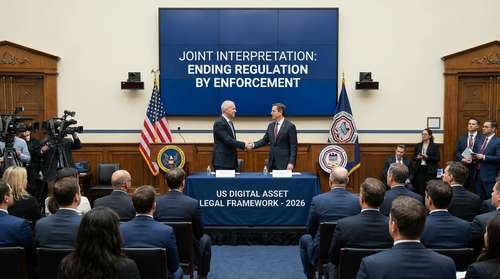
After a decade defined by legal ambiguity and court battles, the United States finally has a definitive roadmap for the cryptocurrency industry. Issued on March 17, 2026, the landmark SEC CFTC joint interpretation marks a profound turning point for digital assets. The comprehensive guidance officially dismantles the controversial practice of crypto regulation by enforcement, replacing it with a principles-based structure. By aligning the Securities and Exchange Commission with the Commodity Futures Trading Commission, the federal government has delivered the exact market certainty that institutions and developers have demanded for years.
This unified posture represents a dramatic shift under SEC Chairman Paul Atkins, who recently declared at the DC Blockchain Summit, "We are no longer the securities and everything commission". The new directives effectively supersede the SEC's informal 2019 framework, affirming that a token itself is simply a digital asset and not inherently an investment contract.
A New Era: The Digital Asset Legal Framework 2026
At the core of this digital asset legal framework 2026 is a streamlined, five-tier token taxonomy that clearly delineates jurisdictional boundaries. The agencies have categorized the digital economy into the following sectors:
- Digital Commodities: Major networks like Bitcoin, Ether, Solana, and XRP are explicitly classified as non-security commodities subject to CFTC oversight. They derive value from network utility and supply dynamics, not from external managerial efforts.
- Digital Collectibles: Non-fungible tokens (NFTs) are analogized to physical collectibles and are largely excluded from securities laws, provided they do not involve revenue-sharing or fractionalized yield schemes.
- Digital Tools: Functional tokens utilized strictly within specific closed ecosystems.
- Stablecoins: Treatment relies on the bipartisan GENIUS Act enacted in July 2025. Compliant payment stablecoins fall strictly outside the SEC's purview.
- Digital Securities: Traditional financial instruments represented on a blockchain remain firmly under SEC jurisdiction, regardless of their technological format.
Crucially, the agencies clarified that passive network participation does not trigger securities laws. Market activities including mining, staking, wrapping, and standard airdrops (where no consideration is provided) are not considered securities transactions.
Ending the Era of Crypto Regulation by Enforcement
For years, the overarching theme of SEC crypto news was the aggressive pursuit of exchanges, protocol developers, and token issuers under a rigid interpretation of the 1946 Howey test. The new guidance entirely reconfigures this historical application. The agencies emphasize that while a non-security asset can initially be sold as part of an investment contract to fund development, that contract is not perpetual. It definitively dissolves once the issuer fulfills its core developmental promises, or if circumstances dictate that the project has been expressly abandoned.
This structural shift provides massive, immediate relief to founders and software developers. Previously, the threat of retrospective litigation stifled domestic innovation and pushed engineering talent offshore. By confirming that dynamic network evolution and functional decentralization ultimately sever a token from its initial securities classification, the government has constructed a viable, legal off-ramp from continuous regulatory scrutiny.
Accelerating Institutional Digital Asset Adoption
This watershed moment delivers the exact US crypto regulatory clarity required to unlock massive capital inflows. With jurisdictional lines clearly drawn between the SEC and the CFTC, traditional finance entities can finally navigate the decentralized space without fearing retroactive penalties. Industry analysts expect this to catalyze a rapid acceleration in institutional digital asset adoption, as asset managers can now accurately value, audit, and confidently disclose crypto portfolios.
Furthermore, the shared framework drastically simplifies crypto compliance for banks and custodial funds, a sector previously paralyzed by overlapping agency claims. Knowing that major portfolio holdings are now formally classified as commodities fundamentally alters fund accounting, income recognition, and risk modeling. Funds utilizing stablecoins for liquidity management now have a precise legal mandate to verify counterparties against upcoming GENIUS Act implementations, ensuring banking partners can offer services without violating federal mandates.
What's Next on the Regulatory Horizon?
While the SEC CFTC joint interpretation establishes the baseline, the broader regulatory architecture is still expanding. Industry leaders anticipate the release of a massive, 400-page formal rulemaking proposal—dubbed "Regulation Crypto Assets"—within the coming weeks. This upcoming docket is expected to outline specific safe harbor provisions for capital raising and introduce an "innovation exemption" designed to onshore perpetual contracts and leveraged derivative markets back to the United States.
The days of launching blockchain products into a regulatory void are over. As the administrative agencies align their enforcement divisions and Congress pushes forward with complementary market structure legislation, the American cryptocurrency market is standing on solid legal ground. The focus now shifts from courtroom defense to ecosystem expansion, securing a matured, institutional-grade market for the future.