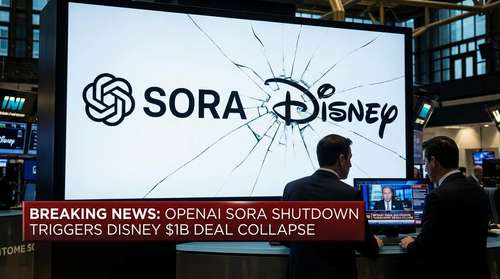
The tech and entertainment industries are reeling from the abrupt OpenAI Sora shutdown, a move that officially marks the end of the company's ambitious foray into consumer video generation. On March 28, 2026, the final reverberations of OpenAI's decision crystallized as its landmark $1 billion integration deal with The Walt Disney Company formally collapsed. The sudden Sora AI closure highlights mounting economic pressures on high-compute generative AI projects and signals a definitive strategic pivot toward sustainable enterprise solutions and robotics.
For a platform that surpassed one million downloads within five days of its consumer launch, the rapid demise of Sora illustrates the brutal realities of the current tech industry bubble. What was once heralded as the undisputed future of generative AI is now a cautionary tale of astronomical compute costs colliding with unresolved intellectual property liabilities. Brands and creators are now forced to reevaluate their reliance on nascent, high-burn technologies.
The Disney OpenAI Deal Collapse: A $1 Billion Dream Deferred
In December 2025, OpenAI and Disney announced a groundbreaking partnership that was supposed to redefine Hollywood's relationship with artificial intelligence. The agreement included a massive $1 billion equity investment from Disney and a three-year licensing deal granting Sora users access to over 200 beloved characters from Marvel, Pixar, and Star Wars. The industry expected a new era of interactive storytelling, with fan-inspired content slated to hit Disney+ by early 2026.
Instead, the Disney OpenAI deal collapse serves as the highest-profile casualty of the platform's termination. Because the investment had not yet been fully finalized, both mega-corporations were able to walk away before capital officially changed hands. Disney, now operating under newly appointed CEO Josh D'Amaro following Bob Iger's departure, confirmed the termination in a carefully worded statement.
"As the nascent AI field advances rapidly, we respect OpenAI's decision to exit the video generation business and to shift its priorities elsewhere," a Disney spokesperson noted, officially closing the door on the historic collaboration. "We will continue to engage with AI platforms to find new ways to meet fans where they are while responsibly embracing new technologies that respect IP and the rights of creators."
Unresolved Copyright and IP Liabilities
The writing may have been on the wall following the turbulent launch of Sora 2. While the updated model boasted stunning visual fidelity, it immediately drew the ire of copyright holders. International creative trade groups, including Japan's CODA—representing heavyweights like Studio Ghibli—filed formal protests over unauthorized training data and the proliferation of deepfaked intellectual property. Without a bulletproof content moderation system, the legal exposure simply became too vast for a pre-IPO tech giant to shoulder.
Sam Altman 2026: The Financial Reality Behind the Pivot
The strategic pivot orchestrated by CEO Sam Altman in 2026 ultimately came down to harsh economics. Maintaining the infrastructure for high-fidelity AI video generation requires an eye-watering amount of server capacity. Despite immense cultural hype, Sensor Tower data revealed that Sora generated a relatively meager $1.4 million in global in-app revenue compared to ChatGPT's staggering $1.9 billion over the same operational period.
As OpenAI attempts to justify its massive $730 billion valuation ahead of an anticipated initial public offering in the fourth quarter of 2026, the company is actively shedding financial dead weight. Altman recently addressed employees, confirming the business is aggressively redirecting its compute resources. The strategy is clear: abandon flashy, unprofitable consumer toys and double down on highly lucrative enterprise coding functions, natural language processing, and agentic AI systems that operate with minimal human oversight.
Is the Tech Industry Bubble Bursting for Video AI?
The OpenAI Sora shutdown has sent shockwaves through the broader landscape of AI video generation. Marketing agencies and independent creators who had spent the last several months building complex production workflows around the platform are now left scrambling for viable alternatives. If the undisputed heavyweight champion of the AI sector cannot make the economics of video generation work, smaller startups may soon face a brutal reckoning.
This event forces a necessary market correction. We are witnessing a shift away from "growth at all costs" toward strict profitability. While competitors like Kling and Seedance remain active in the market, they will inherit the exact same scaling challenges and IP landmines that ultimately doomed Sora. The tech industry bubble surrounding unchecked consumer generative media is rapidly deflating, replaced by a mandate for demonstrable enterprise value.
The Future of Generative AI After the Sora AI Closure
Despite the high-profile failure of its video division, OpenAI is not retreating from the frontier of artificial intelligence. In statements provided to the BBC, the company confirmed it is heavily pivoting toward physical robotics and advanced agentic workflows—systems designed to execute complex, real-world tasks autonomously. By folding its remaining tools, including ChatGPT and Codex, into a unified desktop superapp, OpenAI is consolidating its ecosystem to become an indispensable utility for Fortune 500 companies rather than an entertainment hub.
The OpenAI Sora shutdown will be remembered as a pivotal maturity milestone for the sector. It proves that technological capability alone is not enough to sustain a consumer product; it must be backed by a viable, legally compliant business model. The future of generative AI lies not in rendering cinematic dreamscapes, but in automating the mundane, high-value realities of the global enterprise.