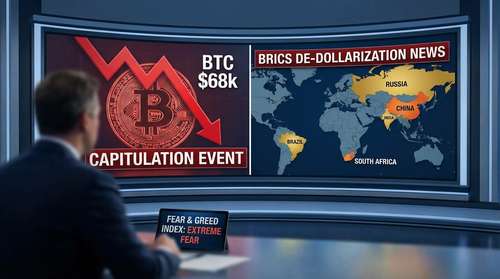
February 16, 2026 – The cryptocurrency market is facing one of its most severe tests in recent history as Bitcoin struggles to hold the $68,000 level. A perfect storm of geopolitical tension and macroeconomic shifts has triggered a massive capitulation event, with data confirming over $2.3 billion in realized losses this week. At the center of this volatility is the accelerating BRICS de-dollarization push, which has rattled global liquidity and sent the crypto fear and greed index today plunging to a record low of 12 (Extreme Fear).
BRICS De-Dollarization Crypto Impact: The New Geopolitical Reality
The catalyst for this week's Bitcoin market crash February 2026 appears to be the aggressive acceleration of the BRICS alliance's financial independence strategy. Just days ago, reports surfaced that China has begun scaling back its holdings of U.S. Treasury bonds, a move explicitly linked to the bloc's "Greater BRICS" agenda. This coordination between Brazil, Russia, India, China, and new members like the UAE and Ethiopia is creating unprecedented uncertainty in dollar-denominated assets.
More critically for the crypto sector, the BRICS cryptocurrency news cycle is dominated by the launch of "BRICS Pay" in testing phases across Russia and the Middle East. This blockchain-based settlement system aims to bypass SWIFT entirely. While long-term bullish for decentralized assets, the immediate short-term impact has been a liquidity shock. Investors are scrambling to understand how a potential competitor to the petrodollar will affect global risk appetite.
Analysing the $2.3 Billion Capitulation Event
The on-chain data paints a grim picture for short-term holders. According to analytics from CryptoQuant, the market has witnessed a Bitcoin realized losses spike of $2.3 billion over the last seven days. This magnitude of capitulation rivals the collapse events of 2021 and 2022, suggesting that weak hands are being flushed out of the market at a historic rate.
Currently trading around $68,340, Bitcoin has retraced significantly from its recent highs. The crypto fear and greed index today sits at a chilling 12/100, a level rarely seen outside of deep bear market bottoms. Historically, such extreme fear often signals a potential reversal point, as sellers exhaust their inventory.
Short-Term Pain vs. Long-Term Fundamentals
Despite the panic, the structural health of the network remains intact. The sell-off is largely driven by "tourist" capital—investors who bought near the highs of late 2025. Long-term holders and miners appear to be holding firm, viewing this dip as a consequence of macro-political maneuvering rather than a flaw in Bitcoin's value proposition.
Institutional Crypto Adoption 2026: Whales Are Buying the Dip
While retail investors panic sell, institutional crypto adoption 2026 narratives tell a different story. Reports indicate that major asset managers, including BlackRock and strategy firms like MicroStrategy, are using this volatility to accumulate. The "smart money" thesis remains unchanged: as BRICS nations destabilize the dollar, non-sovereign stores of value like Bitcoin become essential insurance policies.
We are seeing a divergence between price action and institutional flows. While price bleeds, ETF inflows have remained resilient, suggesting that Wall Street views the $68,000 zone as a prime entry point for the next fiscal quarter.
Bitcoin Price Prediction 2026: Recovery or Recession?
So, where do we go from here? Our Bitcoin price prediction 2026 model suggests that if Bitcoin can reclaim the $72,000 support level by the end of February, a V-shaped recovery is likely. The $2.3 billion wipeout has effectively reset the leverage in the system, creating a healthier foundation for the next leg up.
However, caution is warranted. If the BRICS de-dollarization efforts lead to further instability in the bond market, we could see Bitcoin test lower liquidity pools near $64,000 before finding a true bottom. For now, patience is the ultimate strategy. As the old adage goes in crypto: "Buy when there is blood in the streets, even if the blood is your own."