
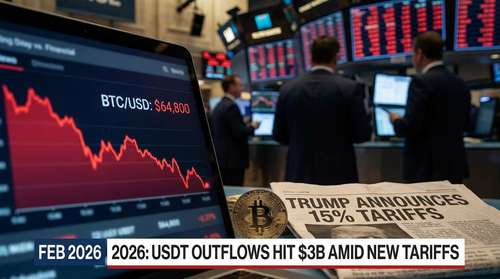
The cryptocurrency market is reeling today, February 23, 2026, as Bitcoin (BTC) decisively shattered the critical $65,000 support level, trading as low as $64,290 during Asian trading hours. A perfect storm of macroeconomic headwinds has struck digital assets, spearheaded by President Trump's sudden announcement of a blanket 15% hike on global tariffs. This policy shift, combined with a staggering $3 billion contraction in USDT supply and a fifth consecutive week of spot Bitcoin ETF outflows, has triggered a severe crypto liquidity crunch that threatens to push prices toward $60,000.
Federal Tariff Impact on Bitcoin: The New "Risk-Off" Reality
The catalyst for this morning's sharp sell-off was the White House's confirmation of new trade levies. President Trump unveiled plans to lift global tariffs to 15%, a move designed to protect domestic manufacturing but one that has immediately spiked volatility across global markets. While intended to bolster the dollar, the policy has renewed inflation fears, causing investors to flee risk-on assets like equities and cryptocurrency in favor of traditional safe havens like gold.
Market analysts were quick to react, noting that the Federal tariff impact on Bitcoin is twofold. First, the strengthening U.S. dollar makes dollar-denominated assets like BTC more expensive for global buyers. Second, the geopolitical uncertainty—compounded by rising tensions involving Iran—has dampened the speculative appetite that typically fuels crypto rallies. "Risk assets are getting sold first," noted a report from TradingView this morning. "Bitcoin trades 24/7, so it is pricing in these macro risks before Wall Street even opens."
USDT Supply Contraction Signals Institutional Exit
Compounding the macro gloom is a flashing red signal from the stablecoin market. On-chain data reveals a massive USDT supply contraction, with Tether's market cap shrinking by over $3 billion in the last 60 days. This metric, often viewed as a proxy for the amount of "dry powder" available to buy crypto, hasn't seen a drop this precipitous since the depths of the 2022 bear market.
Analyst Moreno highlighted this worrying trend in a note to investors, pointing out that such large-scale redemptions typically indicate that large holders and institutions are cashing out of the ecosystem entirely rather than sitting on the sidelines. "When USDT leaves the system, it’s not just rotation; it’s an exit," Moreno explained. This liquidity drain deprives the market of the buying pressure needed to absorb the current wave of selling, exacerbating the crypto market correction today.
Bitcoin ETF Outflows Hit Fifth Consecutive Week
The institutional retreat is further evidenced by the relentless bleeding from U.S. spot Bitcoin ETFs. Data from the past week confirms Bitcoin ETF outflows have reached their fifth consecutive week of negative flows, with over $315.8 million exiting the funds in the last seven days alone. BlackRock's IBIT and Fidelity's FBTC, once the engines of Bitcoin's ascent to its October 2025 peak of $125,000, are now seeing sustained withdrawals.
The Mechanics of the Sell-Off
These outflows create a mechanical feedback loop. As investors redeem ETF shares, issuers are forced to sell the underlying Bitcoin to cover the cash payouts. This adds constant selling pressure during U.S. trading hours, preventing any sustained recovery. With institutional demand weakening, the market is left vulnerable to the crypto market news February 2026 cycle, which has turned overwhelmingly bearish.
Bitcoin Price Prediction 2026: Key Levels to Watch
Technically, the loss of $65,000 is a major blow to bulls. This level had served as a psychological floor throughout early February. Now that it has turned into resistance, traders are eyeing lower targets. Technical analysis suggests the next major support zone lies between $58,000 and $60,000, aligning with the 200-week exponential moving average.
If the Bitcoin price prediction 2026 models hold true, a daily close below $64,000 could open the floodgates for a retest of $52,500. Conversely, to invalidate this bearish structure, BTC would need to reclaim $68,000 swiftly—a scenario that looks increasingly unlikely without a reversal in the tariff policy or a sudden influx of stablecoin liquidity. For now, caution is the watchword as the market digests this multi-front assault on asset prices.