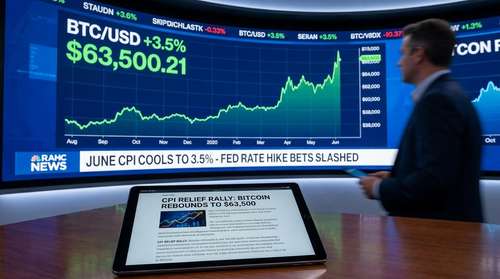
Bitcoin has staged a dramatic recovery, reclaiming the psychological $70,000 threshold on Tuesday, February 10, 2026, defying the massive liquidity shock that rattled global markets just days ago. The sudden volatility follows President Trump's nomination of Kevin Warsh as the next Federal Reserve Chairman, a move that triggered a broad sell-off in risk assets known as the "Warsh Shock." As the crypto sector digests the implications of a new monetary regime, investors are grappling with the "Warsh Paradox"—a policy conflict that could redefine the Bitcoin price rebound and the broader financial landscape for the rest of the year.
The 'Warsh Paradox': A New Era for Fed Monetary Policy
The nomination of former Fed Governor Kevin Warsh has introduced a complex economic thesis dubbed the "Warsh Paradox." Unlike his predecessor Jerome Powell, Warsh advocates for a dual-pronged approach: aggressively shrinking the Federal Reserve's bloated balance sheet while simultaneously aiming to lower interest rates driven by productivity gains from AI and technology. This creates a conflicting signal for Fed monetary policy crypto markets rely on.
Critics argue that reducing the balance sheet—effectively draining liquidity from the financial system—historically correlates with asset price deflation. This fear sparked the initial crypto market crash 2026 saw earlier this month, where Bitcoin plummeted to near $60,000. However, Warsh's supporters believe that productivity-led deflation will allow for organic rate cuts, ultimately favoring scarce assets like Bitcoin in the long term.
Bitcoin Price Rebound: Battling the $70k Resistance
After finding a local bottom at $60,062 on February 6, Bitcoin's aggressive bounce back above $70,000 signals renewed conviction among bulls. The BTC 70k support level is now being tested as a critical flip from resistance to support. Technical analysts point to the rapid absorption of the sell-side pressure as a sign that the market had oversold the "liquidity crunch" narrative.
Trading volumes have surged to over $90 billion in the last 24 hours, indicating that institutional buyers are stepping in to accumulate discounted assets. "The market priced in maximum fear regarding Warsh's balance sheet reduction, but it ignored his pro-innovation stance," notes a senior analyst at a major crypto hedge fund. If Bitcoin can sustain a daily close above $71,600, technical models suggest a clear path to retest the $78,000 region.
Institutional Crypto Liquidation and the AI Washout
The week following Warsh's nomination announcement was brutal for leveraged traders. Data confirms that over $16 billion in institutional crypto liquidation occurred across major derivatives exchanges, wiping out long positions that were overexposed to the "AI trade." The correlation between AI tech stocks and crypto assets briefly hit all-time highs as both sectors faced the same liquidity withdrawal fears.
However, the washout seems to have cleansed the market of speculative froth. Spot Bitcoin ETFs, which saw heavy outflows last week, recorded a net inflow of $450 million yesterday. This reversal suggests that smart money views the Kevin Warsh Fed nomination not as a death knell for liquidity, but as a transition to a more disciplined, yet potentially high-growth, economic environment.
Bitcoin Price Prediction 2026: Volatility Ahead
Looking toward the remainder of 2026, uncertainty remains the only guarantee. With Jerome Powell's term officially ending in May, the transition period will likely keep markets on edge. The Bitcoin price prediction 2026 models have been updated to reflect higher volatility but maintained bullish long-term targets. Standard Chartered has reiterated its year-end target, citing that Warsh's view of Bitcoin as a "check on monetary discipline" could ultimately validate its role as digital gold.
The Road to May
Traders should remain cautious. While the immediate panic has subsided, the "Warsh Paradox" implies that liquidity conditions will tighten before they loosen. Bitcoin's ability to hold the $70,000 line in the coming weeks will be the definitive test of whether the bull market can survive the Fed's changing of the guard.